- Charles Schwab introduces the new S&P 500 futures contract where customers can bet on the close price of the index.
- The S&P 500 ETF from Vanguard reached the level of more than $1 trillion and now constitutes one of the largest targets of investment.
- The S&P 500 companies have been linked to the growth of ETFs and forecast markets.
The investor interest in S&P 500 stocks remains relevant among traditional investments and new index-based market structures.
Recent developments show growing activity around the benchmark U.S. stock index, with Charles Schwab reportedly preparing a prediction-style product linked to S&P 500 price levels while the Vanguard S&P 500 ETF becomes the first exchange-traded fund to surpass $1 trillion in assets under management.
The two developments highlight different ways market participants are engaging with the same group of large-cap U.S. stocks.
Charles Schwab Plans S&P 500-Based Prediction Contracts
According to a report by The Wall Street Journal, Charles Schwab is preparing to launch a new product that would allow customers to take yes-or-no positions on the performance of the S&P 500.
The offering is expected to be introduced through a partnership with Cboe Global Markets and could be launched within the coming months.
Rather than providing contracts linked to politics, sports, weather, or other events, the reported product would focus exclusively on the stock market index.
In the proposed arrangement, clients would open trades based on whether the S&P 500 ends above or below a specific benchmark.The contracts would function as binary outcomes, producing either a yes or no result based on where the index finishes trading.
Moreover, prediction-style markets have expanded in recent years, with platforms such as Kalshi and Polymarket already offering contracts tied to S&P 500 outcomes alongside a broader range of event-based markets.
Charles Schwab’s reported entry would represent the firm’s first move into this segment.
The development follows another expansion of the company’s product lineup. In May 2026, Charles Schwab introduced spot Bitcoin and Ether trading for retail customers. The company also reported net income of $2.5 billion during the first quarter of 2026.
S&P 500 Stocks Continue to Attract Capital Through ETFs
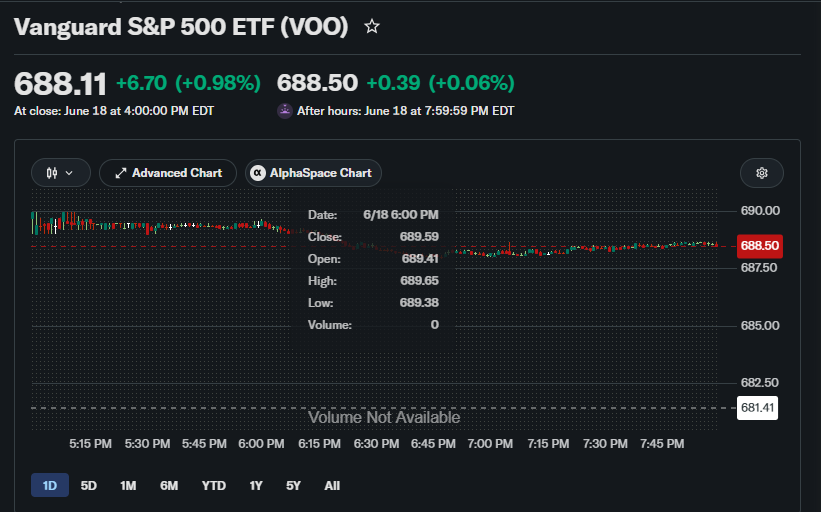
While Charles Schwab is preparing a product tied to index outcomes, capital continues to flow into investment vehicles that directly track S&P 500 stocks.
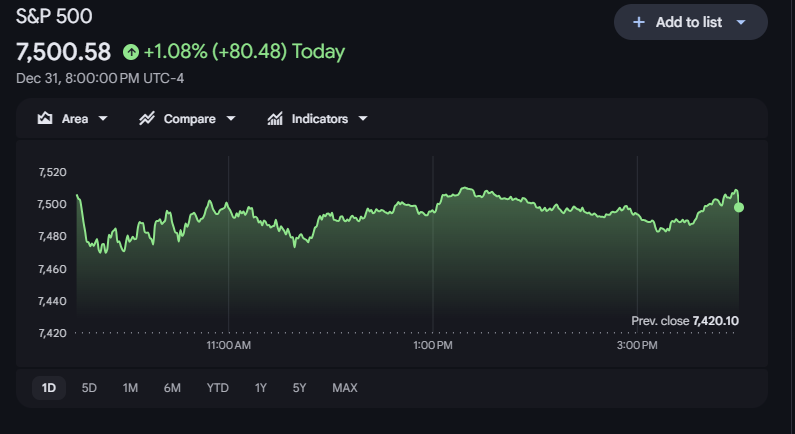
Source: Google Finance
The Vanguard S&P 500 ETF recently became the first exchange-traded fund to reach $1 trillion in assets under management. Moreover, it is preceded by several years of robust asset growth and investment inflows to the fund.
Source: Yahoo Finance
The magnitude of these flows was more than that recorded by the iShares Core S&P 500 ETF, with approximately $176 billion of net inflows reported during the same period.
The Vanguard fund represents a substantial part of the ETF investments. Based on the figures given, about one out of every ten dollars allocated in ETFs ends up in the Vanguard S&P 500 ETF.
Asset Increase Due to Consistent Long-Term Performance
Alongside the increase in asset management, there has been consistent performance over a long period of time.
During the last ten years, the annual average return of the Vanguard S&P 500 ETF amounted to 15.6%. The period under consideration featured significant events in the market, including the pandemic and the 2022 stock market crash.
The way the fund is built has also played a role in its success. The fund has an expense ratio of 0.03%, making it one of the lowest cost financial instruments that can be used for investing in S&P 500 shares.
Its large size has made it liquid with tight trading spreads, features usually associated with big index-tracking funds. Growing to the $1 trillion asset level, the fund created a new bar for the ETF sector.
2022 Bear Market Offers Insights into Investor Behavior
The historical fund flow data helps give some additional perspective regarding how the market reacted during a weak period in the market.
In the bear market of 2022, there is an estimated reduction of 13% of the assets under management of the Vanguard S&P 500 ETF from the beginning to the end of the year.The reduction was based on the change in the market value and not withdrawals by investors.
Even with a reduction in the value of assets, the fund had an approximate net inflow of $40 billion.
The following year, the fund attracted an additional $42 billion. Annual inflows later exceeded $100 billion as the fund continued to gather assets.
The figures indicate that investment activity in the ETF continued during both declining and advancing market conditions.
Different Products Center on the Same Stock Benchmark
The recent developments place the S&P 500 at the center of two separate financial market trends.
Charles Schwab’s reported product would allow market participants to take positions on whether the index closes above or below specific levels, creating a prediction-based structure tied directly to stock market performance.
At the same time, the Vanguard S&P 500 ETF continues to accumulate assets by providing direct exposure to the underlying basket of S&P 500 stocks.