

The financial market gives numerous options to the investor for capital appreciation, where each type of asset class will cater to a specific investment objective. The asset classes that are highly traded include stocks and cryptocurrencies that have their own market structures, regulations, and price mechanisms.
With the evolution of blockchain technology along with the conventional financial markets, there is a growing need for comparison between the two.
“Crypto vs Stocks” illustrates the key differences between those two types of assets regarding ownership, regulation, trading hours, income possibilities, and factors that determine valuations.
The emergence of recent advancements, such as permission to trade spot Bitcoin ETFs, the establishment of stablecoin regulations, and the creation of tokenized stocks, has only narrowed the differences while keeping the characteristics specific to both markets intact.
Crypto vs Stocks: Ownership and Market Structure
One of the most significant differences is the type of property an investor possesses.
A share means ownership of a piece of a company. Shares can grant the investor voting power or dividends depending on the class of shares. The value of stocks is associated with the business performance of the firm in question, its earnings, assets, and the economy as a whole.
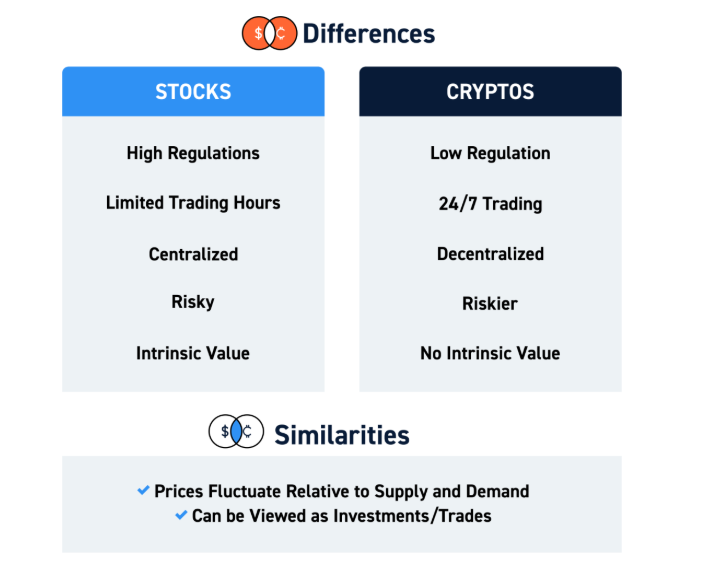
Source: Centerpoint Securities
Cryptocurrencies do not often signify ownership in an enterprise. Cryptocurrencies are commonly known as digital currencies that can be used for storing value, making payments, governance, and utilities on the blockchain platform.
The distinction is as follows:
- Stocks show ownership of a company.
- Cryptocurrencies are digital assets that serve different functions in the blockchain.
- Stock prices depend on the performance of the company, whereas the price of cryptocurrencies depends on the adoption of the blockchain.
Regulation and Trading Hours
The regulatory environment of both markets is very different from one another. The public company is required to have a certain standard of reporting, which includes financial reporting.
The regulatory framework of cryptocurrencies is country-dependent. Standards for disclosures vary among different blockchain companies; however, there has been greater institutional involvement.
The launch of spot Bitcoin ETFs in 2024 has been followed by further institutional involvement, while legislation regarding stablecoins introduced in 2025 added more compliance rules for certain parts of the crypto industry.
Trading opportunities also set apart the two financial sectors. Stock markets trade during working days’ business hours, although most of the brokers have introduced pre-market and after-hours trading. Cryptocurrencies are traded 24/7 all year long.
Comparison Between Cryptos and Stocks
| Feature | Cryptocurrency | Stocks |
| Owning | Ownership of digital assets | Part-ownership of the company |
| Trading | 24/7 trading all year round | Market hours are on weekdays only |
| Regulations | Depends on the country where used | Extremely regulated |
| Potential for Income | Staking, lending, DeFi, yield income | Dividends and share repurchases |
| Factors that Determine Value | Network effect, demand and economics | Earnings, revenues and performance |
Sources of Income and Factors That Determine Price
How the investments could be made profitable differs between the two markets.
Stocks could be profitable by means of generating dividends, whereas companies may buy back stocks in order to reduce their total number in the market and thereby increase earnings per share.
Cryptocurrency investors may get rewarded by staking, lending, or creating liquidity for DeFi protocols. In some blockchains, users could participate in governance and use other decentralized applications as well.
Movement in price is due to various forces.
These are:
- Stocks: Earnings from the company, performance of the company, performance of the industry, and economic environment.
- Cryptocurrency: Network usage, availability of tokens, institutions, adoption, and regulation.
- Sentiment in the market impacts both types of securities but on different fundamentals.
Size of the Market and Risk Attributes
The global stock markets have a market value of over $100 trillion. This makes the market quite deep and prices relatively stable.
The crypto markets continue to remain much smaller, with liquidity being available only for major cryptocurrencies like Bitcoin and Ethereum. Hence, similar amounts of capital flows result in bigger price fluctuations compared to those seen in the stock markets.
While there is a continued high volatility level, with the participation of institutions, this difference has reduced to some extent. There have been instances when the annualized volatility of Bitcoin has fallen into the high 30% to 40% levels, coming nearer to that of high-growth stocks.
Advantages and Disadvantages
These asset classes come with their respective advantages and disadvantages.
The crypto markets allow constant trading, irrespective of geographical boundaries. However, there is regulation uncertainty, cybersecurity threats, the need for private key management, and huge price volatility involved.
The stock markets have regulatory safeguards, standard disclosures, and valuations that is dependent on business performance. Companies that pay dividends might also offer a source of income. But the stock prices still face the risk from the company’s own news, economic recession, and market correction as well.
Conclusion
The comparison between Crypto vs Stocks shows that the two investment markets are based on entirely different principles.
The stocks are the representation of ownership in active businesses in a heavily regulated financial system, whereas the cryptocurrencies are the digital assets created on the basis of blockchain technology and used for many purposes.
Frequently Asked Questions
What is the key distinction between crypto and stocks?
Stocks are ownership rights in a company, whereas cryptocurrencies are blockchain assets that don’t imply ownership of the company in general.
Which one works 24/7?
The crypto market operates around the clock all year round, while the stock market works during regular weekday sessions.
Why does cryptocurrency exhibit more volatility than stocks?
This is because the cryptocurrency market is smaller and more concentrated, hence enabling the capital flow to cause bigger price changes.