
The Distributed Ledger Technology (DLT) has been adopted as the basic technology that underlies the blockchain ecosystem and digital currency because it offers a way to record, verify, and store data in a decentralized fashion through several computers.
Unlike centralized databases, where the data is managed by one single organization, DLT technology ensures that all the participants have access to the same distributed ledger, and therefore every confirmed transaction is stored in an identical manner across the network.
What Is Distributed Ledger Technology?
The Distributed Ledger Technology refers to a digital database technology where there is synchronization of the same ledger in many computers called nodes. Instead of having one computer that stores the information about a certain transaction, many participating nodes store the history of transactions.
In case a transaction is recorded, it gets disseminated through the P2P (peer-to-peer) network to participating nodes for validation of that particular transaction through a consensus mechanism, after which the ledger is updated by all nodes at once.
Unlike conventional databases, DLT eliminates the need for an administrator.
The main features are:
- Decentralized ledger storage in many nodes.
- Consensus-based validation algorithms.
- Synchronization of the ledger copies continuously.
Distributed Ledger Technology Process
The process of DLT function involves verification steps that confirm compliance of all transactions with network requirements before adding them to the ledger.
It starts with submitting a transaction by one of the participants. This transaction gets distributed to all nodes in the peer-to-peer network for verification according to consensus rules.
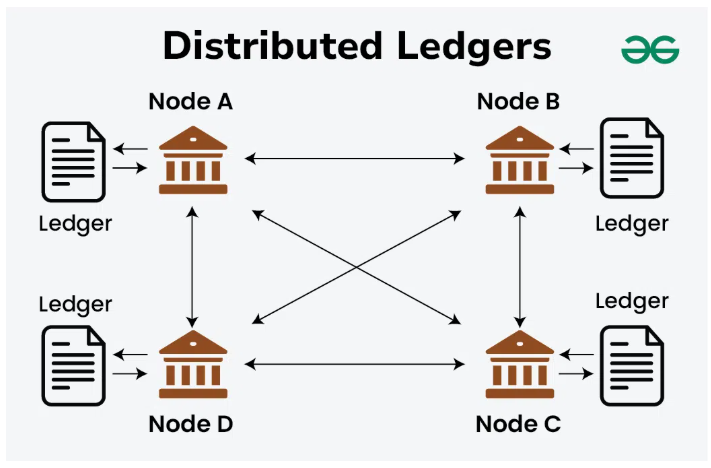
Source: Geegks
Once there is an agreement from the majority of people, the transaction gets included in an unalterable log. Whereas other systems use only one database server, this system guarantees the operation of the ledger even if some nodes go down.
DLT Process
| Step | Description |
| Creation of Transaction | A person generates a transaction. |
| Transmission in Network | The transaction is transmitted to the participating nodes. |
| Verification using Consensus | Transaction is verified through consensus. |
| Updating the Ledger | Transactions that are approved are logged immutably on all the ledgers. |
| Immutability | Historical data is available because of cryptography. |
Consensus protocols make sure that each transaction is secure
Consensus mechanisms are key features of the DLT system since with the help of these mechanisms, network users will be able to establish whether transactions are valid before these transactions are entered into the ledger.
There are different consensus mechanisms used in different distributed ledger platforms depending on the desired degree of security, energy consumption, and decentralization of the network.
The following are some popular consensus mechanisms:
- Proof of Work (PoW): The miners (validators) use their computing power to solve the mathematical problem for transaction validation.
- Proof of Stake (PoS): Digital currencies should be staked by the validators for transaction validation.
- Other systems: There are other types of validation, like DPoS (Delegated Proof of Stake), BFT (Byzantine Fault Tolerance), PoA (Proof of Authority), and PoH (Proof of History).
The consensus mechanism decides on the efficiency of balancing between transaction speeds, decentralization, and security within the distributed ledger technology.
Types of Distributed Ledger Technologies
All distributed ledgers work differently from one another. Different ledger types are adopted depending on the needs of organizations and blockchains.
Permissionless Ledger
The permissionless ledger is a kind of ledger that allows people to participate freely without seeking any permission. Bitcoin and Ethereum are two examples of this kind of ledger system.
Permissioned Ledger
A permissioned ledger system involves controlled participation through the verification of participants. This system is commonly used by businesses and governments for its privacy aspect.
Hybrid Ledger
The hybrid ledger system includes aspects of both permissioned and permissionless ledger systems. Information is made public only where required, and business-related information is kept private.
Federated Ledger
Unlike other blockchain systems, where there is one central party, federated ledgers are controlled by multiple selected parties. In federated ledgers, all parties have their nodes through which they manage the ledger.
Applications of Distributed Ledger Technology
Apart from cryptocurrency transactions, distributed ledger technology has been applied to various sectors due to its decentralized nature.
They include:
- Finance and banking: Payment, settlements and asset tokenization.
- Supply Chain management: Tracks the process of production and distribution of goods and increases traceability.
- Healthcare: It ensures that the health records of the patients remain protected and allows for information exchange among various professionals in the sector.
- Identity: It is instrumental in creating digital identity verification platforms that allow individuals more control over their personal information.
- Real estate: Tracks the ownership records of the real estate property and cuts down paperwork.
- Voting systems: Makes it easier to create verifiable digital voting records.
- Energy Management: Facilitates peer-to-peer energy trade.
Challenges of Distributed Ledger Technology
Despite the growth and application of Distributed Ledger Technology in multiple sectors, there are several technical and regulatory challenges that still exist.
The main challenge is scalability, as some distributed systems have less capability to carry out transactions than traditional payment services. With increased transaction capacity, there may be delays in processing the transaction requests.
Another challenge is interoperability since most distributed ledger technologies cannot transfer data directly with each other.
Regulatory differences between nations continue to grow, thus creating confusion for those enterprises that wish to incorporate DLT systems in multiple jurisdictions.
Quantum computing is another factor that needs to be considered on a longer-term basis since it may eventually necessitate adopting different standards of cryptography in order to ensure the integrity of ledgers. The proof of work-based networks is being scrutinized due to their high energy consumption.
Distributed Ledger Technology in the Future
Further development of Distributed Ledger Technology will center around improving its scalability, interoperability, and efficiency. Layer-2 solutions and other methods of cross-chain communications are being developed in order to increase the efficiency of transactions.
While that happens, governments and banks keep exploring settlement platforms and central bank digital currencies (CBDC) that use blockchain. At the same time, the tokenization of physical and virtual assets is being explored by many businesses to discover new ways of representing ownership rights using distributed ledgers.
As these technologies advance, Distributed Ledger Technology continues to act as the platform used in blockchain networks, but also in managing digital records in various industries.
Conclusion
Distributed Ledger Technology acts as a decentralized way of recording and verifying information in digital form without the involvement of any central authority. The distributed ledger technology helps in blockchain networks, cryptocurrency, digital identities, financial services, supply chains, healthcare, and many other industries.
FAQs
What is Distributed Ledger Technology (DLT)?
Distributed ledger technology refers to a decentralized technology that enables the recording of transactions across several devices rather than a single centralized server.
Are DLT and blockchain the same?
No, they aren’t. The blockchain is just one of the many kinds of DLTs. Apart from the blockchain, there are also other types of DLTs such as the Directed Acyclic Graph.
Why is DLT so important?
Some of the advantages provided by DLT are decentralized, transparency, cryptography, and no requirement of a central entity for maintaining transactions.