WebSocket is one of the most widely used protocols to exchange data between client-side and server applications. For crypto trading, where prices, trades, and transactions happen in seconds, constant connectivity ensures the delivery of the information without creating a new network request for every instance.
Unlike regular HTTP communication, where a new connection is created every time a request is made, WebSocket ensures that the connection remains alive until either side closes the connection.
The process ensures both ways of communication but eliminates delays because of the creation of new network requests. In the case of cryptocurrency exchanges, which generate huge amounts of data during their workdays, WebSocket is widely used for the distribution of live data.
WebSocket: Definition and Operation
WebSocket refers to a communication protocol that creates a connection between client and server using one TCP connection. This connection is established using a conventional HTTP request in which the client requests an upgrade in the communication protocol from the server.
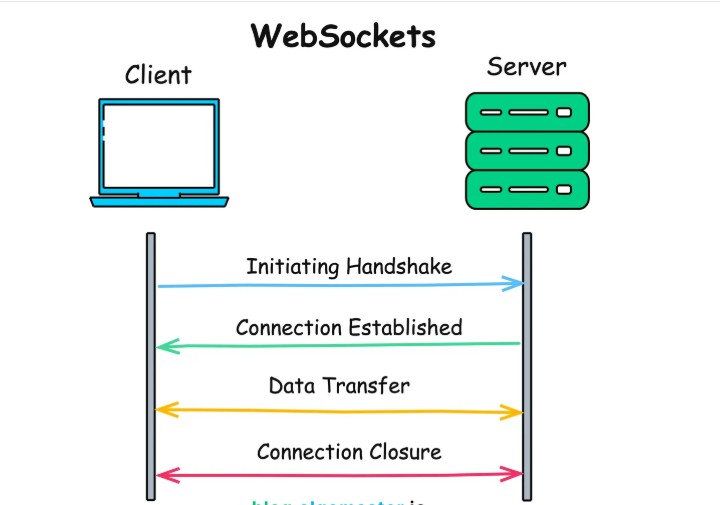
Source: algomaster
After acceptance by the server of the request, the connection remains open until one side decides to close it. During this time, each party sends information to the other without the need for additional requests.
The communication process normally takes the following form:
- The client initiates an HTTP upgrade request.
- The connection stays active throughout.
- The transmission of data is continuous in both directions.
- The connection closes only if any of the parties terminates the session.
However, it is this persistence that separates WebSocket from HTTP, which uses the request-response method for opening and closing connections repeatedly.
WebSocket Events Manage the Connection
Any WebSocket connection depends on four basic events for managing its operation throughout the connection’s life cycle.
The On Open event proves that the connection has been made successfully and communication can be started.
The On Message event occurs every time the server delivers new data to the client.
The On Close event happens when the connection gets terminated either deliberately or because of interruptions on the network.
An error is triggered when there are any issues in the communication process like protocol and connection issues.
Moreover, this helps applications to get market data, check for any interruptions, and free up resources once the communication process is completed.
WebSocket API and WebSocket Streams Are Used for Different Purposes
There are several WebSocket connections used by some cryptocurrency exchanges, according to the needed information.
One of the implementations allows obtaining market data only, while another allows getting market data and the user’s data.
Moreover, these two WebSocket connections use different endpoints and differ in subscription methods. For WebSocket Streams, subscriptions are determined by using “@”, while for the WebSocket API, they are separated from the request parameters.
WebSocket API gives access to a broader range of data that includes user data, but WebSocket Streams focuses only on market data. It allows developers to decide on the kind of connection based on application requirements.
Multiplexing and Multi-Connections Methods for More Data Availability
Applications often need several streams of data simultaneously. There are two main ways in which this can be achieved.
One approach is known as multiplexing and involves combining several data streams together into one single WebSocket connection.
For instance, one connection may be capable of receiving updates from both Bitcoin and Ether markets at the same time. There are some systems that limit the number of streams that can run through one connection.
In the provided example, the number is limited to 1,024 streams for one connection. Another way would be creating more than one WebSocket connection. The use of several connections allows dividing the workload between them and ensures redundancy in case of the failure of one connection.
Nevertheless, having several connections results in increased consumption of CPU, memory, and bandwidth resources. There are certain restrictions on the number of connections that can be created within a certain period.
Cryptocurrency Use Cases for WebSocket Protocol
The WebSocket protocol is extensively employed in cryptocurrency infrastructure since it provides information right after it is generated.
Popular use cases are:
- Live cryptocurrency prices
- Updates on the order book
- Notifications about trade execution
- Balance notifications
- Transactions in blockchain
- Tracking decentralized finance operations
- Market data for trading bots
WebSocket technology is used by trading platforms for the continuous distribution of market prices, whereas blockchain explorers show transactions and blocks that have just been added to the network.
Portfolios use persistent connections to inform their users about any changes in balances or transactions.
WebSocket and HTTP Have Their Own Roles
Even though these technologies transfer data between client and server, they work in different ways.
Every time information is sent via HTTP, a fresh connection needs to be made, which makes this protocol perfect for loading websites, making requests, and getting static information.
The WebSocket protocol creates a permanent connection enabling constant two-way communication. Therefore, using the WebSocket protocol, one is able to reduce the latency of an application relying on uninterrupted streaming, while HTTP is still good for other purposes.
Benefits and Operational Characteristics
The constant connection helps in reducing latency since there is no need for new session creation for each update. This method also uses less bandwidth since there is no need for making more connection requests while still getting continuous information without refreshing the application by the user.
However, managing thousands of connections consumes some server resources. Disruptions in the internet can also lead to disconnections of the current sessions; this means that the developer needs to reconnect to get more information.
Conclusion
WebSocket is a protocol that allows for persistent communication, providing real-time data exchange between the client and the server. In the cryptocurrency exchanges, it provides a continuous supply of market prices, order books, blockchain data, wallet notifications, and trading information through one connection.
Frequently Asked Questions
What is WebSocket?
WebSocket is a term used to describe a communication protocol where both client and server maintain a two-way communication through the same TCP connection and there is no need to establish a new one each time.
Why do cryptos use WebSocket?
With WebSocket, cryptocurrencies can receive real-time data about the trends in the market, order books, and all other activities that happen on the blockchain with just a single connection as opposed to establishing multiple connections with HTTP.
What’s the difference between WebSocket and HTTP.
Whenever a client makes an HTTP request, it creates a new connection whereas WebSocket maintains a permanent connection.