
Key insights
- Pons V2 is designed to expand the capabilities of its launchpad, merging memecoin functionality with the trading of real-world assets in the form of tokens.
- A risk that has been on the minds of token investors for long is reduced by the permanent liquidity locks.
- ETH-based creator payouts reduce the volatility of token prices and provide a more stable financial framework.
Pons V2 is getting ready to revamp token launches on Robinhood Chain with an ETH-based bonding curve, Uniswap V4 integration and creator payments being made out in ETH. In addition, the upgrade will also add trading pairs related to tokenized real-world assets, which will enable the platform to gain greater traction than just with memecoins.
The token is coming from a launchpad ecosystem that’s getting competitive with the departure of Noxa. Although the contracts remain under audit by two security partners, the planned upgrade signals a major redesign of how liquidity, fees, and governance will function on the network.
Upgrade introduces a new launch structure
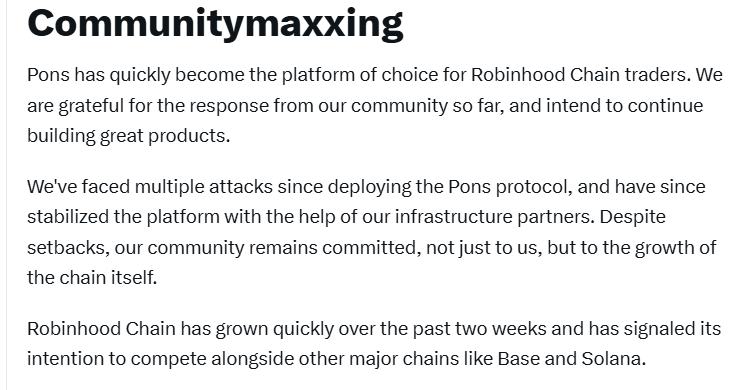
According to the Pons team, the latest version reflects feedback collected during the platform’s first weeks of operation. Developers also said they strengthened the protocol after responding to several attacks that followed the initial launch.
— Ozzy 🇺🇸 (@MEADGod) July 23, 2026
The largest architectural change replaces the previous launch process with an ETH-denominated bonding curve. Tokens will remain on the bonding curve until they accumulate 4.2 ETH, after which liquidity will migrate automatically into a permanently locked Uniswap V4 full-range position.
If a project launches against another supported asset instead of ETH, the accumulated ETH will convert into the selected quote asset before liquidity moves into the new pool.
The protocol also removes trading restrictions for ordinary wallets. Only developer wallets will retain configurable controls. The team said the adjustment should eliminate failed transactions experienced by third-party trading applications under the earlier version.
Developers will also gain the ability to launch tokens against custom trading pairs instead of ETH alone. Supported examples include USDG, NVDA, AAPL, and HOOD, allowing projects to create markets tied to stablecoins or tokenized financial assets.
Key platform metrics
Metric Value
Upgrade timeline Next week
Graduation threshold 4.2 ETH
Liquidity destination Locked Uniswap V4 pool
Supported example pairs USDG, NVDA, AAPL, HOOD
Default creator payout ETH
Fee redesign strengthens creator incentives
The new fee model represents another significant shift in Pons V2. Rather than collecting rewards in newly launched tokens, creators will receive protocol fees in ETH by default.
The protocol will convert fees directly within Uniswap V4 pools through Hooks. As a result, creators avoid accumulating illiquid memecoins that often require immediate selling.
Deployers may instead choose payouts in supported stablecoins or tokenized assets such as USDG. However, developers seeking exposure to their own projects must purchase tokens through the open market rather than receiving them automatically.
The governance framework also expands with several new controls.
- A CTO feature protected by a three-day timelock
- Optional transaction taxes on buys and sells
- Flexible fee distribution for integration partners
- Reflection-style reward models for token holders
The team explained that the timelock addresses a limitation discovered in the V1 contracts while giving communities time to respond before governance changes become effective.
The roadmap is created by competitive pressure
Pons V2 is not a standard software update, but rather a time of change for Robinhood Chain overall.
Noxa, who was previously responsible for 75% of token deployments, previously generated over $12 million in protocol fees through over 60,000 token launches, but ceased to support new launches on July 11. With its exit there were opportunities for other launchpads to compete with it, such as flap.sh, trensh.today, bankr, and Pons.
Robinhood Chain continues to grow past speculation trading. The network already has one-for-one tokenized stocks backed by shares in the network, and is positioning its Ethereum Layer 2 infrastructure around tokenized securities and decentralized finance.
FalconX research also pointed to the tremendous growth of the chain. In the first 3 weeks after launch, Robinhood Chain has seen around $431 Million Tvl, $399 Million Stablecoin Mcap and $9 Billion Dxv. Despite this, over 80% of the volume at DEXes is still attributed to memecoin trading.
Conclusion
Pons V2 represents one of the most comprehensive infrastructure upgrades announced for Robinhood Chain since the network launched. The combination of ETH bonding curves, locked Uniswap V4 liquidity, expanded trading pairs, and revised creator incentives moves the platform beyond conventional memecoin launches. Although the final feature set depends on ongoing security audits, the planned release highlights how launchpads are evolving as Robinhood Chain pushes deeper into tokenized financial assets while competing for market share in an increasingly crowded ecosystem.