
The recent weakness of Bitcoin has garnered interest from other parts of the cryptocurrency sector, but Coinbase CEO Brian Armstrong claims that the industry growth is unaffected. He stated that the sector is growing beyond a single asset, with mentioning of the growing activity in stablecoins, derivatives, and prediction markets.
Key Insights
- Despite recent market weakness, crypto derivatives, stablecoins and prediction markets are growing.
- Brian Armstrong claimed the digital asset industry has come a long way from just one cryptocurrency.
- Future crypto innovation may spread to other parts of the world depending on U.S. regulatory actions.
Bitcoin remains at the center of the digital asset market, but Coinbase Chief Executive Officer Brian Armstrong says the broader crypto industry continues to expand despite the recent price decline. His comments came as market participants focused on growing activity in stablecoins, derivatives, and prediction markets while the largest cryptocurrency remained under pressure.
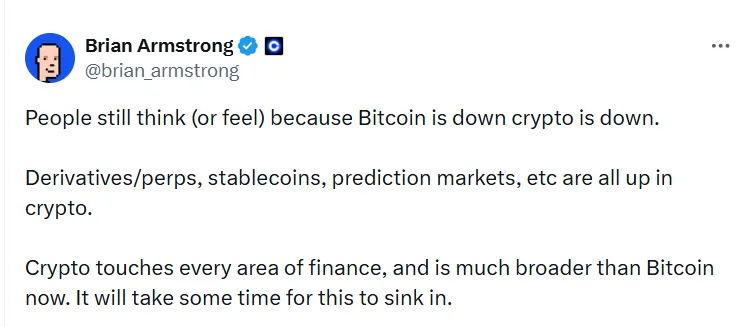
In a June 6 post on X, Armstrong argued that many investors still associate the health of the entire crypto sector with the performance of a single asset. He stated that this view no longer reflects how the industry operates today, as digital asset services now extend across several areas of finance.
Market activity saw greater breadth of participation.
Recent trading activity was up even though prices were not. Bitcoin continued to settle around the $60,000 mark following a significant monthly drop. The market cap was also above $1.2 trillion and trading volume increased significantly in the midst of the selloff.
Armstrong pointed to several areas that continue attracting users and capital.
Segments he highlighted included
- Crypto derivatives
- Perpetual futures products
- Stablecoins
- Prediction markets
According to Armstrong, growth across these sectors demonstrates that crypto activity is becoming more diversified. He said the industry now reaches many parts of financial markets and cannot be measured solely through the performance of one asset.
He also reiterated that Bitcoin remains an important component of the ecosystem and described the current market conditions as part of a cycle the industry has experienced before.
The expansion of a single market driver.
Armstrong’s comments pointed to a shift in the use of digital assets. Bitcoin’s price movements still have some sway on market sentiment, but other sectors have created their own demand and liquidity.
Stablecoins have been growing in significance for payments and settlement. Derivatives trading and risk management are still alive and well, and prediction platforms are a newer segment in the sector.
Despite that, many market participants are still looking at crypto in terms of previous cycles’ framework, Armstrong said. He said that the industry has grown significantly and has expanded its financial footprint.
His remarks indicated that future growth might need to increasingly come from staggered adoption of the asset, not a single one of the crypto services.
Regulatory debate is still a significant issue.
As well as his market insights, Armstrong has been raising questions over digital asset regulation in the United States. If the policies are restrictive, he said, it could promote innovation and investment to cross over the borders.
A key issue on Washington’s horizon is the proposed legislation on stablecoins. In the past, Armstrong has suggested that restrictions on some features of stablecoins could yield opportunities to foreign players rather than bolster domestic leadership.
He also related crypto policy to the international competition more broadly. Armstrong said that competition in the financial technology sector around the world could fuel the U.S. to stay strong in the digital finance sector.
These discussions have also intensified the conflict between traditional financial institutions and cryptocurrency companies ahead of the release of new regulatory frameworks for the structure of the markets.
The potential impact of the new comments on the industry
Armstrong’s recent remarks come as the market is facing increased uncertainty. Investors are closely watching the price developments, regulatory changes and adoption trends in various crypto sectors.
There are a few observations that can be made from his remarks
- The industry is growing in a more fragmented manner.
- Even amid the volatile market, activity in Stablecoins and derivatives has not shown any signs of stopping.
- Future innovation and investment might be directed by regulatory outcomes.
Armstrong’s primary focus is on short-term price performance, but his thinking is that industry development transcends market cycles.
Conclusion
Armstrong, however, contended that the digital asset sector is still growing and that segments like stablecoins, derivatives and prediction markets are still growing. The timing of his remarks came as the crypto sector evolved into a larger financial system that is seeing other sources of growth beyond price action in Bitcoin.
He also stated that regulatory actions will be a key factor in shaping the direction of the industry. Bitcoin will continue to be a major component of the market, but longer-term success will increasingly rely on adoption across a range of different crypto services and jurisdictions being able to foster innovation through a competitive regime of policy, Armstrong said.