

In crypto lending, people can borrow against their cryptocurrency holdings to earn or lend funds while retaining ownership. However, many lenders also practice rehypothecation.
Rehypothecation means lending platforms can use client deposits to earn additional income by executing multiple transactions simultaneously. Though rehypothecation has been around for a while in traditional finance, it really stands out in the digital asset field.
In addition, crypto lending platforms do provide the annual rate of interest on the money value of the cryptocurrency deposited in their vaults, such as Bitcoin and Ether.
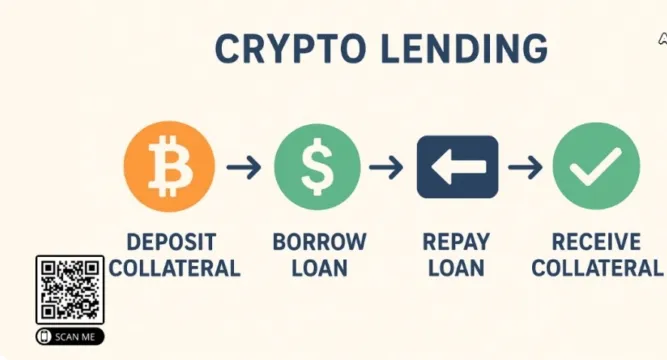
Source: animalverse
Other entities lend assets to other borrowers (institutions, market makers, hedge funds, customers, etc.) to be paid the returns. The arrangement may provide improved liquidity and capital efficiency, but it will also add more parties to the same guarantee.
Even with the rapid adoption of crypto lending both centrally and on a decentralized platform, rehypothecation risk is a key exposure that needs to be taken into account by market participants in the evaluation of their lending products.
Rehypothecation Risk in Crypto Lending Explained
If an institution takes an asset as collateral from a customer and then places that asset into financial transactions that it conducts, it is considered to be rehypothecating assets.
Traditional finance has long used it in the banking and brokerage industry, where collateral usage is limited by regulation. The standard approach is very similar in crypto lending, where a crypto investor places their money on a site with yield-generating accounts.
There are several steps to a standard lending structure:
- A user funds their lending account with cryptocurrencies.
- The platform will give interest on the holdings.
- The funds deposited are lent to institutional borrowers.
- The money borrowed is employed in trading, leverage, or liquidity activities.
- The site makes money by making loans and pays a portion to the depositors.
The steps enable platforms to provide attractive yields while maintaining the liquidity of their assets in the financial markets.
Although the risk of rehypothecation arises when multiple obligations are tied to the same collateral. When a borrower can’t return the assets, the platform can encounter issues in satisfying customer withdrawals.
How exposure occurs from rehypothecation.
There are several risk types associated with rehypothecation in crypto lending.
| Risk Type | Description | Potential Outcome |
| Counterparty Risk | Borrowers refuse to repay loans | Leaving the assets of the borrowers unavailable. |
| Liquidity Risk | Large withdrawal requests exceed available reserves | Withdrawals are imposed by freezing. |
| Leverage Risk | Reused collateral to obtain more borrowing power | Larger market losses |
| Transparency Risk | Limited transparency on asset usage | Investors are unable to assess exposure |
One of the largest worries is counterpart risk. The financial stability of the lending platform and its borrowers is critical to deposit holders.
Liquidity challenges can also emerge during periods of market volatility. A platform may find it difficult to access funds that have already been loaned to another customer if many customers try to withdraw funds simultaneously.
Rehypothecation Risk Indicated by Major Companies
Celsius Network
Celsius Network drew many deposits with accounts that paid interest. The firm reportedly had customer money invested in several lending and investment initiatives. The firm faced liquidity problems and eventually went bankrupt during the market downturn.
Voyager Digital
Voyager Digital’s losses were significant when it lent large sums of its customers’ funds to the hedge fund lender Three Arrows Capital. Three Arrows Capital defaulted on its obligations, and Voyager was found to be insolvent.
Three Arrows Capital
Financial contagion was also illustrated by the failure of Three Arrows Capital, which spread liquidity pressure through a chain of borrowing relationships among several institutions. Some lenders lost money with the failure of the hedge fund to pay back.
The CeFi & DeFi approaches to rehypothecation.
Centralized finance (CeFi) and decentralized finance (DeFi) have two entirely different notions of collateral.
| Feature | CeFi | DeFi |
| Platform assets | User interacts with the platform through their assets | User interacts through smart contracts |
| Transparency | Limited disclosures | On-chain visibility |
| Management Risk | Counterparty failure | Smart contract vulnerabilities |
| Asset Tracking | Internal systems | Public blockchain records |
Moreover, with the centralized lending approach, users are required to rely on the company’s disclosures to understand how the assets are being employed. In decentralized systems, users have the ability to conveniently monitor a lot of transactions with the backbone of blockchain reports.
Regulatory attention continues to increase.
Digital asset regulators have been studying rehypothecation with increasing focus.
Conventional financial institutions generally have collateral reuse restrictions and investor protection regimes. The Crypto market is subject to constantly changing regulations in various jurisdictions.
Many cryptocurrencies are in bankruptcy proceedings, and how customer assets are treated is a major concern. In some instances, terms of service on the platforms outlined that the money deposited with them became the property of the company, making customers unsecured creditors in insolvency proceedings.
The developments have led to a rise in the attention that’s drawn to asset segregation, reserve disclosures, and transparency requirements in the lending sector.
What Investors can do to reduce rehypothecation risk
There are a number of ways that investors can determine the extent of their exposure when considering lending products.
Checking terms and loan agreements for the platform can give some information on whether the assets put into the platform could be reused.
Independent audits and disclosures may provide further transparency of asset management practices.
Having spread investments across a number of platforms can minimize concentration risk.
Some investors also opt for self-custody solutions, in which case the private keys do not pass through a third party, and assets are not lent without their consent.
Yield levels may also be used to understand risk profiles. It’s still vital to understand how returns are earned when assessing any type of lending product.
Conclusion
Rehypothecation risk is an important challenge in crypto lending as it relates to how the customer assets are managed after they are deposited. The practice can also be beneficial for liquidity and yield generation, but it also brings in counterparty risk, liquidity risk, leverage risk, and transparency risk.
FAQs
What is rehypothecation risk in crypto lending?
Rehypothecation risk happens when a platform takes your deposited crypto assets to reuse them.
What’s the purpose of rehypothecation?
The purpose is to increase the income of the platform to be able to make the most of the money, and provide the depositors with some interest on their money.
Is rehypothecation legal?
It varies. These rules are used in both traditional finance and crypto, and there is some variation based on location.
Disclaimer: This article is for informational and educational purposes only and should not be considered financial, investment, or legal advice. Always conduct your own research before making any financial decisions.