Developers are constantly striving to make interactions with blockchain technology easy and user-friendly in the fast-evolving landscape of decentralized finance (DeFi). One of the latest innovations that is getting noticed is intent-based transactions.
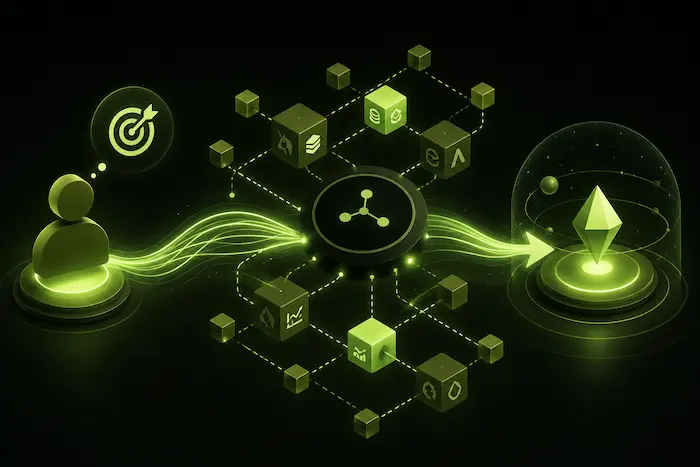
Instead of the user having to define all the steps of a transaction, the model allows the user to specify what he/she wants the transaction to do and have third parties execute it.
With the rise in blockchain adoption, the concept of DeFi has gained significant attention, particularly as various blockchains and applications start attracting liquidity providers.
The traditional blockchain transaction also faces a number of issues which need to be solved, including token authorization, trading venue choice, gas fees calculation and execution path. Intent-based transactions are designed to help reduce that complexity by decoupling the intent of the user from the execution of the transactions.
How do Intent-Based Transactions work?
Under the traditional transaction model, every action needed to achieve a process must be identified by the user. For instance, during a token swap, one must choose a liquidity pool, approve spending tokens, pay the gas fees, and then send the transaction to the blockchain.
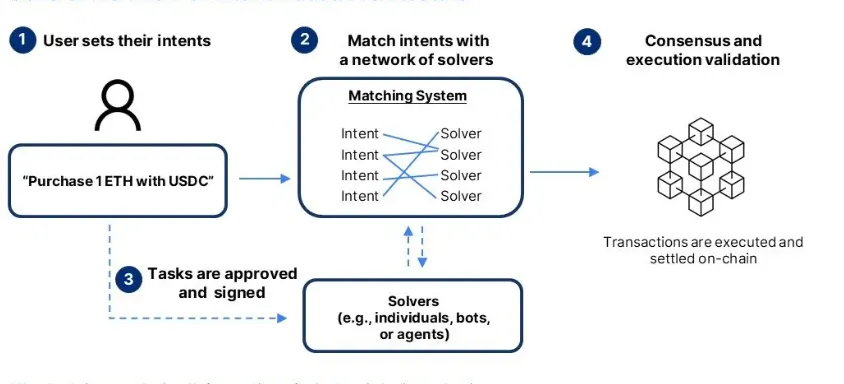
A user can submit a request such as, “Swap 1 ETH for at least 2,000 USDC,” without specifying how the trade should be completed. The responsibility for finding the execution path is transferred to a network of solvers.
Source: Rubic
The approach is often described as moving from a command-based system to an outcome-based system. Users focus on the result, while the execution infrastructure determines how the result is achieved.
Why DeFi Platforms are Pursuing Intent-Based Transactions
DeFi is becoming more complex, and so is intent-based transactions. With the growth of blockchain usage across various networks, liquidity fragmentation, cross-chain transfers, and transaction fees have become more common problems for users. Completing a single operation often required interactions with several protocols.
Intent-based systems were designed to reduce the number of decisions users must make before executing a transaction.
According to documentation published by CoW Protocol, intent-based trading can allow users to submit desired outcomes while competing solvers search for optimal execution paths. Gas abstraction is also possible in some implementations of the model. Users need not keep blockchain native tokens for fees, as solvers can pay upfront and recoup the fees at settlement in such systems.
How Intent-Based Transactions Work
An intent-based transaction has a lifecycle distinct from the public mempool lifecycle.
User creates an Intent.
It starts with a user signing a message with a particular goal. This can be a change in assets, moving money between different blockchains, buying an asset at a discount to its target price, or something else entirely, for the purpose of obtaining a yield.
Intent Is Broadcast
The request is communicated to a network of solvers, fillers, or searchers. The participants assess the liquidity options and execution facilities available.
Solvers Compete
Solvers process the request and attempt to find the best solution that meets the user-specified constraints.
Settlement Occurs On-Chain
The winner makes the transaction and settles the outcome. If the user has already configured certain conditions, the transaction is processed if those conditions are fulfilled; if not, it isn’t.
Intent-Based Transactions and Solver Networks
Solvers need to find the routes to execute and be competitive for executing the outcome requested. These activities can involve finding liquidity on different markets, arranging orders between users, or using a variety of methods to streamline the transactions.
The competitive nature ensures that many parties do their best to execute. Solvers do the comparing for users, so folks don’t need to handle it themselves.
According to UniswapX, the protocol uses a Dutch auction model. This lets fillers compete to execute orders while giving the best prices to users. Nevertheless, several blockchain protocols have adopted intent-based architectures.
CoW Protocol
According to the CoW Protocol, the platform uses batch auctions that allow solvers to compete for trade execution while aiming to reduce the effects of MEV.
UniswapX
According to Uniswap Labs, UniswapX enables gas-free swaps by aggregating liquidity from multiple sources and using competitive fillers.
1inch Fusion
According to 1inch, Fusion orders allow professional resolvers to execute transactions while covering gas costs.
Across Protocol
According to Across Protocol, users can specify where they want assets delivered while relayers manage the underlying cross-chain transfer operations.
Benefits and Challenges
There are a number of operational benefits to the intent-based transactions.
Users can concentrate on the results not the mechanics of the transaction. Solvers can search across multiple liquidity sources, potentially improving execution efficiency and pricing. Some implementations also offer protection against certain types of MEV by delegating execution to a third party.
Challenges
The structure of the solver can be complicated and particular, and the participation involves technical knowledge and infrastructure. A problem of centralization can occur if a few entities control execution.
In addition, some of the execution may occur off-chain before final settlement, which introduces a transparency issue that will need to be addressed by protocols. A new layer of logic is needed to facilitate an intent-based future of transactions.
Intent-driven transactions are gaining traction across the trading space, liquidity aggregation, and cross-chain applications.
The model sets out to make interactions with blockchain more usable by eliminating the need to declare what actions are to be taken and instead specifying what results are to be achieved. As DeFi infrastructure grows, the model will be used to make blockchain interactions more user-friendly.
The approach does not eliminate the complexity of blockchain systems. Instead, it transfers much of that complexity to solver networks that execute.
Conclusion
Intent-based transactions let users focus on what they want from a blockchain deal, not how to make every move themselves. With CoW Protocol, UniswapX, 1-inch Fusion, and Across Protocol using this setup, it’s getting more common in decentralized finance. So, as these protocols keep adding intent-based systems, this model becomes more visible in the space.
FAQs
What are intent-based transactions?
Intent-based transactions enable customers to define the end goal and the solvers determine the transaction’s execution.
Who performs transactions that are based on intent?
The participants are specialized and are called solvers, fillers, or searchers, and they compete to satisfy the user’s request.
What protocols support Intent-Based transactions?
Some of them are CoW Protocol, UniswapX, 1inch Fusion, and Across Protocol.
Do gas fees go away for intent-based transactions?
In some implementations, users can pay gas fees upfront and will be reimbursed during settlement, so that they can have a gasless experience.