

The use of crypto wallets has become essential in the web3 ecosystem, enabling people to make use of cryptocurrencies and other decentralized applications on blockchain networks. Nonetheless, there are various challenges that arise when making use of cryptocurrency wallets.
The idea of account abstraction was introduced with the view to solving different issues related to the functioning of the cryptocurrency wallets. In an effort to simplify development in the Web3 ecosystem, account abstraction makes it possible for developers to create wallets that do more than just offer entry to them through private keys.
Since the advent of the ERC-4337 protocol in Ethereum that made account abstraction possible without changing the consensus of the blockchain, there has been a lot of buzz about this innovative technology.
According to the Ethereum roadmap, the use of account abstraction in wallets makes them programmable, unlike in the past when wallets were only used to store key pairs for securing the information. This technology seeks to solve different issues facing cryptocurrency wallets.
How Account Abstraction Innovates Traditional Wallets
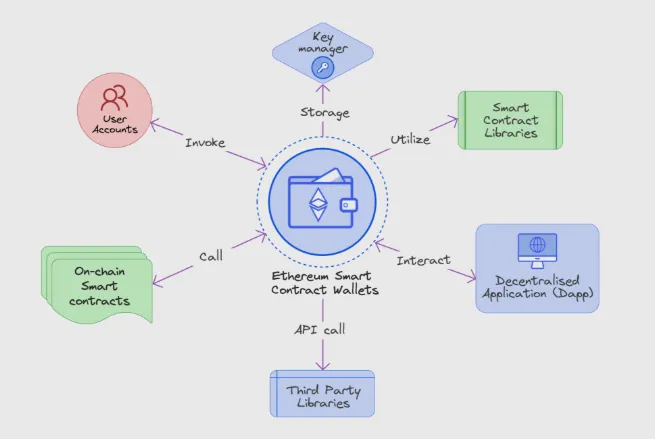
In Ethereum’s conventional system, transactions are made from externally owned accounts (EOAs). These accounts are secured with private keys, and signing each transaction is possible only with those keys.
Source: Particle Network
The issue here is that, for one, securing the seed phrase and private key becomes important since the loss of either could potentially render access to funds impossible. Another problem here is that each transaction may need to be authorized separately.
In account abstraction, a wallet can utilize a smart contract in order to implement customized authorizations for transaction operations in ERC-4337.
Rather than relying solely on the use of a private key, several security methods may be employed in facilitating the functioning of wallets that work on account abstraction, some of which include biometric identification, two-factor authentication, social recovery techniques, transaction limit, and multi-signature process.
The concept of account abstraction is said to have been proposed initially by Vitalik Buterin, a co-founder of Ethereum, back in 2021. However, the ERC-4337 standard did not see its implementation on the Ethereum mainnet until March 2023.
Account Abstraction and New Wallets
A major advantage of account abstraction lies in its capability to offer features that are often found in traditional finance applications.
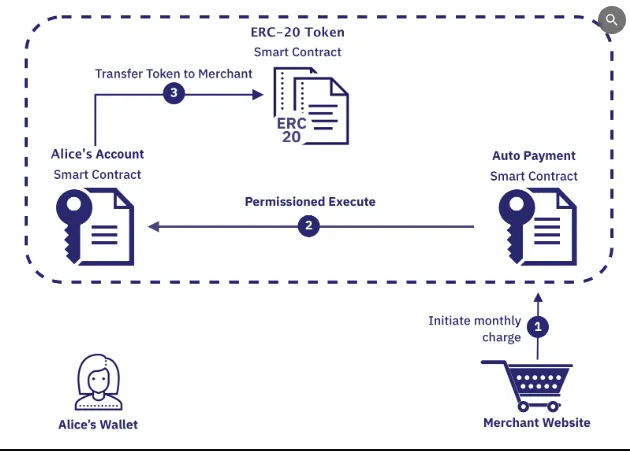
For example, one can utilize the function of bundling different transactions into one action, which means one does not have to seek permission to execute each transaction individually. In addition, one can schedule future transactions, automate payments, and restrict spending under particular conditions.
Another feature offered by account abstraction wallets is social recovery. Web3 wallet users don’t necessarily have to rely on their seed phrases; they may use social recovery instead.
The other one is gas abstraction. In conventional Ethereum transactions, users must own ETH to pay fees on the blockchain. With account abstraction, transaction fees can be paid in the network’s accepted ERC-20 tokens, while other applications would cover fees for users.
Source: Starknet
According to the ERC-4337 specification by Ethereum, these features can be achieved through a process in which User Operation objects are executed via a special contract, the EntryPoint contract.
Ethereum Account Abstraction Gains More Functions
This process of abstraction development is further reflected in EIP-7702, a proposal for Ethereum that is included in its 2025 Pectra hard fork.
EIP-7702 allows an externally owned account to temporarily become a smart contract wallet without requiring a permanent change in the wallet’s nature.
In this way, standard wallets will be able to take advantage of certain functionalities of programmable wallets, such as batched transactions, other forms of authentication, and sponsored transactions.
As such, individuals can enjoy enhanced features related to their wallets without the need to sacrifice existing wallet designs.
Benefits and Drawbacks of Account Abstraction
Some of the benefits of using account abstraction include:
Account abstraction eliminates the need to rely on complicated processes such as the use of seed phrases and private keys. Additionally, account abstraction supports dynamic control over accounts, which is useful for company treasuries and expense allocations.
Programmable inheritance concepts are yet another addition from account abstraction. Wallets can be programmed such that they distribute funds to selected beneficiaries should there be an extended period where there have been no interactions within the wallet.
On the other hand, certain challenges do exist.
For one, the underlying technology introduces additional complexity compared to regular wallets. Social recovery relies heavily on selecting trusted individuals, as the chosen recovery contacts can influence account recovery.
Some market analysts have also noted that programmable recovery mechanisms differ from the traditional self-custody model commonly associated with cryptocurrency ownership.
Why Account Abstraction Matters for Web3 Adoption
According to figures cited in the wallet industry, 62% of cryptocurrency users regularly use at least two wallets. The statistic illustrates the disjointed nature that most people face when engaging with different blockchain networks and apps.
Account abstraction, a key concept, seeks to solve the issue in terms of designing a flexible wallet infrastructure that can fulfill different requirements.
ERC-4337 and EIP-7702 set standards for incorporating programmatic security mechanisms, wallet recovery, variable costs, and auto-payments into wallets within the Ethereum blockchain.
Conclusion
Account abstraction marks a significant milestone in the development of crypto wallets technology within blockchain technology development towards greater usability.Using standards like ERC-4337 and EIP-7702, the Ethereum platform has created protocols which enable wallets to provide programmable security, recovery services, flexible fees, and automatic transactions.
FAQs
What is account abstraction?
Account abstraction is an aspect of the blockchain technology where wallets are controlled via smart contract code rather than being operated purely by the means of private keys.
What is ERC-4337?
ERC-4337 is the Ethereum implementation released in 2023 which implements account abstraction through Ethereum consensus layer changes.
Can account abstraction eliminate seed phrases?
The possibility of social recovery and biometric authentication via account abstraction means less reliance on seed phrases.