

The economic situation is determined by several factors, which are used to influence decisions related to the process of borrowing, expenditure, investments, and the flow of cash within the financial system. This way, the economic situation impacts inflation rates, employment, confidence, and financial markets, therefore becoming the subject for constant monitoring on the part of enterprises, investors, and policymakers.
One of the main methods used by central banks to accomplish their aims is monetary policy. Depending on the state of the economy, the central bank moves from policies aimed at stimulating development to those that decrease inflation, influencing households, businesses, and investment markets, including cryptocurrencies.
What is Monetary Policy?
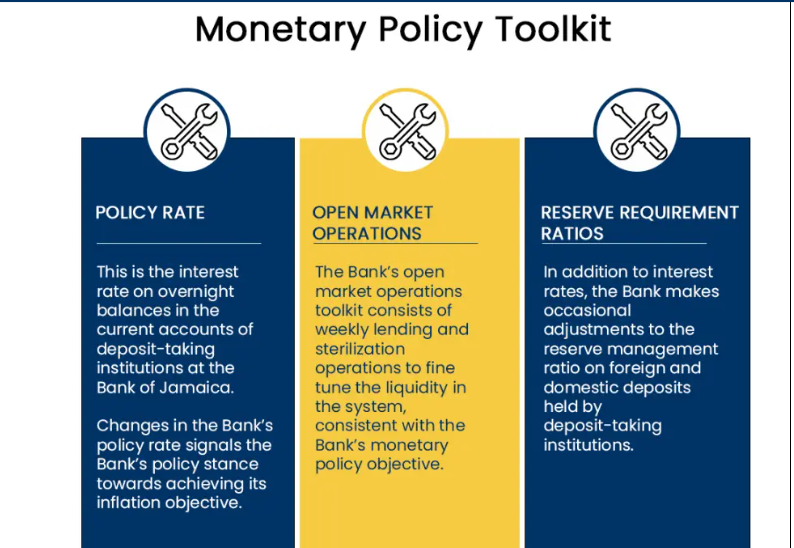
Monetary policy involves measures taken by the country’s central bank to control the amount of money in circulation and affect interest rates. Among the main aims of such policies are price stability, promoting employment, and sustainable economic growth.
Source: Bank of Jamaica
In almost all countries, central banks act independently of government institutions. Such an arrangement is meant to ensure that policies consider long-term economic factors rather than short-term political ones.
The following are the major bodies responsible for the implementation of monetary policies. These include the United States Fed, the European Central Bank, and the Bank of England. The policies developed by the bodies mentioned above will influence interest rates on loans, spending, investment, and activities in the markets.
Expansionary and Contractionary Monetary Policies
Depending on the state of the economy, the central bank can adopt either of the two types of monetary policies.
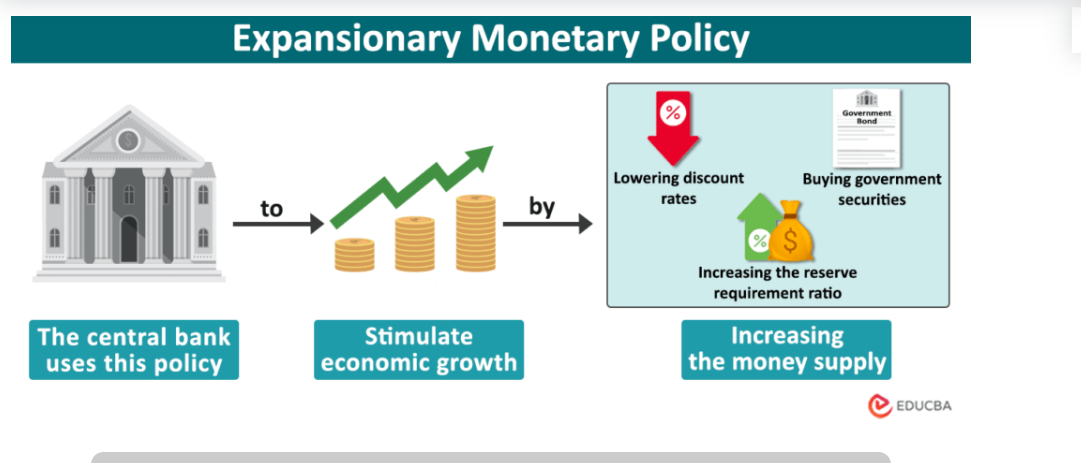
Expansionary monetary policy is adopted during periods of poor economic performance or unemployment. In this case, the central bank lowers the interest rate and increases the supply of money.
Source: EDUCBA
One such well-known instance was during the financial crisis of d States2008, where the Federal Reserve lowered interest rates to almost zero and made large asset purchases using quantitative easing. The same strategy was adopted by many policymakers during the COVID-19 outbreak to help stabilize the financial market and support economic activities.
Contractionary monetary policies are adopted when the level of inflation goes up. Here, interest rates go up while the money supply within the financial system comes down.
From 2022 to 2023, the Federal Reserve increased its benchmark interest rate from near zero to 5.25%-5.5%, which was one of its fastest ever increases in history. As the situation with inflation improved, it started cutting down the rates in 2024 and kept doing the same till 2025 due to uncertainty regarding inflation.
Monetary Policy Instruments
There are several tools that are applied by central banks to conduct their monetary policies.
The most common one is the adjustment of interest rates. Through changes in the base interest rates, the central bank can impact the cost of borrowing for all types of borrowers, such as mortgages, business loans, and personal borrowing.
Open market operations include buying and selling government bonds to either infuse liquidity into the market or withdraw funds from the market.
Reserve requirement refers to the lowest number of deposits that banks have to keep from customers’ deposits before lending. While some central banks still use the reserve requirement, the Fed of the U.S. lowered the reserve requirement to zero in 2020; hence, the tool is now ineffective as a policy tool.
Quantitative easing is usually done during abnormal economic situations where a traditional reduction in interest rates does not work. The policy involves the acquisition of long-term assets by the central bank to enhance liquidity in the financial sector.
The opposite strategy, called quantitative tightening, shrinks the balance sheet of a central bank through either maturity or the sale of assets into the financial market.
Summary of Monetary Policy Tools
| Monetary Policy Tool | Purpose | Economic Effect |
| Interest Rate Changes | Raise or cut interest rates | Higher interest rates discourage spending, while low interest rates boost spending and investments |
| Open Market Operations (OMOs) | Buying or selling government bonds | The amount of money that is circulating in the economy will be altered |
| Reserve Ratios | Imposing reserve ratios on banks | The banking industry’s ability to make loans |
| Quantitative Easing (QE) | Buying of financial assets | Long-term financial markets are infused with liquidity during times of poor economic performance |
| Quantitative Tightening (QT) | Lowers the holdings of financial assets in the central bank’s balance sheet | Helps reduce liquidity in the financial markets |
Monetary and Fiscal Policies Play Diverse Roles
While both these policies affect the performance of the economy, they function through distinct agencies and diverse procedures.
Monetary policy is carried out by independent central banks through interest rates, money supply, and liquidity.
On the other hand, fiscal policy is conducted by governments through taxes, expenditure, and budgetary policies passed by legislative bodies.
Both policies can function simultaneously. In the period of the COVID-19 situation, the government applied fiscal policy while the central bank lowered the interest rate and increased liquidity.
Impacts of Monetary Policy
On Consumers
- The interest rates on mortgages, automobile loans, and credit cards can be altered immediately after the decision of the central bank.
- With the lowering of the interest rate, the consumer would have more cash to spend since borrowing money becomes easier.
- With an increase in the interest rate, people would earn higher interest on their savings and fixed deposits.
On Businesses
- Businesses should assess interest rates prior to business expansion and investments in new ventures.
- When interest rates go down, businesses will have easier access to financing.
- Increasing interest rates might discourage businesses from hiring and investing money.
On Financial Markets
- Financial markets often react after central banks make their decisions regarding monetary policies.
- If interest rates decline, the liquidity level within financial markets will improve.
- If interest rates increase, investors will be attracted to less risky assets such as government securities.
Constraints of Monetary Policy
Monetary policies may not always yield instant and consistent outcomes.
When there is a severe economic recession, interest rates might get close to zero without yielding enough borrowing and expenditures, causing a condition known as a liquidity trap.
On the other hand, hiking up borrowing costs too much may hamper economic activities and lead to recession. One more problem may appear in the case of stagflation, that is, a situation in which high inflation is accompanied by slow economic growth.
How Does Monetary Policy Affect Cryptocurrency Market?
The monetary policy also influences the digital assets market via changes in investment behavior and financial conditions.
Low interest rates and high levels of liquidity tend to make borrowing more affordable, which may prompt investors to invest in risky securities, such as digital assets.
The time span from 2020 until 2021, when the interest rates were historically low, was characterized by a higher interest in Bitcoin and other digital assets.
In turn, a higher interest rate would make the government securities and cash reserves more appealing. The period of the Fed’s tightening policy in 2022-2023 was marked by falling digital assets prices together with other risky assets.
Nonetheless, the prices of digital assets bounced back in the years 2024 and 2025, even while interest rates were still quite high. It was through this that it became evident that monetary policy is just one of the many elements that affect the price of cryptocurrencies.
Conclusion
Monetary policy continues to be among the most important tools that central banks use to affect inflation, unemployment, interest rates, and economic activity.
In response to changes in the economy, monetary policy uses interest rates, open market operations, reserve requirements, and quantitative easing or tightening.
Frequently Asked Questions
What is monetary policy?
Monetary policy is the set of measures carried out by a country’s central bank aimed at controlling the supply of money and the cost of borrowing money with the goal of ensuring price stability and promoting economic growth.
Who determines monetary policy?
Monetary policy is conducted by independent central banks such as the Federal Reserve of the United States, the European Central Bank, and the Bank of England.
Who implements monetary policy?
The monetary policy is carried out by independent central banks such as the Federal Reserve System of the U.S., the European Central Bank, and the Bank of England.