
key insights
- Washington strengthens the growing number of state victories against sports prediction markets.
- There is ongoing disagreement with federal and state authorities concerning legal interpretations.
- The future of a national framework over state by state litigation may rest on the shoulders of future appellate rulings.
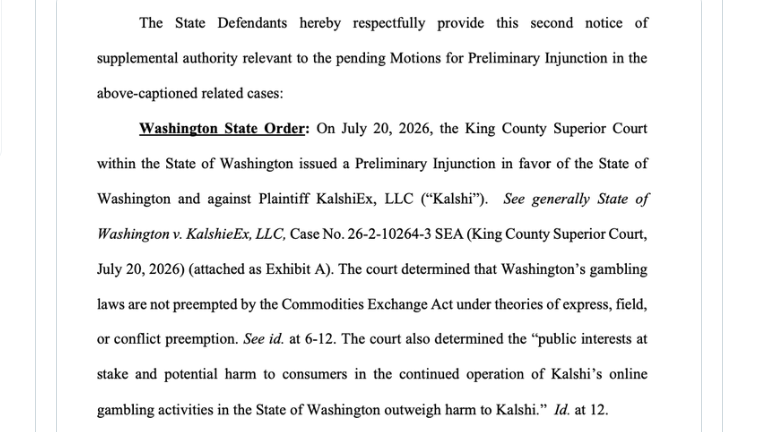
A Washington judge granted a preliminary injunction against Kalshi Washington’s edict on prediction markets after it had already sparked a legal fight over the legality of prediction markets. The ruling bolsters efforts by the State to control sports prediction leagues and sparks more debate on whether state gambling law comes before federal commodities law.
On July 20, King County Superior Court Judge John McHale issued a preliminary injunction for Washington state. Both parties, however, have until Aug. 3 to provide more information, but the restriction will not come into effect before Aug. 5. The ruling comes as Kalshi continues fighting similar cases across several states while maintaining that federal law governs its products.
BREAKING: Washington state court issues preliminary injunction against Kalshi, finds that the company conducts illegal gambling activities in violation of Washington State gambling laws and that the Commodity Exchange Act does not preempt state gambling laws. pic.twitter.com/pwJeDmYbD5
— Daniel Wallach (@WALLACHLEGAL) July 21, 2026
Washington court sides with state gambling regulators
The dispute began after Washington accused Kalshi of offering unlicensed gambling products tied to sports and other real-world events. State officials argued that labeling wagers as event contracts does not exempt them from Washington gambling laws.
Judge McHale agreed that the state had shown a strong likelihood of succeeding during the preliminary stage. He wrote that Kalshi offers illegal gambling activities to Washington consumers and actively solicits bets through its platform. The judge also concluded that potential consumer harm outweighed the company’s arguments against temporary restrictions.
Although the injunction has been approved, enforcement remains delayed while the court reviews further submissions. McHale also encouraged both sides to discuss measures that could better protect Washington consumers during the legal process.
Kalshi rejected the court’s interpretation of federal law. A company spokesperson said states lack authority to regulate prediction markets because Congress assigned that responsibility to the Commodity Futures Trading Commission under the Commodity Exchange Act.
The company also argued that several courts, including the Third Circuit Court of Appeals, have recognized federal jurisdiction over regulated prediction markets. Kalshi criticized Washington for continuing enforcement efforts despite those rulings.
State victories continue reshaping the legal landscape
The Kalshi-Washington injunction adds another setback to the company’s growing list of state court battles.
Michigan previously secured a temporary restraining order blocking Kalshi’s sports-related contracts. New York also defeated Kalshi’s effort to prevent enforcement of its gambling laws against similar products. Nevada already restricts the company’s sports event contracts, leaving Washington positioned to become another state limiting access.
Sports and gaming attorney Daniel Wallach said the broader litigation trend increasingly favors state regulators. According to Wallach, states have prevailed in 19 of 23 judicial decisions involving requests for preliminary injunctions or temporary restraining orders related to prediction market disputes.
Minnesota has already submitted the Washington ruling as supplemental authority in its own litigation involving Kalshi, Polymarket and the CFTC. That development could influence another closely watched decision expected in the coming weeks.
Key legal milestones
| Event | Outcome |
|---|---|
| Washington preliminary injunction | Approved, effective no earlier than Aug. 5 |
| Michigan case | Temporary restrictions on sports contracts |
| New York litigation | Court allowed state gambling enforcement |
| Nevada | Sports contracts already restricted |
| North Carolina | Recognized federally regulated prediction markets under future tax framework |
Industry faces growing regulatory uncertainty
The Kalshi-Washington injunction highlights a widening divide between federal regulators and individual states.
The Commodity Futures Trading Commission maintains that registered derivatives exchanges operate under exclusive federal oversight. The agency has challenged several states after they attempted to apply gambling laws to federally regulated event contracts.
Meanwhile, some jurisdictions continue taking the opposite approach. Washington, Michigan and New York argue that sports event contracts function as gambling products when offered without state authorization. Courts in those states have accepted that argument during preliminary proceedings.
Not every state has followed that path. North Carolina recently adopted legislation recognizing federally registered prediction markets and creating a tax framework scheduled to begin in 2027.
Despite expanding litigation, Kalshi continues growing its business. The company recorded roughly $33 billion in monthly trading volume during June, surpassing the combined $13.95 billion reported by Polymarket and its U.S. platform. It has also explored crypto perpetual futures while defending its core prediction market business.
Legal uncertainty clouds future expansion
The Kalshi-Washington injunction does not immediately block the company’s services in the state, but it significantly raises legal pressure ahead of broader court reviews.
If the injunction takes effect after Aug. 5, Washington will join other states restricting Kalshi’s sports-related contracts. That outcome may encourage additional jurisdictions to pursue similar enforcement while appeals continue.
The overall conflict has yet to be resolved. Federal commodities law could still supersede state gambling laws for prediction markets, a question that remains to be decided in court. Until a national response is given to this question, Kalshi Washington’s injunction provides a glimpse of the potential impact of the new legal fragmentation on the availability of prediction markets throughout the United States.