

- Kalshi Michigan lawsuit results in court ruling halting any sports betting contracts in Michigan till July 13.
- Michigan ordered Kalshi to comply with geofencing regulations and imposed a fine per day in case of violation.
- Meanwhile, the legal battle was ongoing as the trading volume rose amid the FIFA World Cup.
Prediction market regulation in the United States continues to face new legal challenges after a Michigan state court temporarily barred Kalshi from offering sports-related event contracts to residents of the state.
The latest court action adds another chapter to the ongoing dispute over whether prediction market contracts fall under federal commodities regulation or state gambling laws.
However, according to Michigan state regulators, the sports bets offered by Kalshi are in violation of state betting regulations, while the company itself claims that these bets fall under federal jurisdiction.
The order issued for a period of two weeks is taking place amid the growing volume of prediction market trade in connection with the ongoing 2026 FIFA World Cup.
Kalshi Michigan Lawsuit Results in Temporary Court Order
The Ingham County Circuit Court issued a temporary restraining order preventing Kalshi from offering sports-related event contracts to Michigan residents for 14 days. Judge Rosemarie E. Aquilina signed the order on Monday, with the restrictions remaining in effect through July 13.
According to a statement released by Michigan Attorney General Dana Nessel, the court also ordered that Kalshi could face a civil fine of $120,000 for every day it fails to comply with the geofencing requirements contained in the order.
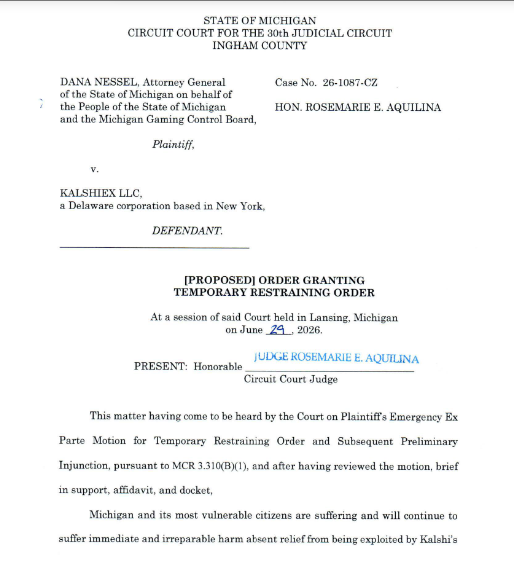
Source: STATE OF MICHIGAN CIRCUIT COURT
Nessel said Michigan’s gambling laws were designed to protect residents from unlicensed gambling operations and stated that companies failing to comply with those laws could face legal consequences.
The court filing also stated that Michigan residents could suffer irreparable harm if the sports contracts continued to be offered in the state. Judge Aquilina wrote that the platform’s sports betting operation was being presented as an investment opportunity while exposing residents to unlawful gambling activity under state law.
Key court requirements
| Item | Details |
| Court | Ingham County Circuit Court |
| Judge | Rosemarie E. Aquilina |
| Order duration | 14 days |
| Expiration date | July 13 |
| Daily non-compliance penalty | $120,000 |
| Restriction | Sports-related event contracts for Michigan residents |
State Lawsuit Returns to Michigan Court
The temporary restraining order follows earlier procedural developments in the case.
Michigan first filed its lawsuit against Kalshi in March, alleging that the company’s sports event contracts violated the state’s Lawful Sports Betting Act. State regulators contend that the contracts amount to unlicensed sports betting within Michigan.
Kalshi later sought to move the dispute into federal court. However, the U.S. District Court for the Western District of Michigan granted Attorney General Nessel’s request to return the lawsuit to state court, allowing the case to proceed before Michigan judges.
The latest restraining order represents the first significant ruling after the case returned to state jurisdiction.
Michigan’s allegations include
- Sports event contracts violate the Lawful Sports Betting Act.
- The contracts constitute unlicensed gambling activity.
- Michigan residents require protection under existing state gambling laws.
Prediction Market Jurisdiction Remains Under Legal Review
The Kalshi Michigan lawsuit reflects a broader legal disagreement involving multiple states and federal regulators.
Over a dozen states in the United States have filed lawsuits against the operators of platforms like Kalshi, Polymarket US, and others. It is claimed that the contracts provided by these companies for sport events constitute unauthorized sports betting services in these states.
However, at the federal level, the Commodity Futures Trading Commission has adopted an opposing stance. According to the agency, all federally-regulated event contracts come under its jurisdiction exclusively, meaning that they can be made available across the country through the federal laws.
Prediction market companies have also challenged several state enforcement actions in court as they seek rulings clarifying whether federal commodities regulation preempts state gambling statutes.
Michigan became the second state to obtain a court-ordered restriction on Kalshi’s sports event contracts after Nevada secured a similar temporary order earlier this year.
Separately, Kentucky filed a lawsuit on June 17 against five prediction market operators, including Kalshi and Polymarket, alleging that they were operating unlicensed sports betting platforms.
Trading Continues Even While World Cup is On
Other legal measures were also in play even with the increase in trading activities in prediction markets.
According to data provided by DefiLlama, Kalshi managed to achieve over $30 billion in trading volume during the month, a 79% increase from the previous month. It is worth noting that the trading volume has increased steadily every month starting from July 2025.
Rival platform Polymarket also reported higher trading activity during the same period, although Kalshi widened the gap between the two platforms over recent months.
Sports-related contracts have accounted for much of the recent growth following the start of the 2026 FIFA World Cup.
Data from Dune showed that daily taker volume reached a record $713 million on June 20. The metric measures contracts bought or sold by traders filling existing market orders.
According to DefiLlama and DefiRate, the monthly trading volume of the sports betting contract on Kalshi was $9.5 billion, recording a growth of 40%, while that on Polymarket was $5.3 billion, posting a growth of 175%.
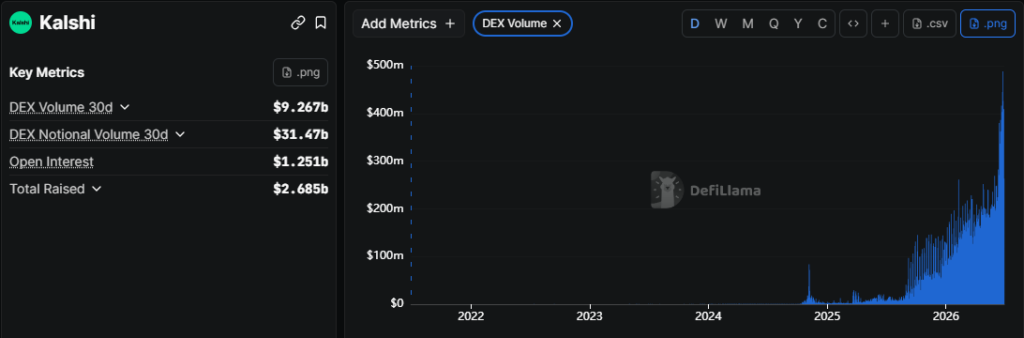
Source: DefiLlama
Platform data also showed that Polymarket’s World Cup winner market generated more than $3.5 billion in trading volume.
Earlier this month, research firm Bernstein estimated that the 2026 FIFA World Cup could contribute more than $3 billion in additional sports betting handle while generating between $5 billion and $10 billion in extra consumer prediction market trading volume.