
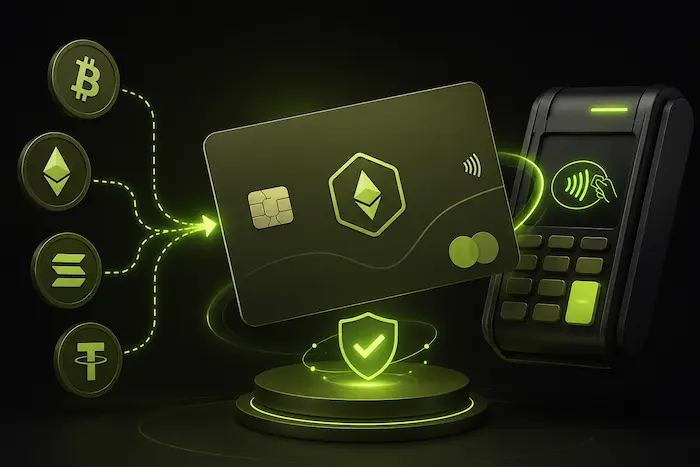
The continuous advancements in payment technology have seen cryptocurrencies move beyond being merely investment tools to become payment solutions. With new innovations in financial technology, it is becoming easier for consumers to access their cryptocurrency funds through the same payment network that is used for traditional purchases.
One such innovation allows users to carry out their regular purchases without having to deal with the digital currencies themselves. In the process of purchasing, the cryptocurrency gets converted into local money, making the purchases instant and easy through well-known payment networks like Visa and Mastercard.
Connecting Digital Assets with Payment Systems Through Crypto Cards
Crypto cards are almost the same as regular payment cards, except that they are connected to a cryptocurrency account or digital wallet rather than a regular bank account.
When the transaction is taking place, the firm that issues the crypto card will first convert the required amount of the cryptocurrency into fiat money, depending on the currency used by the particular country.
The payment will be received by the merchant in fiat money, and there will be no requirement for the merchant to have any cryptocurrency wallet or anything to do with blockchain technology.
Crypto cards accept popular cryptocurrencies, including Bitcoin (BTC), Ethereum (ETH), and various stablecoins. There are companies that enable users to choose from a larger range of cryptocurrencies to use for transactions.
How Do Crypto Cards Work in Transactions?
The transaction starts once users deposit funds into their wallet or account with cryptocurrencies. The moment the card is used at any store, online shop, or ATM, the company issuing the card recognizes the transaction value and converts it to an equal value of cryptocurrencies.

Source: Payment Scan
The service provider acquires the necessary amount of cryptocurrency and exchanges it into fiat currency. This money is transmitted via the Visa or Mastercard payment gateway in order to complete the deal. This process normally takes place within a matter of seconds, which makes the process almost as quick as using a standard debit/credit card.
For instance, in the case where someone owns $500 worth of BNB and uses $100 to pay for their meal in a restaurant, the service provider will convert about $100 worth of BNB to fiat currency, make the payment on behalf of the person and deduct the money from their wallet.
Individuals who hold different digital currencies can also have control over their spending preferences. In some cases, card issuers enable cardholders to pick a particular cryptocurrency that will be used during their transactions, whereas other issuers provide priority settings, whereby transactions switch to another currency when the first chosen currency is not enough for a transaction.
Crypto Cards are Either Debit or Credit
There are mainly two types of crypto cards, which differ in the manner through which they work.
Firstly, there are crypto debit cards where individuals have to use the cryptocurrency they possess. For every purchase that one makes using such a card, the amount of cryptocurrency held decreases. In most cases, customers are required to convert the cryptocurrency into fiat money before spending it.
Cryptocurrency credit cards are similar to conventional credit cards because the creditor offers a credit facility that allows users to pay for transactions and then repay according to the terms of the card.
As a result of this, the reward system of some of these cards includes receiving crypto rewards rather than regular cash back or airline miles. Another example of how these cards function is by using cryptocurrency as collateral, whereby the credit limit depends on the value of the cryptocurrency.
Crypto Debit Cards vs. Crypto Credit Cards
| Feature | Crypto Debit Card | Crypto Credit Card |
| Funding | from Available crypto balance | Credit provided by the issuer |
| Payment mode | Crypto is converted to fiat for purchase | Fiat money borrowed by the merchant |
| Spending limit | Depends on the amount of crypto | Depends on approved credit limit |
| Credit check | Not always needed | Normally done |
| Rewards | May vary based on the issuer | May provide rewards in crypto currency |
| Repayment | No need to repay after purchase | Monthly repayment as per the issuer’s rules |
| Risk | Price of crypto affects the ability to spend | May involve interest charges on any balance carried over |
Advantages and Other Operational Aspects
Crypto cards present a means through which consumers can use digital assets without any modifications being made to the payment methods used by merchants. Because the conversion happens prior to settlement, merchants will keep receiving payments in the local currency, while consumers spend cryptocurrency.
Some firms even provide cryptocurrency-based rewards on certain purchases. Besides, travelers can use crypto cards internationally without having to change their money in advance.
Several operational factors remain relevant for users. Cryptocurrency prices may fluctuate between the time assets are acquired and spent. Issuers of cards may also charge conversion fees, fees for ATM withdrawal, inactivity fees, and spreads of prices from the market rate to the actual conversion rate. These are different for various providers and can influence the total cost of the transaction.
In addition, regulations in different countries differ as well. There are crypto cards that cannot be used in some countries due to compliance issues. Moreover, the conversion of cryptocurrencies into fiat money at the time of making transactions can lead to taxation based on local regulations.
Characteristics of Cryptocurrency Cards
Instant Asset Exchange
- A cryptocurrency card converts the cryptocurrency into local fiat money.
- Merchants receive fiat money without dealing with cryptocurrencies.
- This exchange usually takes place within seconds.
Various Spending Methods
- Consumers have the ability to choose the cryptocurrency that will be used to make purchases.
- Some providers provide the option of trading multiple types of cryptocurrencies within one account.
- The priority will change to some other supported cryptocurrency in case of low balances.
Points to Consider While Using a Crypto Card
- Each provider has their own rates and fees.
- Converting the cryptocurrency into fiat money can lead to taxable events.
- There is variation in availability due to different regulatory needs.
Cryptocurrency Card Providers
Many cryptocurrency firms have already started offering crypto payment cards via the existing card networks.
These firms include Crypto.com, Coinbase, Binance, Bybit, Bitget, and Gemini. The services offered by these cards usually allow the user to spend various cryptos using the Visa/Mastercard network, but the features and services offered may vary from one company to another.
Conclusion
Crypto cards enable the use of cryptocurrencies as a means of payment by converting cryptocurrencies into cash and then using conventional payment systems for transactions.
The cards do not require any merchant acceptance of cryptocurrencies, as they perform an operation of converting cryptocurrencies into fiat currency.
FAQs
What is a crypto card?
A crypto card is a payment card that is linked to a cryptocurrency account/wallet, and which converts cryptocurrency to fiat currency at the time of transaction, hence enabling payments using card network companies.
How do crypto cards work?
The moment a transaction is made, the service provider converts the needed amount of cryptocurrencies into local currency before making a payment to the merchant using Visa or MasterCard.
What is the difference between a crypto debit card and a crypto credit card?
Crypto debit card uses the cryptocurrencies owned by the owner of the card. A crypto credit card gives credit and earns rewards in digital currency.