Tron (TRX) is among the most active blockchain platforms that enable the exchange of stablecoins, provide solutions for DeFi, enable smart contract execution, and offer digital assets.
Since the emergence of its blockchain in 2018, the network has developed from the original purpose of content sharing to becoming an engine for billions of transactions carried out using the Tron Virtual Machine.
The Tron blockchain is based on the DPoS consensus mechanism that provides for voting among the token holders involved in decision-making processes and transaction validations.
As of 5 June 2026, Tron was used to process over 94.8 billion TRX circulating in the network and approximately $771M worth of transactions within the past day, which makes Tron a primary platform for stablecoins.
History of Tron (TRX)
The Tron project was created in 2017. At its launch, the platform issued its native TRX token as an ERC-20 token on the Ethereum network through an initial coin offering in August 2017.
Source: coinbereue
A year after its launch, Tron launched its own network that would allow it to transfer its native coins from Ethereum to its mainnet. This allowed it to take control of its own network management and development.
Tron has since ventured into decentralized finance, stablecoin settlement, gaming, and smart contract execution. It has processed more than 12 billion transactions since its inception.
Tron’s Operations Method
The consensus protocol employed by Tron is that of Delegated Proof-of-Stake. This blockchain does not rely on miners for verifying and producing new blocks. Users have to stake TRX coins in order to get their voting power.
With voting power, they elect 27 Super Representatives to produce new blocks. The election process is continuous and serves as a means of participating in governance.
Additionally, there are four main types of resources that power the blockchain as well.
Tron Resource System
| Resource | Purpose |
| Bandwidth | Handles transaction size |
| Energy | Provides energy for smart contract execution |
| Voting Rights | Allows participation in governance |
In case users lack Bandwidth or Energy resources, they will need to burn TRX to execute their transactions.
Tron Virtual Machine Smart Contract Support
The Tron Virtual Machine (TVM) serves as the execution environment for decentralized applications and smart contracts on the Tron network.
TVM maintains its compatibility with most of the Ethereum development environment. Therefore, applications built with Solidity require minimal code changes to run on the Tron Virtual Machine.
Moreover, one aspect where this network differs from Ethereum is its resource system, in which the main measure of computational work is Energy rather than the standard gas fees.
Tron Network (TRX) and Stablecoin Transactions
Transactions involving stablecoins have become a major use case on the Tron network.
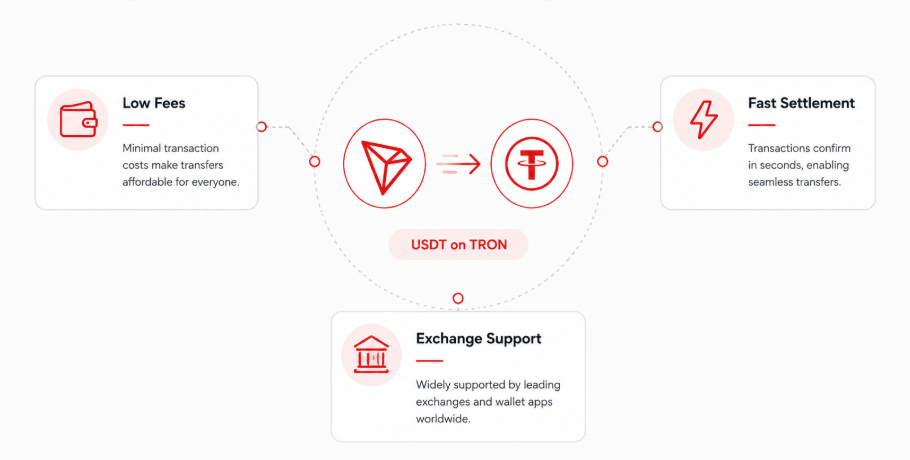
The blockchain platform has become popular in Tether (USDT) transactions owing to its transaction speed and resource model. The network launched an initiative in March 2025 whereby users can send USDT instead of TRX fees.
Source: Coinbereue
Moreover, the functionality works based on the GasFree wallet scheme.
With the model:
- Clients have to pay an activation charge of 1 USDT once only.
- Every transaction is charged a flat rate of 1 USDT.
- Fees are to be paid in USDT and not in TRX.
Moreover, an energy fee reduction of 60% was agreed upon by the community in August 2025. Back then, the Tron network had about $78 billion in USDT circulating within millions of wallets.
DeFi, NFT, and Digital Applications
Tron can accommodate various types of blockchain applications. In the DeFi space, the network supports applications such as JustLend and JustStable.
Moreover, the blockchain can facilitate:
- Non-fungible tokens and trading
- Blockchain gaming solutions
- Collectibles
- Distribution platforms
- Cross-border payments
- Peer-to-peer transactions
Smart contract support makes it possible for developers to create solutions from multiple sectors by using the network’s resource model.
The Importance of TRX Within the Platform
The TRX token is the native utility token of the Tron blockchain.
Some of the tasks it performs within the network include:
- Transaction fee payments
- Resource staking on the network
- Participation in governance
- Collateral in DeFi solutions
- Settlement for blockchain transactions
A combination of issuance and token burning is employed for the token distribution process.
New TRX tokens are minted via protocol-generated rewards. For every block generated, there are eight TRX awarded to the generating Super Representative, while the remaining 128 TRX are provided as voting rewards.
At the same time, TRX tokens are taken out of circulation via token burning, where network consumption fees are paid in TRX.
Token Supply and Network Activity
The governance model is still based on the Super Representative system. Conversations have been sparked about the model’s validator concentration compared to other blockchain systems with more validators.
Previous criticism was because of the first allegations made regarding the content in the whitepaper of the project.
In 2025, there were more institutions included in the validation process due to the inclusion of the Nansen, Kiln, and P2P.org infrastructure providers.
Conclusion
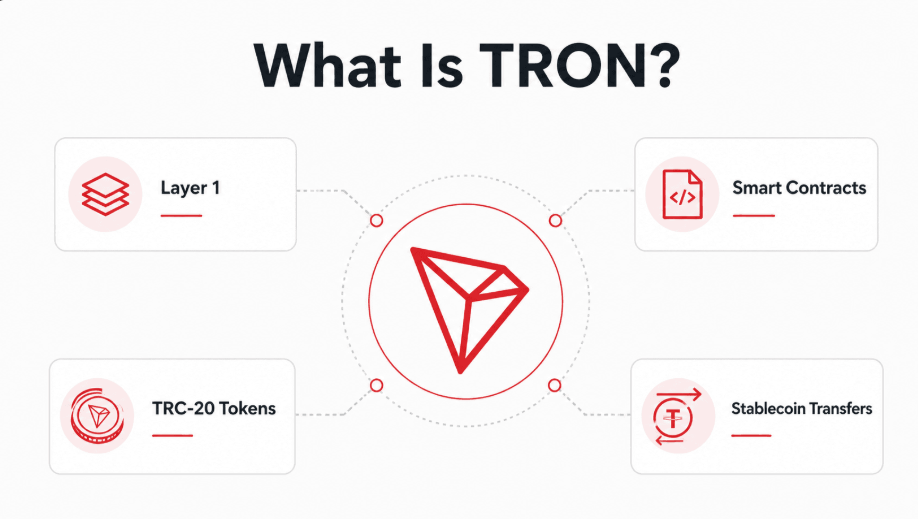
Tron (TRX) is a Layer 1 blockchain capable of executing smart contracts, sending stablecoins, and supporting Decentralized Finance, NFTs, and other digital assets. With its DPoS consensus mechanism, resource-based transaction system, and Tron Virtual Machine, Tron can be considered one of the most advanced blockchain systems that executes billions of transactions.
FAGs
What is Tron (TRX)?
Tron is a Layer 1 blockchain technology that facilitates smart contract deployment, decentralized applications development, transfer of stable coins, DeFi solutions, and many other transactions with digital money. The TRX coin is native to this blockchain.
How are transactions validated on Tron?
Tron operates using the DPoS consensus mechanism. The Tron owners (TRX holders) can stake their cryptocurrency to appoint 27 Super Representatives for transaction validation and block generation.
What is Tron Virtual Machine?
It is the platform where smart contracts on the Tron network get executed. TVM demonstrates strong compatibility with the Ethereum programming environment.