

Key Insights
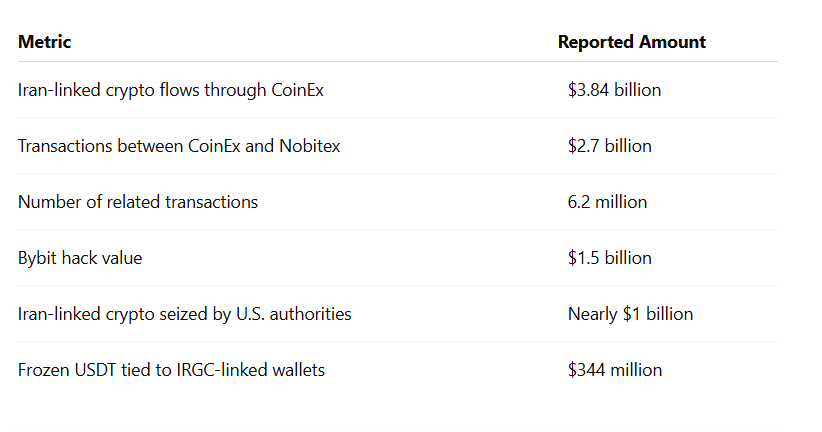
- Since 2019, investigators have attributed over $3.84 billion worth of Iran-related crypto transactions to CoinEx.
- The wallets allegedly linked to Iran’s central bank were also traced with blockchain analysis.
- CoinEx rejected any connection to official Iranian organizations and insisted on the security measures it has implemented.
CoinEx has again been called into question following a report claiming that over the last few years, over $3.84 billion USD of cryptocurrencies that have been associated with Iranian entities have been transacted on the exchange. According to TRM Labs’ blockchain analysis in a report by The Wall Street Journal, the findings have started a debate on sanctions compliance among the digital asset sector.
The report comes amid U.S. authorities’ renewed efforts to attack cryptocurrency networks that could allow for cross-border transactions with sanctioned jurisdictions. While it remains unclear if CoinEx is facing any accusations by U.S. regulators, the claims could spur increased scrutiny from compliance authorities, banking institutions, and policymakers.

Investigation traces Iranian crypto activity through CoinEx
The report noted the total worth of cryptocurrency transactions between CoinEx and more than 60 Iranian cryptocurrency organizations has exceeded $3.84 billion since 2019. The study indicated that CoinEx would be a key exchange platform for Iranian users to reach global markets.
CoinEx’s biggest counterparty in Iran was reportedly Nobitex, Iran’s biggest cryptocurrency exchange. The investigators estimated that over $2.7 billion was sent between the two platforms via some 6.2 million transactions on the blockchain.
The volume of transactions jumped up following 2020. As of 2024, CoinEx is said to have become the biggest foreign counterparty for Nobitex. The findings also indicated that transactions were more from the exchange to Nobitex than vice versa, indicating the use of CoinEx by Iranian users to access the wider market liquidity.
Key Figures From the Investigation
Beyond Nobitex, investigators identified blockchain exposure involving several Iranian exchanges, including Wallex, Ramzinex, Bit Pin, Aban Tether, Excoino, Bit24, Ompfinex, Sarmayex, and Exir.
Bybit hack connection draws additional attention
The report gained further significance after investigators traced activity involving two wallets allegedly controlled by the Central Bank of Iran. Researchers said those wallets appeared within transaction paths linked to cryptocurrency stolen during the Bybit hack.
U.S. authorities previously attributed the $1.5 billion attack to North Korean hackers. Investigators tracked the movement of stolen assets through bridges, decentralized finance protocols, wallet transfers, and exchange deposits.
According to the findings, some of those transaction routes eventually reached CoinEx deposit addresses. TRM Labs said the traced transfers represented only a fraction of the broader activity but demonstrated how sophisticated actors move funds across multiple blockchain networks.
The report also cited historical blockchain interactions involving wallets later associated with Iran’s Islamic Revolutionary Guard Corps and individuals who subsequently became subject to U.S. sanctions.
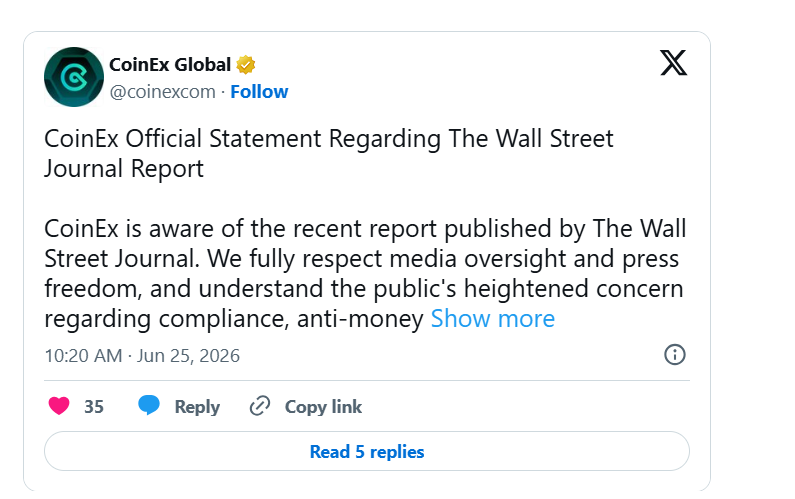
CoinEx rejected the allegations following publication of the report. The exchange stated that it had never maintained commercial relationships with Iranian government entities, domestic Iranian exchanges, the Revolutionary Guard, or sanctioned organizations.
The company also argued that blockchain transactions passing through an exchange do not prove awareness, participation, or support for those activities. In addition, CoinEx said it had strengthened sanctions screening, geo-fencing measures, transaction monitoring systems, and Iran-related risk controls.
Regulatory pressure expands across crypto markets
The allegations emerge during a period of increased sanctions enforcement against Iranian cryptocurrency activity. Earlier this year, the U.S. Treasury sanctioned four Iranian crypto exchanges, including Nobitex, under its Economic Fury campaign.
Authorities accused those platforms of helping sanctioned actors access digital asset markets. Chainalysis previously estimated that Nobitex accounted for roughly half of Iran’s cryptocurrency trading activity.
Meanwhile, U.S. officials reported the seizure of nearly $1 billion in Iran-linked digital assets and supervised the freezing of $344 million in USDT connected to wallets associated with the Islamic Revolutionary Guard Corps.
The CoinEx findings also revive concerns about laundering routes connected to major crypto thefts. According to the previous investigations, millions of dollars worth of trading was done on decentralized protocols prior to its arrival on other platforms via Bybit.
Industry Implications
The report highlights the growing importance of blockchain intelligence in the sanctions battle. Transaction tracing is now a key tool for regulators in identifying the movement of funds which may go undetected by the traditional financial system.
The case highlights rising expectations for centralized exchanges in terms of customer verification, transaction monitoring, and sanctions screening. With growing scrutiny from regulators, exchanges could be putting pressure on themselves to prove that compliance requirements can detect more intricate patterns of cross-border transactions.
Conclusion
At this time, the allegations against CoinEx are not part of a formal U.S. enforcement action. The report, however, has sparked a bigger debate on blockchain compliance and transparency in its use while also calling into question the responsibilities of centralized trading platforms. While investigators are still probing crypto traffic on networks, the results might influence the future regulations across the digital asset industry.