
Applications built on blockchain technology could be complex due to the distribution of operations across several networks. The users need multiple wallets, tokens for gas payments, and switching between the networks prior to performing a transaction. Chain abstraction seeks to simplify this process through the abstraction of most of the network specifics behind the application layer.
This method allows users to concentrate on what they wish to do without being concerned about what blockchain executes the transaction. This system doesn’t eliminate individual blockchains, but it creates additional architecture that controls actions within these blockchains.
What Is Chain Abstraction?
Chain abstraction means creating blockchain applications that abstract from the need to interact with underlying networks. A traditional multi-chain approach requires the user to choose the network, hold the native token of the chosen network to pay fees, or move funds before accessing an application.
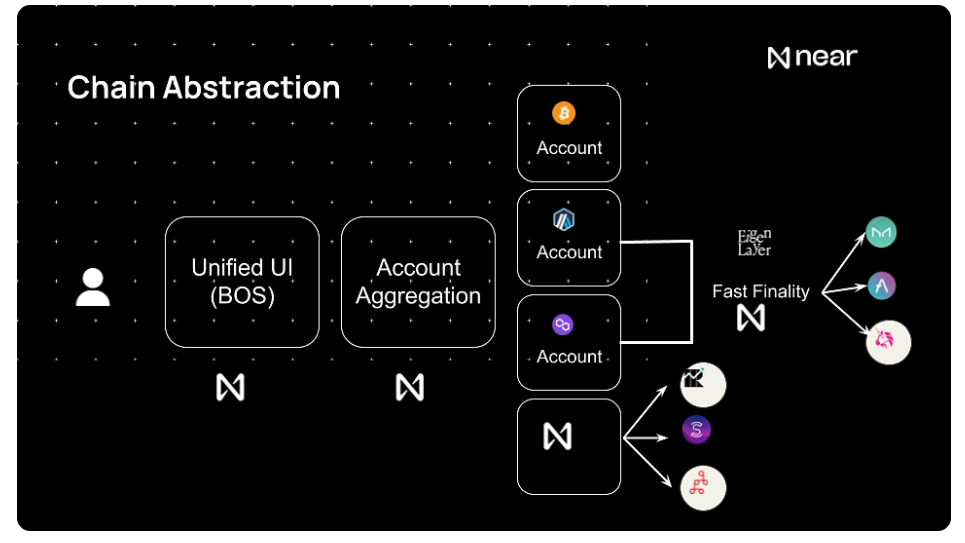
Source: CoinGecko
In a chain-agnostic approach, these tasks could be done on the backend infrastructure of the application. The user uses the application, and the system decides where the transaction is to take place. Different blockchain ecosystems have implemented various approaches.
How Does Chain Abstraction Work?
The chain abstraction system can involve wallets, smart contracts, bridges, relayers, liquidity systems, and transaction routing systems. The specifics will depend on the use case and the network supported.
The user can take an action without specifying all blockchains involved in the process. It is the underlying infrastructure that makes sure that the transaction will be made on the appropriate network and deals with all processes required before performing the transaction on the appropriate blockchain network.
The unified accounts became the goal for some systems. The NEAR Protocol Chain Signature system is one such example. This allows signing the transactions from other blockchains using only one NEAR account. Another system developed by Particle Network is called Universal Accounts.
The other systems are involved in transaction routing and execution. The Socket Protocol is the system which offers an architecture for enabling coordination between multiple blockchains.
How Is the Issue of Wallets and Fees Handled?
Wallet handling is among the major concerns impacted by chain abstraction. For example, users within the traditional multi-chain setting might have to deal with different wallets and tokens from various networks. The abstraction layer can take care of these aspects through the supporting infrastructure. This can enable the user to undertake an action without obtaining native tokens from all the networks.
The same applies to transaction fees. Chain abstraction does not remove gas fees, but the system can take care of certain fee-related operations behind the scenes. Nevertheless, a user might use an application without calculating which network token is required.
Benefits of Chain Abstraction
One potential benefit is a simpler user experience. New users will also find the process of finding wallets, selecting the network, transferring tokens, and dealing with fees hard to comprehend. Simplifying the above tasks may facilitate access to such applications.
The concept of chain abstraction can also solve liquidity fragmentation. Assets are spread across different networks, and users may otherwise have to move funds before accessing a particular application. Cross-chain infrastructure makes coordination possible without the necessity for each process to be executed manually.
Alternatively, the developers could employ distinct networks for transaction fees, abilities, liquidity, or user accessibility without exposing too much of that process to the user interface.
Key Challenges of Chain Abstraction
The approach also creates technical challenges. Integrating more networks means having more systems that need protection. In case the abstraction layer is hacked, the consequences may be far-reaching and affect all interconnected networks.
A centralized approach may also become a problem. Some systems use a coordinating layer that becomes vulnerable to failure in case it is not available or hacked. Moreover, interoperability has not been easy to achieve since each blockchain is built using different technology, which varies in aspects such as programming language, consensus algorithm, architecture, and data structure.
For example, Ethereum and Solana have different approaches used in building them; therefore, there is a need for interoperability among them. Difference between Chain Abstraction and Account Abstraction
The notion of chain abstraction is similar to that of account abstraction; however, there are distinctions in their scope. Account abstraction aims at making it possible for the blockchain to become programmable in order to allow gas sponsoring, social recovery, and transaction bundling.
Moreover, chain abstraction centres on interconnections among several chains. Using both strategies would help simplify account management and inter-chain interactions.
FAQ
Does chain abstraction eliminate blockchains?
No. Blockchains will still process transactions. The concept of chain abstraction is an additional level that takes care of interaction with them.
Does chain abstraction eliminate transaction fees?
Not really. Fees will be charged on transactions. The additional infrastructure can do something in relation to fees without users having to worry about tokens on each network separately.
Is chain abstraction only about transferring across networks?
No, it is not. Chain abstraction can also relate to unified accounts, transaction routing, gas management, liquidity access, and multi-network applications.