
Avalanche’s AVAX jumped nearly 30% over 24 hours on Sept. 20, moving above $10 as new institutional developments drew attention to the network. The token reached $10.73 before giving back some gains. Bitcoin and Ether posted smaller moves over the same period.
The move comes as Avalanche gains attention for its potential role in tokenized financial markets. Reports have linked the network to potential work with Intercontinental Exchange, while Paxos is preparing deeper integration with Avalanche. The developments come as AVAX breaks above key technical levels, adding an institutional dimension to the token’s latest rally.
Institutional Activity Puts Avalanche in Focus
New York Life Investment Management plans to bring a tokenized high-yield fund to Avalanche through Centrifuge, adding another major asset manager to the network’s institutional projects. The investment firm oversees hundreds of billions of dollars in assets.
Avalanche is also being tested by Intercontinental Exchange, the parent company of the New York Stock Exchange, according to reports. ICE has spent about a year testing the network’s technology as it explores infrastructure for tokenized securities trading.
The potential platform could support trading around the clock, extending securities markets beyond traditional exchange hours. An ICE executive said Avalanche “checks a lot of those boxes.”
ICE has not announced a final technology choice, leaving the outcome of the testing uncertain. The reported work adds to Avalanche’s push into tokenized real-world assets, as financial firms explore blockchain-based versions of traditional investments.
Paxos is also planning deeper integration with Avalanche. The stablecoin issuer provides infrastructure for regulated digital assets, and its expansion on the network could support institutional settlement and other financial transactions.
<embed>https://x.com/avax/status/2100596265146777983?s=20 </embed>
Activity across Avalanche has also increased beyond the institutional projects. Measures including decentralized-finance deposits, active addresses and transaction volumes have risen, while interest in real-world-asset lending has brought protocols such as Aave and other institutional participants into focus.
Helicon Upgrade Adds Another Focus
Avalanche is scheduled to activate its Helicon mainnet upgrade around Sept. 22 at 15:00 UTC, changing several rules for network validators. The update will shorten the minimum staking period and raise the uptime requirement for new staking periods.
Under Helicon, validators will be able to stake AVAX for as little as 48 hours, down from the current 14-day minimum. The upgrade will also introduce automatic renewal of staking periods and require 90% uptime for new periods.
The changes will also affect Avalanche’s reward curve. Current modeling indicates the revised system could lower annual token inflation by about 0.5 to 1 percentage point, although the actual effect will depend on network participation and staking behavior.
The upgrade gives traders another near-term event to watch as AVAX trades around its recent highs. Network performance and validator participation will provide early indications of how the new rules are working once the upgrade goes live.
AVAX Faces Resistance Near $11
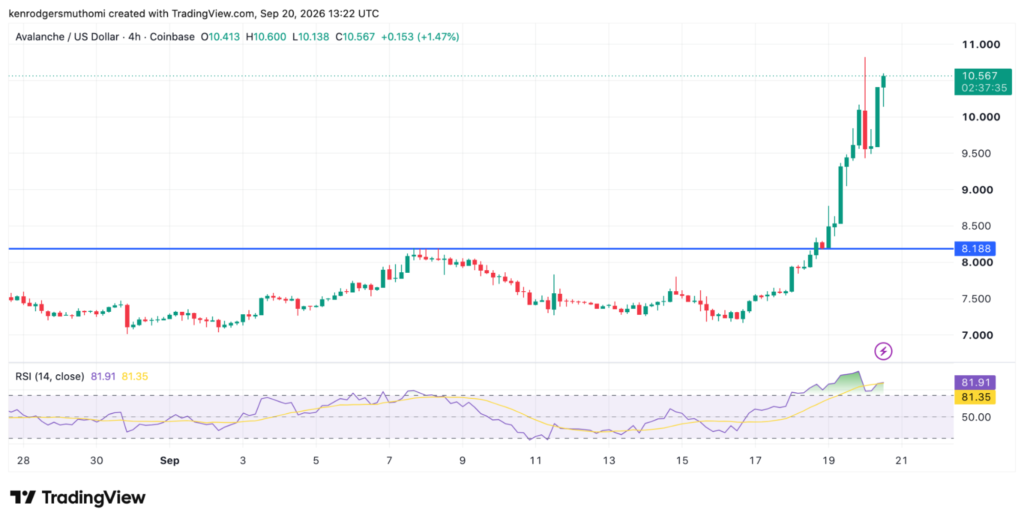
In particular, AVAX surged to about $10.57 following a break above resistance level of $8.19 on the four-hour chart. The rise was the continuation of its latest rally and saw $11 in the spotlight.
The buying momentum is quite strong. In the four-hour Relative Strength Index (RSI), the gauge is trading at 81.91, higher than the 70 level that is considered overbought territory. This highlights the extent of the latest surge but may indicate that there will be some profit-taking if the buying momentum weakens.
 Source: TradingView
Currently, $11 stands out as the next level for AVAX to break through, after which $11.50 and $12 will become the next levels to target. Otherwise, a drop from its current levels could take the token towards $10. Previously, $8.19 was a resistance level and will become a key support level in case of a pullback.
Institutional Adoption Shapes the Longer-Term Story
Avalanche is expanding beyond crypto-native applications as financial firms explore tokenized assets and custom Layer-1 networks. New York Life’s planned tokenized fund is one example, while ICE’s reported testing of Avalanche technology could open another path into financial-market infrastructure.
Centrifuge, Grove and Progmat are also building projects around tokenized assets and institutional finance. Progmat plans to migrate more than $2 billion in tokenized securities, adding to the value of assets being developed on or moved to blockchain networks. Other projects are working on institutional credit and Treasury products.
move from testing to live use could bring more financial activity to Avalanche. Higher network usage would also increase the role of AVAX in staking and fee payments, while transaction activity contributes to the token’s burn mechanism.
For now, much of the institutional activity remains at the testing or development stage. That leaves the scale and timing of adoption uncertain. Wider production use would provide a clearer measure of whether Avalanche can turn the recent institutional interest into sustained network activity.
Adoption Remains the Longer-Term Test
Avalanche’s expansion into tokenized assets and institutional settlement will depend on how much activity ultimately moves onto the network. Its customizable Layer-1 infrastructure could also support applications in areas such as payments, gaming, consumer services and finance.
The network offers fast transaction finality, compatibility with Ethereum-based applications and the ability to create application-specific Layer-1 networks. It is competing, however, with other blockchain platforms pursuing similar institutional use cases. Regulatory changes could also affect how quickly tokenized securities gain wider adoption.
AVAX has a maximum supply of 720 million tokens, while Avalanche burns transaction fees. Changes to staking rules can also influence the supply available in the market. Those mechanics make network activity an important part of the token’s broader economics.
The September rally has put Avalanche’s institutional projects and Helicon upgrade in focus. Whether that interest translates into sustained network growth will depend on the rollout of those projects, broader market conditions and actual on-chain usage rather than announcements alone.