

Key Insights
- A New York court has paused a lawsuit seeking control of 3.799 million BTC.
- The claim includes about 1.09 million BTC linked to Satoshi Nakamoto addresses.
- Legal challenges argue dormant wallets do not qualify as abandoned property.
Bitcoin ownership claims involving wallets linked to Satoshi Nakamoto have encountered a major legal obstacle after a New York court paused proceedings in a closely watched lawsuit. The case seeks legal title to 3.799 million BTC worth more than $200 billion and could influence how courts treat dormant digital assets.
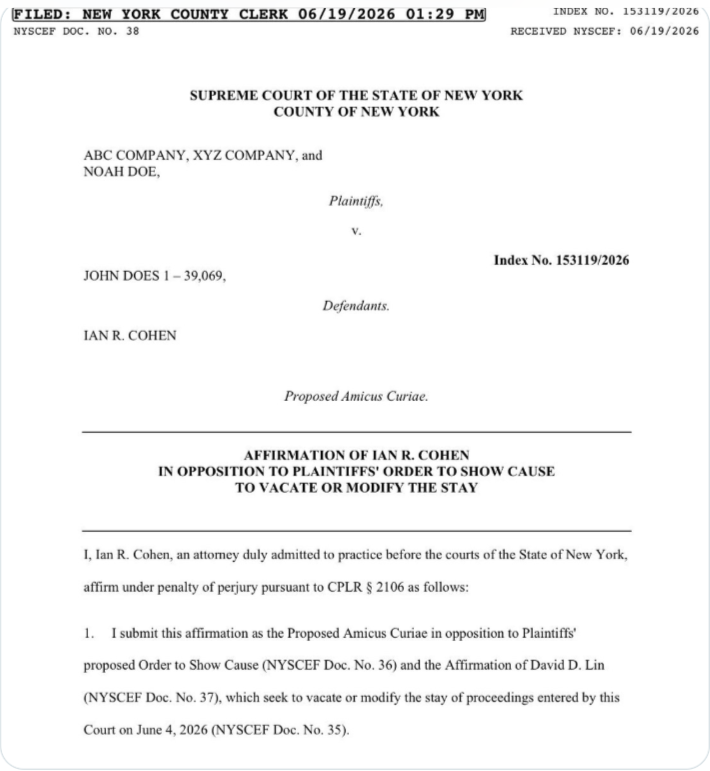
Galaxy Head of Research Alex Thorn disclosed that the court stay temporarily blocks plaintiffs from obtaining ownership rights while legal objections are reviewed. The ruling affects claims against thousands of wallet addresses, including those widely believed to belong to Bitcoin’s creator.
Court review freezes multi-billion dollar claim
The dispute began in March when anonymous plaintiffs identified as Noah Doe and two Wyoming-based entities filed a lawsuit in New York. They say that cryptocurrency wallets that have been inactive for a long time should be treated as lost property in Texas.
They filed for the rights to 39,069 wallet addresses with an estimated 3.799 million BTC. Among them are 21,744 addresses commonly associated with Satoshi Nakamoto, containing approximately 1.09 million BTC.
Case Snapshot
| Item | Details |
|---|---|
| Total BTC targeted | 3.799 million BTC |
| Estimated value | More than $200 billion |
| Wallet addresses involved | 39,069 |
| Satoshi-linked addresses | 21,744 |
| BTC in Satoshi wallets | About 1.09 million BTC |
| Court hearing date | July 14 |
The legal challenge intensified on May 29 when attorney Ian R. Cohen submitted an amicus brief opposing the lawsuit. Cohen argued that New York’s lost-property laws do not apply to self-custodied digital assets.
He also maintained that wallet inactivity does not prove abandonment. His filing states that the key control is the key to ownership.
Cohen was granted a hearing and a stay by Justice Kathy King on June 4. The halt in the decision meant that there was no default judgment or inquest until the court heard the objections.
Abandonment claims have been raised on the basis of evidence
Some of the wallet owners have already lost access to their holdings, plaintiffs say. In their argument, they claim dormant addresses must be considered abandoned property under New York law.
Cohen attacked both sides of that argument—in effect, the legal and the factual.
He pointed to blockchain records showing activity from some addresses identified as abandoned in the lawsuit. Those transactions indicate that individuals still possess access to the associated private keys.
Galaxy researchers reached similar conclusions. Thorn reported that Galaxy identified 52 named addresses that moved a combined 34,335 BTC. He added that 29 of those addresses transferred 12,302 BTC after receiving notice of the legal action.
That activity has become a central issue in the case. Critics argue that recent transfers undermine claims that the wallets were lost or inaccessible.
Cohen also wondered how practical it is to sue the pseudonymous wallet addresses. In his filing, the defendant could not be described as an identifiable person, making it hard for people who are impacted to defend themselves in court.
The attorney said that if the stay was lifted the plaintiffs could win ownership without any real opposition by obtaining a default judgment.
Digital assets are now being represented by a wide range of other organizations. Other entities are now representing digital assets too.
Wider Consequences for Digital Asset Ownership
The legal battle is seen as a precedent for how dormant cryptocurrency investments will be handled in the future by courts. If the plaintiffs win, it could set a precedent for other claims involving inactive wallets.
Industrialists have already sounded alarm.
Ripple’s Emeritus CEO David Schwartz has wondered whether a New York court has jurisdiction over the unknown owner of decentralized wallet addresses. One of the strongest points of the lawsuit against him is jurisdiction, he said.
The subject of the debate has also crossed over with the general topic of holding inactive cryptocurrencies. In a recent post, Binance founder Changpeng Zhao has proposed a new solution for network upgrades that are quantum-resistant.
In a recent post, Binance founder Changpeng Zhao has put forward a solution for quantum-resistant network upgrades that would force dormant wallet owners to perform transfers within a certain timeframe.
But any such change must be approved by the community at large, Zhao said.
The court stay, for now, is a huge blow to the plaintiffs’ case who want to claim dormant Bitcoin addresses. The July hearing will be a crucial one whether to continue the challenge or to encounter additional legal obstacles.
Conclusion
As a New York court suspended the lawsuit against wallets associated with Satoshi Nakamoto, it has now reached a critical turn. Plaintiffs are prohibited from acquiring legal ownership during the stay, and important objections are considered.
The case might set a precedent for digital asset ownership rights. The ruling could affect long-dormant BTC holdings for years to come.