
The concept of getting free cryptocurrency is gaining popularity in various blockchain communities. Most of them tend to hand out tokens to users in exchange for taking part in activities on the platform or as incentives for testing out the network. The increasing popularity of airdrops has also been linked to increased instances of fraudsters trying to take advantage of this trend.
Various forms of airdrop fraud have started surfacing among cryptocurrencies. They usually involve some kind of scam that appears like a legit offer of tokens to people, but actually involves stealing money or compromising someone’s wallet
What Is A Crypto Airdrop Scam?
An airdrop scam is an illegal scheme pretending to be a legal cryptocurrency airdrop. Scammers announce token giveaways for free on various platforms such as websites, social media sites, applications, emails, or even advertisements.
However, the aim is not to receive any tokens at all but rather to steal access to accounts, collect private information, or even have someone send their money. In many cases, victims believe they participate in legitimate campaigns alongside fraudsters.
The Major Features of Airdrop Scams
- Offers of free cryptocurrencies
- Demand for connecting the wallet to mysterious web pages
- Demands for sharing private keys and seed phrases
- Phoney advertisements on social media sites
- Coercion of users to take action while the deal is still valid
Methods Used in Airdrop Scams
There are several ways scammers use to dupe victims.
Websites for Airdrop Scams
The first scamming technique involves creating fraudulent websites resembling legitimate projects. The users are required to connect their wallet accounts in order to collect tokens. Such actions may result in vulnerabilities in smart contracts or potentially dangerous permission grants.
Phishing Schemes
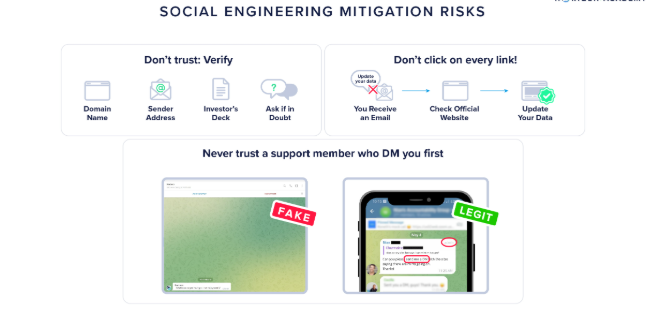
Fraudulent actors use various means of communication, such as direct messages, emails, social media publications, and web ads, in order to provide website links. Such websites mostly function as phishing schemes designed to access users’ wallet private keys.
Reputation Misappropriation
Fraudulent individuals pretend to be established cryptocurrency exchanges, blockchain projects, or prominent individuals. Some attacks even exploit hacked accounts.
Source: Horizon Academy
| Scam Approach | What It Entails | Associated Threat |
| Phoney Websites | Connecting wallets to the scam website | Wallet exposure |
| Phishing schemes | The visitor gets to the fake page | Credentials theft |
| Impersonating Social Media Accounts | Senders pose as a reputable individual | Loss of money |
| Advance Fees | Users make payments of crypto to receive something | Direct loss of crypto |
| Malicious Smart Contracts | Users grant malicious permissions | Misappropriation of money |
| NFTs with Malicious Links | Users receive NFTs which have a promotion link | Access to malicious pages |
Airdrop Scam and Unsolicited NFTs
Another approach involves sending users unsolicited tokens or NFTs. The unsolicited tokens may have links to external websites.
Users can come across these links while looking through their wallet history and investigating NFTs’ metadata. In some cases, phishing attacks occur where fake NFTs are released just after the official NFT release, with the intent of exploiting public interest.
Security advice recommends users from clicking suspicious tokens/NFTs that may pop up unexpectedly. Any attempt to sell or engage with them will increase user risks further.
Red Flags That Investors Need To Be Aware Of
Identifying such red flags will minimize the chances of being involved in any fraud.
Some Of The Common Warning Signs Are As Follows:
- Promise of unrealistic gains.
- Request for private key/recovery phrase.
- Demand for payment of cryptocurrency before the token is transferred.
- Asking for personal data.
Minimizing Risks in Joining Airdrop Activities
There are different measures that users can implement to minimize risks involved. They include:
Security measures
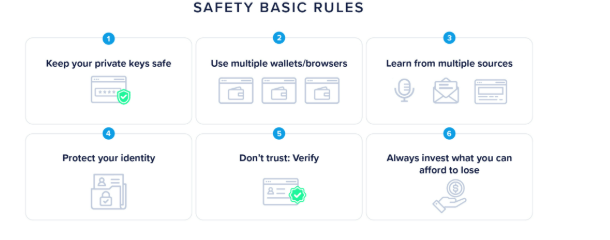
- Ensure that notifications come from authentic sources.
- Conduct some preliminary research about the project and its goals.
- Examine website before linking your wallet address
- Proceed with caution when confirming transactions prior to signing them off.
- Activate two-factor authentication whenever it is available.
Source: Horizon Academy
Using Different Wallets
There are crypto holders who use only testing wallets and airdrop wallets. They contain no large sums of money, which is why the possibility of losses in case of leakage is very low.
Securing Sensitive Data
Private keys and recovery phrases grant complete access to money kept in wallets. Security experts strongly recommend that users not share this information with anyone.
What Drives People to Develop Airdrop Scams
The rising popularity of airdrops as free promotions makes room for scammers who may target both novice and seasoned crypto enthusiasts. The more interested individuals become in cryptocurrencies, the more schemes they develop to exploit people.
These schemes are quite predictable and use techniques such as phishing websites, identity fraud, unrequested tokens, and misleading rewards, among others. To make their schemes work, scammers need to convince users of their legitimacy.
Conclusion
Airdrop scams continue to pose a danger in the world of cryptocurrencies. The most common tricks used by such scammers include fake websites, phishing schemes, impersonation, surprise NFT drops, and false rewards. Protection advice includes confirming data through credible sources, protecting your wallets, checking for permissions to execute certain transactions, and avoiding any newly appeared offers.
FAQs
What is an airdrop scam?
It is a form of fraud where users receive a reward of cryptocurrency to steal either users’ money or their sensitive information.
Is it required to provide your private key when using Airdrop?
Never. It is necessary to understand that a legit airdrop does not ask you to provide anything related to your identity.
How to handle unexpected NFTs or tokens?
One shouldn’t interact with it until one verifies the legitimacy of its source.