
Introduction to Cloud Mining begins with the explanation of cryptocurrency mining, without using any mining equipment. In cloud mining, computing power can be rented from companies that have their own mining farms.
In recent times, as Bitcoin mining has become extremely capital-intensive, cloud mining has emerged as an option for individuals interested in mining but who would like to avoid the hassles that come with it.
The principle here remains the same as in the mining process of Bitcoin and other cryptocurrencies. In particular, the Proof of Work method involves solving cryptographic puzzles using specialized equipment. The profits of such mining are shared between the customers who purchased mining contracts.
The economics of cloud mining have undergone a lot of change due to the recent bitcoin halving that happened in April 2024, in which the block reward was cut from 6.25 BTC to 3.125 BTC.
How Does Cloud Mining Work?
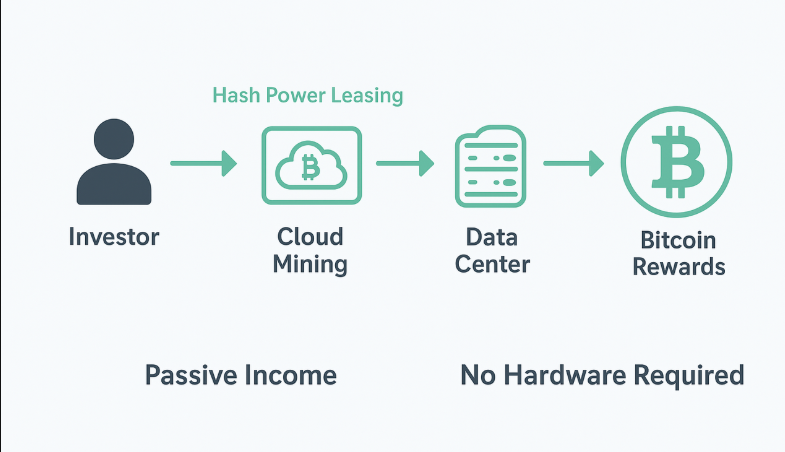
Mining companies lease computing power and conduct all activities like buying, maintaining the ASIC miners, covering electricity costs, etc. The user enters into a contract in which the leased hashing power, duration of the contract, and the cryptocurrency to be mined are agreed upon.
Source: Kucoin
The process usually involves the following:
- Choosing the right cloud mining firm and mining package.
- Payment for the mining package chosen.
- Assignment of the mining capacity of that service to one’s mining package.
- Receipt of mining reward directly into their cryptocurrency wallet.
The payments normally come periodically, and depending on several criteria, including the difficulty level of the network, total mining hashrate of the service, contract assignment, fee structure, and the block reward of Bitcoin.
Common Cloud Mining Process
| Stage | Description |
| Contract Purchase | The user chooses the type of mining and its term |
| Payment | The user pays for the mining contract |
| Hashrate Allocation | The provider allocates hashpower to the user |
| Mining Activity | Mining hardware is involved in mining process |
| Profit Distribution | The profits are distributed based on contract terms |
Cloud Mining after Bitcoin Halving
The Bitcoin halving in April 2024 changed the economics of mining. As block rewards were reduced, less Bitcoin was generated from mining.
The reaction of mining service providers has taken the following forms:
- Use of more advanced ASIC devices.
- Improvement of operational processes in the mines.
- Diversification into other infrastructural services.
- Enhancement of electricity management skills.
Moreover, contemporary mining equipment consumes less than 10 joules per terahash compared to about 20 joules per terahash consumed three years ago. In addition, according to market estimates, around 50%-55% of global mining activity uses energy derived from renewable sources.
Benefits that May Result from Cloud Mining
Cloud mining eliminates several demands placed on miners in traditional crypto mining. The user doesn’t have to purchase any hardware or worry about repairs, and can create a mining environment.
Some of the listed benefits include:
No Hardware Maintenance
Mining companies will handle maintenance, repairs, updates, and facility management.
Less Infrastructure
The user does not need to pay for cooling, electricity, or noise-reduction infrastructure, as is usually the case in home-based mining operations.
Flexible Participation
Shorter timeframes in many contracts provide users with participation without long-term hardware commitment.
Fraud Risks Remain a Major Concern
Cloud Mining would be incomplete without addressing the risks associated with the sector. Industry reports identified cloud mining as a significant source of cryptocurrency-related fraud during recent years.
More than $500 million worth of losses had been reported from cloud mining frauds during the year 2024. Several legal cases were initiated against operators who were involved in misleading people about mining operations or fraudulent investments.
The popular case was the one involving HashFlare, which operated from 2015 until 2019. It was found out that the operator had manipulated mining data provided to users.
These founders later pleaded guilty to charges involving the losses of around $577 million that investors incurred.
In addition, VBit Technologies was indicted by the Securities and Exchange Commission of the United States in December 2025 for defrauding in connection with a mining contract ponzi scheme that resulted in losses of $48.5 million for more than 6,400 individuals.
Red Flags That You Need to Be Aware Of
Some red flags that are associated with cloud mining regulatory cases include:
- A promise of guaranteed returns.
- No signs of actual mining.
- No details on how much is charged when withdrawing money from the mining account.
- Focusing too much on referrals.
- Unclear price policy.
Important Aspects for Investors
Generally, genuine cloud mining service providers provide information about their operations and agreements.
Characteristics Shared By Experienced Cloud Mining Service Providers
| Characteristic | Common Characteristic |
| Mining Activity | Mining Participation in Public Mining Pools |
| Operations | Details of the mining operation, along with audit reports |
| Charges | Posted rates |
| Compliance | Conducting KYC and AML tests |
| Infrastructure | Mining facilities |
Confirmation of the actual performance of mining through public mining pools is among the most important methods of verifying that mining operations are generating cryptocurrency earnings.
Future of the Cloud Mining Business
Cloud Mining Defined remains closely tied to broader trends in Bitcoin mining. According to one analysis, in as little as three years, some large miners may earn less than 20% of their income from mining as they expand into infrastructure-based operations.
Such changes occur on the heels of economic shifts driven by the Bitcoin halving and increased network competition. From the perspective of cloud mining participants, it is business models, transparency, and contract terms that matter most.
Conclusion
Cloud mining has continued to provide a different approach towards mining, where one is able to rent computing power instead of buying their own hardware. This approach removes several conditions necessary for carrying out normal mining. These conditions include having appropriate equipment, paying electricity bills, and managing facilities. Nonetheless, the industry has faced considerable cases of fraud that have involved fictitious mining schemes.
FAQs
What does cloud mining mean?
Cloud mining is basically a system where you can buy hashing power from another company and mine cryptocurrencies using no mining hardware yourself.
How is cloud mining income calculated?
Some factors will be used in calculating your mining income. The factors include hash rate, network difficulty, fee, and block reward.
How will the Bitcoin halving impact cloud mining?
The previous bitcoin halving happened in April 2024 when the block reward was cut from 6.25 BTC to 3.125 BTC.