

Key Insights
- The Bitcoin mining difficulty decreased by 10.09%, which is the second-largest drop in difficulty this year.
- The miner profits were negative due to the 15% drop in price during the month of June, which caused some hashpower to turn off.
- Several mining firms continue shifting infrastructure toward AI and high-performance computing operations.
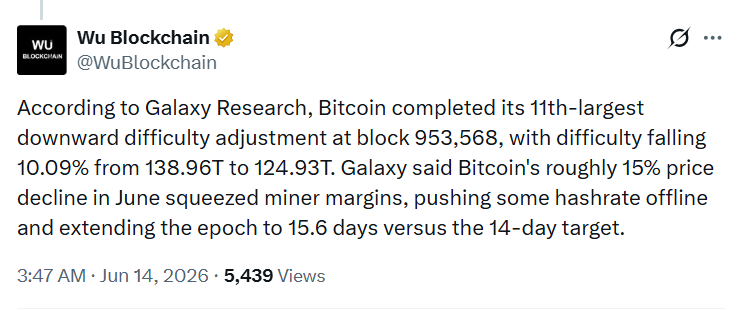
Bitcoin mining difficulty recorded one of its largest downward adjustments in recent history after lower prices reduced miner profitability and slowed block production. The network completed its latest retarget at block 953,568, lowering difficulty from 138.96 trillion to 124.93 trillion.
The 10.09% drop is the 11th biggest drop in history and the largest drop this year, according to data tracked by Galaxy Research and cited by WuBlockchain. The move followed a lengthy period of stalling block generation which stemmed from a drop in network hashpower.
Network rebalances, after extended mining cycles.
The mining difficulty is set to ensure that it takes an average of about 10 minutes for blocks to be mined. The protocol adjusts automatically every 2,016 blocks according to the number of computers that are securing the network.
The new adjustment came after a 15.6-day mining cycle. This was longer than the protocol goal of about 14 days, and indicated that blocks were being generated less quickly than they should have been.
If the production rate of the blocks on the network decreases, difficulty is lowered, which makes it easier for the network to find blocks. This works well because it lets the system run without going awry even if people don’t all participate.
Galaxy Research reported that the recent one is part of a trend during market downturns. As prices drop, mining reduces and some miners shut down machines, network hashpower decreases and difficulty drops to rebalance.
Profitability problems make adjustments in miner activity.
Many mining companies had their monthly reporting period in June be an unpleasant one. The research data indicated that Bitcoin prices fell by approximately 15% over the course of the month, thereby posing a threat to revenues and operating margins.
Some miners closed down the less efficient machines as profits declined.Overall, the network hashrate dropped as the number of active equipment was reduced, and block rewards are less competitive.
The slowdown was starkly illustrated by the length of the adjustment cycle. There were less machines clamoring for rewards and blocks were slower to be mined and the network would lower the difficulty level.
Analysts from the industry said the change wasn’t a sign of network security issues. Instead, it shows the automatic protocol response should there be a change in mining participation.
Important persons from the recent change
- Difficulty fell from 138.96T to 124.93T
- The reduction measured 10.09%
- It took 15.6 days to mine the epoch.
- The drop is the 11th-worst in network history.
- It is the 2nd most significant decrease in 2026.
Active operators may be able to receive some revenue relief.
Lower difficulty could lead to better miner returns for those staying online. A less competitive environment means that the active participants might be able to produce more rewards with the same amount of computing power.
Industry estimates put hashprice above $30 per petahash per second as a result of the adjustment. Efficient operators with good electricity rates have better revenue opportunities with a higher hashprice.
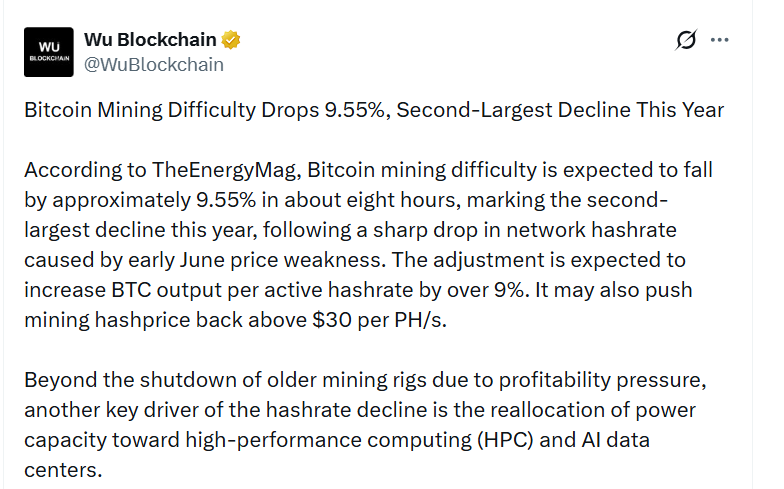
But benefits are not likely to be equally shared within the sector. Older mining companies continue to be at risk for further price declines or higher energy costs.
The adjustment is an interim fix that won’t address any underlying profitability issues. Operating decisions will remain to be driven by market conditions throughout the industry.
AI’s impact on the mining industry is ongoing.
The increasing demand for AI infrastructure is also a factor impacting the sector. Some of the mining firms are investing in high performance computing centers.
Home to a massive AI data center campus, Core Scientific is set to turn its Pecos, Texas mining operation into a major facility. Around 300 megawatts are being repurposed by the project for the mining operations.
TeraWulf’s high performance computing hosting revenue for the first quarter of 2026 was $21 Million. That was higher than its mining revenue at that time.
In the meantime, HIVE Digital said it is building a 320-megawatt AI infrastructure project in the vicinity of Toronto. The plant will have more than 100,000 graphics processing units.
The developments are part of a wider trend for companies to find new income streams, other than traditional mining, to boost revenue.
Conclusion
Bitcoin’s daily difficulty is going through an important downward adjustment following a decline in market activity and lower participation by miners. The 10.09% decrease is due to the built-in solution of the network which adapts to different levels of hashpower.
The adjustment could make it more favourable for the efficient operators, but profitability is dependent on market performance and energy costs. At the same time, the continuing development of AI and high-performance computing activities is evidence that many mining companies are moving into other business models as the industry transforms.