Decentralized finance is a crypto ecosystem that comprises many decentralized exchanges, lending services, yield farming, and liquidity pools. With each new protocol entering the market, it is possible that customers will need to find out the best way, price, and fees for any given transaction.
Moreover, it is here that the DeFi aggregators step into the scene. This kind of platform serves as an aggregator of liquidity, prices, lending interest rates, and yields. Users can view all available protocols and can even transact on the best route software algorithms and smart contracts.
What is a DeFi Aggregator?
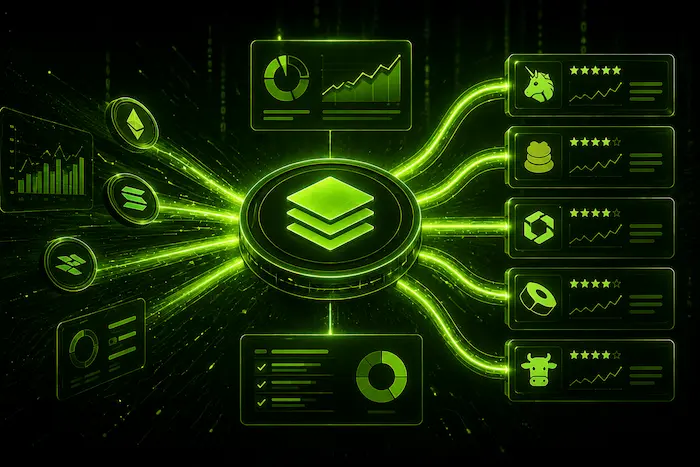
A DeFi aggregator is a platform that integrates with various DeFi protocols and streams all the data to be displayed in the dashboard.
The main purpose is to enable users to discover the most efficient options for activities like swapping tokens, lending, borrowing, staking, and yield generation.
DeFi aggregators do not depend on a single decentralized exchange platform or lending protocol, but instead, they will look around various platforms and opportunities on the market and choose a path on which to act.
The process enables users to interact with several liquidity providers without having to do an in-depth search on different platforms.
The most well-known functions of DeFi Aggregators include the following:
- Compare various exchanges for the best token price
- Find available liquidity pools
- Compare the interest rates for loans.
- Find yield farming possibilities.
How Do DeFi Aggregators Work
DeFi aggregators continuously monitor the market for information about different liquidity pools, lending protocols, and DEXs.
The data may include:
- Token prices
- Liquidity available
- Interest rates
- Opportunities to earn yield
- Transaction fees
Once such data has been collected, the aggregator applies a routing algorithm to figure out how best to execute the transaction.
Additionally, someone who is trading one token for another, for example, may be able to receive a better price by executing the transaction using several pools of liquidity instead of just one exchange.
DeFi Aggregators and Market Fragmentation.
As decentralized finance grows, liquidity has spread across various protocols. However, if the aggregation tools weren’t present, users would have to do the comparison by themselves between exchanges, lending platforms, and farming opportunities before deciding.
Defi aggregators solve this challenge by combining various liquidity pools in a unified interface.
It has emerged to become a core pillar of the entire Defi ecosystem, and Defi aggregators will go on to play an integral role in the Defi phenomenon.
Transaction Process
- User submits a transaction request.
- The aggregator scans supported protocols.
- The liquidity, prices, and fees are compared.
- The optimal route is selected.
- Smart contracts carry out the transaction
DeFi Aggregators vs Individual DeFi Protocols.
| Feature | Individual Protocol | DeFi Aggregator |
| Liquidity Source | Single platform | Multiple platforms |
| Rate Comparison | Manual | Automated |
| Trade Routing | Limited routing | Optimized routing |
| Difficulty | Easier | Harder |
| Slippage Reduction | Limited | Improved through aggregation |
| Access to Opportunities | Single shot-per-protocol | Multiple protocols simultaneously |
Types of DeFi Aggregators
Various aggregators specialize in different aspects of decentralized finance.
DEX Aggregators
DEX aggregators specialize in token swaps. They pull off liquidity from many different decentralized exchanges in the hope of finding the best trading route.
Some firms cited in DeFi include 1inch and Matcha.
Yield Aggregators
Yield Aggregators make it easier to transfer assets from staking to lending and farming opportunities.
Some examples are Yearn Finance and Beefy Finance.
Lending Aggregators
Lending aggregators analyze the lenders’ and borrowers’ rates on different protocols and pinpoint any available opportunities for borrowers to access these platforms without having to individually check each one.
The advantages and disadvantages of DeFi aggregators.
DeFi aggregators, similar to other decentralized finance technologies, have advantages and disadvantages.
Potential Benefits
- Savings in comparing protocols.
- Multiple liquidity sources are available.
- Optimized routing leads to less slippage.
- Simplified user experience
- An increased flow of lending and earnings prospects
Potential Risks
- Smart contract vulnerabilities
- The frequent change in market conditions influences the price.
- The need for third-party services.
- Additional costs for complex trades
- Some services may have potential for centralization risk.
Cross-Chain Development and Future Growth.
As a result of the development of decentralized finance (DeFi), the trend of connecting liquidity between blockchain networks is becoming more relevant.
The future of DeFi aggregators implies increased interoperability that will enable users to use services and assets available on other blockchains without moving from one application to another.
With the growth of the DeFi ecosystem, aggregators become important mediators that will help people discover many markets and participate in different services without leaving one platform.
Conclusion
By combining liquidity, pricing, lending rates, and yield opportunities across various protocols, DeFi aggregators are a crucial piece of the DeFi ecosystem. These platforms streamline accessing decentralized services, while also enabling users to compare options more efficiently, through their data collection, smart routing and blockchain-based execution.
FAQs
What is DeFi Aggregator?
DeFi aggregators represent platforms that compile data and liquidity provided by different DeFi protocols and show them in one place.
Is it possible to make use of DeFi aggregators solely for trading purposes?
Absolutely not. There are also specialized DeFi aggregators focusing on token swap, loan and lending, staking, yield farming, etc.
What are the possible risks involved when using DeFi Aggregators?
There are smart contract risks, changes in market conditions, extra transaction fees, and third-party risks.
What are some examples of DeFi Aggregators?
Some examples cited are: 1inch, Yearn Finance, Matcha, Beefy Finance and Zapper.
Disclaimer: This article is for informational purposes only and not financial advice. Cryptocurrency investments involve risk. Always conduct your own research and consult a qualified financial advisor before investing.