
The use of public blockchains allows one to analyze transactions in such networks since transactions in public blockchain networks are known to everyone.
A dust attack is when tiny amounts of cryptocurrencies, referred to as dust, are sent to numerous addresses. While initially, this might seem like a trivial act, there is something deeper that attackers aim for.
The attackers could perform blockchain analysis to determine if the receiver of the dust interacts with the funds and connect other wallets belonging to the same user.
This attack has been carried out on various public blockchains like Bitcoin, Litecoin, and BNB Chain because all transactions on these chains are visible on the internet.
What is Crypto Dust?
In the crypto world, “Dust” refers to small amounts of coins or tokens that hold negligible value and are not even worth a cent.
Dust comes naturally after a transaction has been made. Moreover, it’s held in the exchange wallet from uncompleted trading orders with small balances left over.
Within the Bitcoin network, dust is closely associated with transaction costs.
Bitcoin Dust Thresholds
| Transaction Type | Dust Limit |
| Standard Bitcoin Transaction | 546 satoshis |
| Native SegWit Transaction | 294 satoshis |
Bitcoin Core generally considers transaction outputs below these thresholds as uneconomical to spend because transaction fees may exceed their value.
Transactions below the dust threshold are considered spam and may be rejected by validators.
Dusting Attacks in Cryptocurrency
A dusting attack starts by transferring small amounts of cryptocurrency to many wallet addresses.
Receivers do not even realize they receive money, since the amounts are so small. After that, attackers observe further activity on the blockchain and determine whether the dust transaction aligns with other transactions.
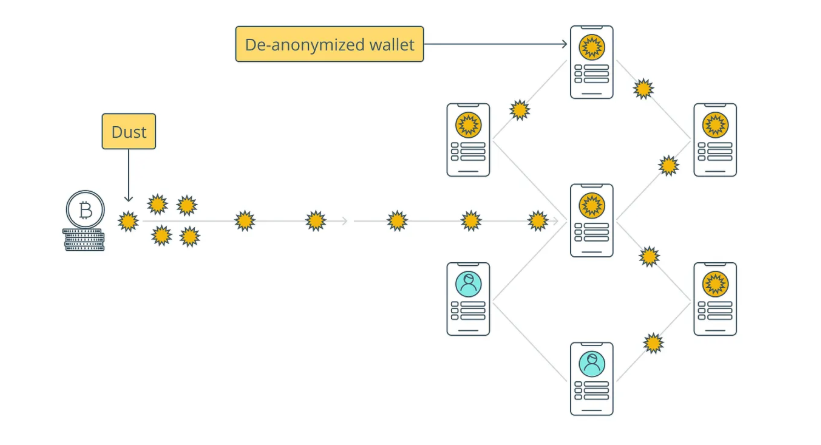
Source: Medium
Once the dust transaction is used, blockchain analysis can trace relationships between addresses.
The steps involved include:
- The attackers will send dust to many different wallet addresses.
- The recipients will unknowingly hold on to the dust or spend it.
- The transactions of the dust will be analyzed by blockchain analysis tools.
- Other wallet addresses will be connected.
- The attackers try to determine who owns the wallet.
How effective this attack is will depend on how transparent public blockchains are.
Why Attackers Conduct Dusting Attacks
The main reason why attackers launch dusting attacks within cryptocurrencies is to obtain information about wallet users. This is accomplished by associating various wallets with one person based on transactions.
Samourai Wallet developer stated that there are different reasons why the attacker conducts dusting campaigns:
Common Goals
- De-anonymization of wallet address
- Monitoring transactions
- Surveillance of finances
- Phishing operations aimed at targets
- Social engineering attacks
- Ransom threats against the identified owner of funds
After the identification of an individual’s association with activities on the blockchain network, the criminals may use this data against their victims via various cybercrimes.
Historical Examples of Dusting Attacks
One of the more widely reported cases occurred in October 2018. Developers of Samourai Wallet announced that some users were experiencing dusting attacks.
The wallet provider later introduced tools that allowed users to identify suspicious dust transactions and prevent those funds from being spent alongside regular holdings.
An additional case occurred in October 2020 on BNB Chain.
During the attack, the attackers used phishing sites for their attack and made use of small amounts of BNB by sending it to several wallet addresses through linking the phishing site using the memo field of the transaction.
How Users Can Limit Exposures
Although dusting attacks cannot cause losses in crypto, there are ways to minimize their effectiveness.
Privacy Steps
- Do not deposit any sudden dust payments.
- Ensure that wallets have features that detect any suspicious transaction attempts.
- Generate a fresh address for each payment transaction.
- Ensure you have good security measures on your account.
- Be careful with messages sent to you.
In addition, some crypto wallets can even freeze or flag transactions as suspicious in an effort to prevent attackers from analyzing your spending habits.
Dusting Attacks and Privacy
The case of dusting attacks in crypto is one such instance where small amounts of transactions that take place within blockchains can be exploited for large-scale traceability efforts.
In order to trace the activities of the users of wallets, criminals try to match the addresses by sending them small amounts of cryptocurrency.
Several past examples of Bitcoin holders, Samourai Wallet users, and BNB Chain members becoming victims of dusting attacks demonstrate how the approach was used across different blockchain platforms.
Conclusion
Dusting attacks are good examples of how even a minimal transaction in cryptocurrencies can be leveraged to obtain information about public blockchains. By sending small amounts of crypto assets to many wallets, attackers seek to trace addresses to a single owner and reduce users’ privacy.
Frequently Asked Questions
What is a dusting attack on cryptocurrency?
A dusting attack is where hackers send minimal quantities of cryptocurrency to several wallets.
Is there any possibility that a dusting attack could help steal cryptocurrency?
No, because dusting attacks are mainly conducted to track cryptocurrency wallets and are therefore not conducted with the intention to steal anything.
Which cryptocurrencies are susceptible to dusting?
Any cryptocurrencies, such as Bitcoin, Litecoin, BNB Chain, Bitcoin Cash, etc., using public blockchain technology can be subjected to a dusting attack.
How do you protect yourself from crypto dust?
To avoid any dusting attacks, one must avoid spending dust and monitor transactions made in their wallet.
Why do public blockchains allow for dusting attacks?
Public blockchains give complete visibility of all transactions made.
Disclaimer: This article is for informational purposes only and not financial advice. Cryptocurrency investments involve risk. Always conduct your own research and consult a qualified financial advisor before investing.