
Over the last ten years, cryptocurrency trading has gone through a surge in popularity and several trading platforms have surfaced to enable transactions in cryptocurrencies and digital assets.
These platforms include lesser-known exchanges in the crypto world, called “nested exchanges,” which have been a source of concern for regulators and compliance experts as they provide a way to transact digital assets within the larger trading platforms.
Regulated exchanges will do Know Your Customer (KYC) and Anti-Money Laundering (AML) checks before users can trade; many nested exchanges will let users access crypto services with little to no verification.
The model is to open an account on a big cryptocurrency exchange and provide trading services to third parties using those accounts. Financial crime risks, transparency and custody concerns have been raised by regulators and compliance experts about the set up, which could make it easier for people to access the digital asset market in areas where infrastructure is lacking.
What is a Nested Exchange?
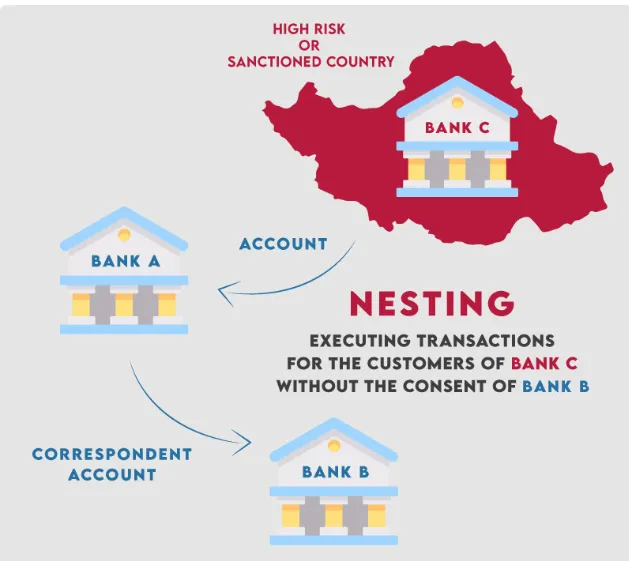
Nested exchange is a type of cryptocurrency exchange that doesn’t have direct access to banking services or liquidity providers, but instead trades within accounts established by a larger exchange.
Source: Gate Learn
The architecture is similar to that of traditional finance correspondent banking. That system is one in which a financial institution relies on another bank’s infrastructure for its customers’ transactions. However, a nested exchange acts as a middleman between a user and a larger cryptocurrency exchange.
The process involves a few steps:
| Step | Activity |
| 1 | A nested exchange opens an account with a larger exchange |
| 2 | Customers put money into the nested platform |
| 3 | Customer money is commingled. |
| 4 | Trades are made in the bigger exchange account |
| 5 | The nested platform manages customer balances internally |
Consequently, the larger exchange will generally have activity from an individual account rather than from individual users.
What is the reason for Nested Exchanges?
Nested exchanges are typically used in markets where access to the larger exchanges is restricted.
The services may be available to users who experience any of the following:
- Geographic barriers
- Limited banking infrastructure
- Regulatory restrictions
- The absence of exchanges in the world
Nested exchanges can offer cryptocurrency services that may not be available elsewhere to local users, and by linking local users to larger exchanges. Certain operators may have multiple accounts across various exchanges, enabling customers to choose from a variety of exchanges.
Although the utilization of nested exchanges may be convenient for accessing cryptocurrency exchanges, there are several risks associated with the structure.
Loss of Funds
The user transfers the assets to the platform. In the event that the exchange is closed by the authorities, or it is not possible to recover the deposited funds due to operators discontinuing activity without notice, customers may not be able to access their money.
Legal Exposure
An illegal money handling platform can cause legal problems. Financial regulations and sanctions requirements can be violated in exchanges that can be investigated by authorities.
Criminal Activity Risks
According to Gate Learn, some exchanges have been connected with ransomware payments, fraud, hacks, and financing terrorism. These platforms may be appealing to bad actors, as they are not verified by customers.
Regulatory Shutdowns
There have been prosecutions of non-compliant exchanges in several jurisdictions. Abrupt enforcement actions may leave customers without access to assets on affected platforms.
Nested Exchanges vs. Decentralized Exchanges
Once you look at nested exchanges and decentralized exchanges (DEXs) you might think they look alike as they can both enable users to trade without going through identity verification procedures.
| Feature | Nested Exchange | Decentralized Exchange |
| Custody | Platform holds customer funds | Customers own their assets |
| Trade Execution | using different smart contracts and liquidity pools | with various smart contracts and liquidity pools. |
| Transparency | transactions are performed are limited | Transactions are observed on-chain. |
| Identification | Usually required | Usually not required |
Nevertheless, it’s the custody and transparency that make the difference. With DEX, users never lose control of their assets during the transaction and with a nested exchange, funds are managed and processed by the exchange itself.
SUEX Cryptocurrency Exchange
The most common case of a nested exchange is SUEX OTC.
SUEX was the first cryptocurrency exchange ever sanctioned by the U.S. Office of Foreign Assets Control (OFAC), on 21st September 2021. The exchange reportedly did not provide extensive customer verification protocols and ran through accounts on big platforms.
According to Chainalysis’s data, a major share of SUEX’s transaction volume was linked to ransomware proceeds and hacking transactions.
Following the sanctions designation, Cryptocurrency Binance deactivated accounts associated with SUEX. A related platform, Chatex, was later sanctioned as well. The case became an important example of regulatory scrutiny involving nested exchange operations.
How Users Can Identify Nested Exchanges
Nested exchanges rarely advertise their operating model. But there are a few things that can alert users to them.
The common signs are:
- No verification requirements for KYC.
- There are not many details available regarding how trades are executed.
- Multiple Venue aggregated rates.
- No disclosures of licensing or regulations.
- Unclear jurisdiction information
Users can also check wallet transactions using blockchain explorers. If assets are moving directly to wallets of the larger exchanges instead of being kept in the service infrastructure, then it might be a nested service.
Users can assess several factors before depositing money into any cryptocurrency platform:
- Identity verification requirements
- Regulatory disclosures
- Security practices
- Clarity of execution of trades
- The company’s standing in the industry.
- The company’s reputation in the industry.
Conclusion
Nested exchanges work by offering cryptocurrency trading services on accounts that are hosted with larger exchanges. The model can provide access to digital asset markets in areas where the infrastructure is lacking, but it also brings forth custody, transparency, compliance and regulatory risks.
FAQs
What’s a nested exchange?
It’s a crypto exchange that uses accounts from a bigger exchange service for trading.
Why get regulatory attention to nested exchanges?
There have been concerns regarding transparency, customer verification and the potential for these platforms to be misused in illegal financial activity.
Are the nested exchanges same as decentralized exchanges?
No! Decentralized exchanges enable users to have control over their assets whereas nested exchanges have custody of their customers’ money.