Key insights
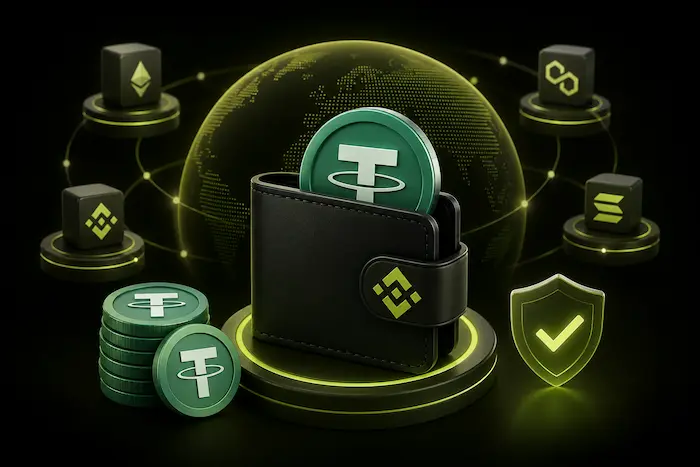
- Binance Wallet facilitates USDT gas payments on BNB Smart Chain, Ethereum, Solana and TRON.
- With Binance Exchange balances, there are more options to pay for transactions.
- Binance has announced more integrations on the network, but has so far not specified which chains it will integrate or when.
Binance Wallet now enables USDT gas payments for four blockchain networks, meaning that users can now pay gas fees using USDT on these networks without having to hold the corresponding gas tokens. The feature will include BNB Smart Chain, Ethereum, Solana, and TRON, and Binance is working on other network integrations, announced on September 25.
The update fixes a widespread problem in cryptocurrency transactions. Sometimes users have enough tokens to make transfers but they don’t own enough native tokens to cover the blockchain fees. As such, they may have to obtain or transfer extra tokens for the transaction to be completed as it should be.
Binance Wallet users now have the option to pay eligible network fees with USDT. The company hasn’t given a timeline for additional blockchain support.
Four networks announce an alternative method of fees.
Binance’s updated support documents lists four networks where Binance Wallet can be used for USDT gas. In each of these blockchains, users had to keep their respective native tokens to pay transaction fees.
Binance Wallet Removes Native Gas Token Requirement With USDT Payments
Binance Wallet now allows users to pay gas fees with USDT on BNB Smart Chain, Ethereum, Solana and TRON, removing the need to hold each network’s native gas token before making transactions. Binance said… pic.twitter.com/6YCUDWL4Bd
— Wu Blockchain (@WuBlockchain) September 28, 2026
The following networks are supported.
- Typically a chain that will need BNB for transaction charges.
- Ethereum, the platform where the majority of users pay gas fees with ETH.
- Solana, which charges transaction fees with SOL.
- TRON, transactions are based on TRX and network resources.
The new option allows users with USDT balances to fund eligible network fees directly. However, Binance has not confirmed whether every transaction type supports the payment method.
The company calculates network fees according to prevailing blockchain conditions. Therefore, charges can fluctuate with transaction demand and network congestion.
Ethereum and other Ethereum Virtual Machine networks can experience higher fees during periods of increased activity. Solana fees also vary with network conditions, although its transaction costs follow a different structure.
On TRON, users rely on bandwidth and energy resources to process transactions. When available resources cannot cover a transaction, the network may burn TRX to cover the remaining cost.
Exchange balances provide additional payment options
Binance Wallet also allows eligible users to cover network fees through supported balances held in their Binance Exchange accounts.
According to the support guide, users can select eligible Spot, Funding, or Earn balances when choosing the fee payment method. It supports the assets BNB, USDT, USDC, ETH, and SOL on eligible networks.
This is an alternative for those that do not have enough USDT in their self-custody wallets.
For those who don’t have the required exchange accounts, Binance provides several other options. These can include transferring the necessary gas token to Binance Exchange, receiving tokens from a different wallet, or buying supported assets with a bank card.
Furthermore, qualified users are able to withdraw BNB from their Spot or Funding account to pay fees on BNB Smart Chain, Ethereum and opBNB. Binance requires more than 0.01 BNB in the relevant account before users select this option.
However, users must still select the correct blockchain when transferring assets. Binance warns that sending assets through an incompatible network can make recovery difficult or impossible.
The payment update is not to eliminate blockchain fees; instead, it’s to alter the way that users will cover transaction costs. The fees to process transactions are still paid to network validators and others.
Binance also states that network fees do not go directly to the company. Separate service charges may still apply to certain wallet products, including swaps.
TRON promotion adds temporary fee relief
The USDT payment rollout follows a separate promotional campaign targeting TRON transactions.
The promotion was initiated by Binance Wallet on September 23, giving wallet users who adhere to the conditions zero gas fees to transfer USDT and other TRC-20 tokens.The campaign runs through December 22, 2026, with support from TRON DAO.
The offer remains subject to available campaign spots. After the promotional period, Binance says qualifying transfers will receive a discounted fee of 1 USDT per transaction.
The promotion differs from the broader USDT gas payment feature. The four-network option changes the asset users can select to pay network charges, while the TRON campaign temporarily reduces eligible transfer costs.
Binance wallet is moving toward transactions.
Since renaming the Binance Web3 Wallet in December 2024 Binance has expanded its self-custody wallet services. The company has made changes, to how users manage their assets and navigate their wallets.
Binance also suspended trading fees for eligible wallet transfers in February 2025, but users had to cover blockchain gas fees. Later the company added more wallet functions, such as trading and integration with decentralized applications.
Binance Wallet’s application and web interface launched perpetual futures trading in April 2026. In May, it added Event Rush on BNB Chain, enabling users to buy and sell tokens that are related to the events with USDT.
This has been expanded in the latest update to include transaction fees as well. However, Binance has not announced which other networks will gain support for gas payment for USDT or when this will happen.