
Key insights:
- ZachXBT may automatically reject cases from several countries through his planned support website.
- He says weak cooperation from authorities makes some investigations inefficient and difficult to resolve.
- Country restrictions could create a wider debate about access to private blockchain investigation services.
ZachXBT crypto investigations could become harder to access for victims across several countries under a proposed screening system. The blockchain investigator said Saturday that his upcoming website could restrict cases based on jurisdiction and previous investigative experiences.
The proposal could affect victims in Canada, the UK, India, Nigeria, Morocco, Algeria and Bangladesh. However, ZachXBT framed the restrictions around institutional cooperation rather than allegations against individual victims.
New website could screen cases by location
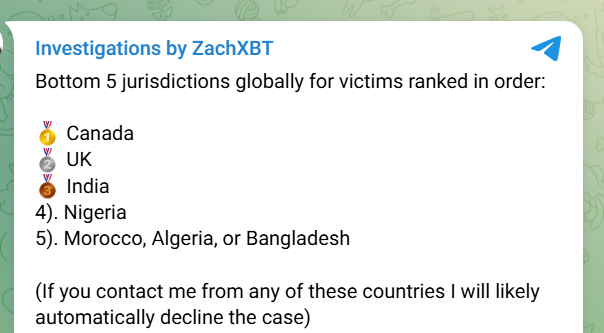
ZachXBT outlined the plan through his Telegram channel while discussing the website’s forthcoming support system. The platform would handle case reviews, scam recovery assistance, investigations and on-chain analysis.
However, the investigator said he wants greater control over which requests receive his time and resources. Geographic screening could become part of that selection process.
He ranked Canada, the UK, India and Nigeria among jurisdictions where he would least likely accept cases. He also placed Morocco, Algeria and Bangladesh in another low-ranked group.
The proposed system could automatically reject requests originating from countries included in those categories. That approach would represent a significant change in how victims reach the independent investigator.
The announcement quickly attracted criticism. His Telegram post received more than 1,000 negative reactions as users debated the proposed restrictions.
ZachXBT also alleged that users connected with one listed country manipulated reactions through automated accounts. That allegation has not been independently established.
India and Canada draw sharper criticism
ZachXBT crypto investigations have previously involved cases requiring cooperation with police, exchanges and other institutions. He cited those experiences when explaining his dissatisfaction with India.
The investigator alleged that Indian authorities mishandled several cryptocurrency cases. He referenced efforts involving frozen assets and funds associated with North Korea-linked Lazarus Group activity.
He also claimed authorities once arrested cryptocurrency exchange founders after confusing a phishing website with a legitimate platform. His examples represent his account of those cases rather than independent findings about Indian law enforcement.
Canada received particularly strong criticism from the investigator. ZachXBT argued that authorities sometimes failed to act after receiving detailed evidence about suspected criminals. He also described Toronto as a significant center for fraud activity. Additionally, he criticized authorities over their handling of the TradeOgre seizure.
ZachXBT argued that legitimate users became caught in that enforcement action. He said authorities struggled to distinguish lawful cryptocurrency activity from suspected illicit transactions.
In June, he had already said he would reject cases from Canadian victims. He cited previous investigations where authorities allegedly failed to respond adequately to evidence.
Private investigators confront jurisdiction barriers
The dispute highlights a structural problem facing ZachXBT crypto investigations and other cross-border blockchain cases.Criminal investigations are still limited to national jurisdictions while cryptocurrency is able to travel across borders in just minutes.
Any third party can follow the movement of data on public blockchains. Typically, it takes cooperation from exchanges, courts, police or other intermediaries to recover assets, though. Therefore, just the evidence is not enough to ensure that victims can get their cryptocurrencies. Wallets can be identified that don’t have a legal basis for investigators to freeze and seize their contents.
ZachXBT seems to be wanting his new platform to focus on cases that have a more viable institutional option. The latter method might be able to save investigative resources, but geographic limitations raise different issues.
In the event of a victim of the crime, they have little control over the effectiveness of their local authorities. It would therefore be possible to block entire jurisdictions, denying assistance to users other than those who are legal users, based largely on their address.
Proponents of selective screening believe that investigators should focus on cases with evidence that will yield results. Critics argue that victims should not bear responsibility for government shortcomings.
Country screening raises wider questions
ZachXBT crypto investigations have gained visibility because blockchain evidence can connect transactions across exchanges, wallets and decentralized platforms. That capability has made independent investigators increasingly important during major cryptocurrency thefts.
Yet the proposed restrictions show the limits of private investigative work. While blockchain transparency can uncover paths of transactions, it cannot take the place of formal law enforcement powers.
The debate also sheds light on the question of limited resources allocation in independent fraud services. Unlike public agencies with statutory duties, a private investigator has discretion in which cases to take on. But there is a risk of reputation and fairness issues when there are general country-wide restrictions. They may also complicate cooperation between investigators and legitimate victims operating within those jurisdictions.
For cryptocurrency companies, the dispute reinforces another problem. Effective fraud response increasingly depends on coordination between private analysts, exchanges and government authorities.
That coordination becomes more important as stolen funds cross borders and move through multiple services. Weak cooperation in one jurisdiction can disrupt recovery efforts elsewhere.
Conclusion
ZachXBT crypto investigations could become substantially more selective when his planned support website launches. His proposed country screening reflects frustration with authorities he considers ineffective in handling cryptocurrency crime.
However, the restrictions would affect victims rather than government agencies directly. That distinction will likely remain central to criticism surrounding the proposal.
The final structure of the website remains uncertain, including how strictly geographic restrictions will operate. Yet, the proposal reflects the increasing conflicts between a globally interconnected blockchain traceability and nationally disparate enforcement regimes.