
Key insights
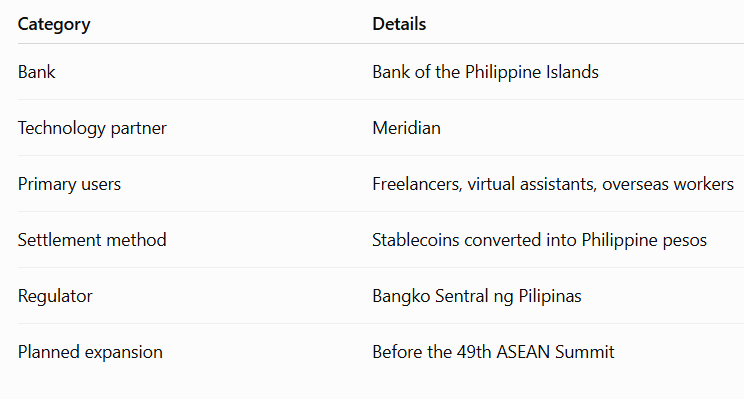
- The BPI stablecoin pilot involves the blockchain during settlement, but customers are still allotted Philippine pesos via the traditional bank account.
- Regulatory oversight continues to be the core, and expansion is linked to consumer protection, transparency of the reserves and compliance with the regulations regarding the use of stablecoins.
- If the pilot initiative is successful before the ASEAN Summit, it could be a template for other banks in Southeast Asia in the region.
The Philippine banking industry’s digital transformation continues with the launch of blockchain-based settlement rails for cross-border payments through BPI’s pilot project for stablecoins. The plan is to lower the cost of transferring money and the time it takes for freelancers, virtual assistants, and expatriates who earn money overseas to receive it, while maintaining the regulated banking system in this country.
The Bank of the Philippine Islands started experimenting with a settlement system using a stablecoin in a partnership with Meridian, a global digital clearinghouse, according to ABS-CBN and the Philippine Daily Inquirer. It will use stablecoins for the incoming international payments before it can convert the amounts into Philippine pesos and deposit them into the customer’s BPI account. The lender anticipates to grow the service before the 49th ASEAN Summit in November, provided regulatory approval is given.
Bank moves stablecoins into regulated banking
The BPI stablecoin pilot will initially support payroll transfers and overseas earnings received by freelancers, virtual assistants, and workers operating outside traditional employment structures. Instead of replacing existing banking infrastructure, the system uses stablecoins only during settlement before delivering local currency directly into customer accounts.
BPI President and Chief Executive Officer Jose Teodoro Limcaoco said the initiative extends the bank’s digitalization strategy by allowing overseas recipients to receive money faster and at lower cost without compromising security.
Meridian President and Chief Executive Officer Will Haering said the partnership demonstrates that stablecoin technology can operate within regulated banking while maintaining customer protection and operational reliability.
The pilot will proceed under the supervision of the Bangko Sentral ng Pilipinas. Any nationwide expansion will depend on consumer protection measures, reserve transparency, and compliance with future stablecoin regulations.
Key project details
Regulatory framework is constantly changing.
The BPI stablecoin pilot follows the tougher guidelines by Philippine regulators regarding digital assets.
The Bangko Sentral ng Pilipinas (BSP) in June launched tougher rules for licensed virtual asset service providers. The central bank asked exchanges to enhance due diligence procedures and evaluate the credibility, liquidity, transparency, legal compliance, and the operational aspects of the cryptocurrencies before listing them.
The guidance also emphasized more on fiat-backed and asset-backed stablecoins. Providers should consider the composition of the reserves, redemption rights, issuance processes, and the assets that back the listed tokens, and should constantly monitor them.The regulator also maintained its prohibition on privacy coins for licensed virtual asset service providers.
Meanwhile, the Philippine Securities and Exchange Commission has expanded testing through its Strategic Regulatory Sandbox. The program now includes tokenized real estate projects, investment products linked to United States equities, and crypto-related services.
Earlier this month, BlockShoals received final approval to begin StratBox testing with Binance serving as its global crypto-asset service provider partner. However, the Bangko Sentral ng Pilipinas clarified that neither company currently holds a Philippine virtual asset service provider license. The central bank also emphasized that sandbox participation does not replace separate licensing requirements.
Banking adoption gives rise to wider market signals.
The BPI stablecoin pilot comes after a trend of stablecoin interests in the Philippines. BPI stablecoin pilot shows growing interest in stablecoins in the Philippines.
In 2024, Coins.ph launched its stablecoin, PAX Gold (PHPC) on the Ronin blockchain to facilitate faster transfers of money and gaming winnings for users in pesos. Unlike that one, BPI actually has a banking concept to bank payments, rather than blockchain-based payments.
The Philippines continues to be one of the largest remittance markets globally with approximately $40 billion received from overseas workers. This will make a great difference to millions of Filipinos who rely on foreign income, since the settlement process will be quicker and transaction costs lower.
Improved uptake by recognised financial institutions is also indicating that stablecoins are now no longer just cryptocurrency trading platforms, but regulated payment infrastructure as well. Banks are increasingly considering blockchain settlement as an opportunity to be more efficient and to follow financial regulations.
Conclusion
BPI’s stablecoin pilot is a cautious move toward the mainstream of banking utilizing blockchain technology. It does not seek to replace existing payment systems, but offers a hybrid solution of combining stablecoin settlement and traditional banking protection to enhance cross-border payments.
The pilot may enhance the Philippines’ leadership in the region’s digital financial infrastructure and help overseas workers and freelancers to receive their payment timely and at a lower cost.