

Planning for retirement involves making crucial decisions about where to invest savings. People tend to invest in different types of assets to accumulate wealth.
Nevertheless, in recent years, another type of asset, namely cryptocurrencies, gained popularity among people seeking various ways to accumulate wealth.
The increasing role of cryptocurrencies like Bitcoin has raised questions concerning their potential inclusion in traditional retirement portfolios.
Their historical performance, limited supply, and rising importance in the market attracted widespread attention. However, there are several issues to consider before investing in cryptocurrencies in retirement.
Determining the Goal for Saving for Retirement
Generally, retirement plans start by estimating one’s future financial requirements. One way to do this is to estimate annual living costs, forecast future income, and determine how long one will be retired.
A common formula in retirement planning is:
(Amount of annual expenses – Amount of annual income) × Number of years retired
For instance, an estimated annual retirement expense of $80,000, an annual income after retirement of $30,000, and a 30-year retirement yield an estimate of $1.5 million.
| Retirement Planning Factor | Value of Example |
| Annual retirement costs | $80,000 |
| Annual income after retirement | $30,000 |
| Retirement period | 30 years |
| Approximate retirement goal | $1.5 million |
Planning for Retirement Using Cryptocurrencies and Their Past Performance
The past performance of cryptocurrencies has attracted the interest of some investors over the long term. Bitcoin was invented in 2009, while Ethereum was invented in 2015.
From the historical performance records cited by Coinbase Learn and market monitoring websites like CoinMarketCap, it can be observed that Bitcoin generated higher overall returns compared to gold, the S&P 500 index, many prominent tech stocks, and some real estate indices from 2010 through 2021.
Nonetheless, the historical records indicate that there were significant levels of volatility in the performance of Bitcoin during the aforementioned years.
Some of the trends identified in historical records include:
- Longer investment horizon translated to more earnings.
- Bitcoin outperformed various financial instruments over the given period.
Also, one should note that past results do not guarantee future success. Inflation and Purchasing Power
Inflation and Purchasing Power
Inflation is a crucial factor in retirement planning, as it erodes purchasing power over the long run. An increase in the cost level may adversely affect investments if the return on investment is not high enough to beat inflation rates.
According to the United States Bureau of Labor Statistics, core inflation averaged about 4.48% per year from 2020 to 2023. Therefore, inflation might reduce the real return on investment.
There are several reasons for inflation in any economy, and one is an expansion of the money supply. Crypto investors have analyzed cryptocurrencies as a deflation-proof investment due to their limited supply.
Supply Dynamics of Bitcoin and Ethereum
Bitcoin runs on a fixed supply of up to 21 million bitcoins. Bitcoin is released into circulation using a halving process which happens once every four years.
However, Ethereum works on a unique system. In 2022, after moving from proof-of-work to a proof-of-stake system, the dynamics of Ethereum supply changed when EIP-1559 introduced the concept of burning some transaction fees.
These distribution methods have led some in the market to call Bitcoin the digital equivalent of gold as they watch the issuance trends of Ethereum.
Developing a Diversified Retirement Portfolio for Cryptocurrency
Diversification plays an important part in retirement investments. Investors normally prefer to spread their investments in different forms of assets rather than putting all their money in one form.
Some examples include:
- Stocks
- Bonds
- Cash
- Real estate
- Precious metals
- Cryptocurrencies
Diversification is an important aspect of portfolio management, and it is also true for digital currencies. Instead of relying on a single cryptocurrency for the entire digital currency portfolio, it might be a better choice for investors to diversify by holding several digital currencies.
When considering retirement-oriented investment portfolios, existing assets such as Bitcoin and Ethereum will be the top priority owing to their size and market experience.
Long-Term Investment Strategy Through Dollar-Cost Averaging
Consistency is often a key factor in long-term investing. One example of the strategies mentioned in the Coinbase Learn is that of Dollar-Cost Averaging (DCA).
Under a DCA approach:
- A fixed amount is invested regularly.
- Buying irrespective of the state of the market.
- Making decisions in accordance with the set guidelines.
For example, an investor can choose to invest the same amount of money every month in purchasing Bitcoin for years.
Advantages and Disadvantages of Using Cryptocurrency for Retirement
Financial planners and investment experts always emphasize the advantages and disadvantages of using cryptocurrency in the context of retirement planning.
Advantages:
- Investment Growth: Past performance has been better than that of many traditional forms of investment at certain times.
- Diversification of Portfolio: Crypto is distinct from other investment categories.
- Protection Against Inflation: Scarcity features have made many people believe that specific cryptocurrencies can serve as an inflation hedge.
Risks:
- Volatility: Fluctuations in value are still common.
- Regulatory Risk: The laws regarding cryptocurrency regulation differ from country to country.
- Security Risk: If a person loses the key that allows access to a wallet or if his crypto money is stolen, there is a risk of total loss of assets.
- Tax Risk: Each state has its own tax laws concerning cryptocurrencies.
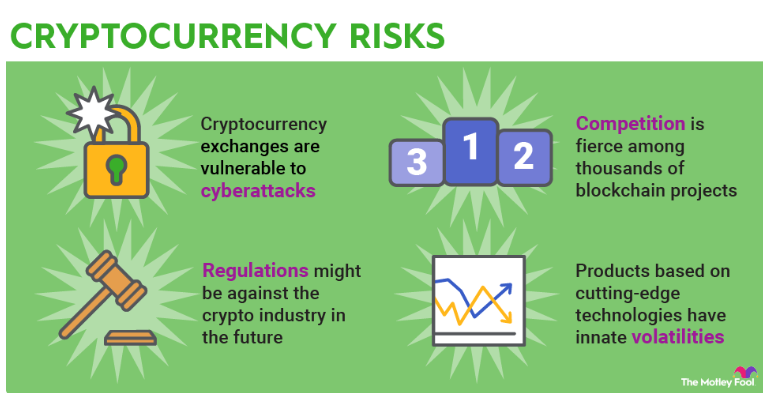
Cryptocurrency risks Source: The Motley
Conclusion
Retirement planning through cryptocurrencies has become a rather popular niche. Cryptocurrencies are becoming increasingly important in the investment strategies of individual investors.
FAQS
Can cryptocurrencies be used for planning retirement?
Cryptocurrency might be used by some individuals in the planning process as part of their retirement plan. It all depends on various aspects such as one’s risk capacity and time horizon.
Which cryptocurrencies are frequently taken into consideration when making investments for future retirement?
The two cryptocurrencies that are frequently considered in investments, based on Coinbase Learn, are Bitcoin and Ethereum due to their market capital and precedence.
How much should be invested in cryptocurrencies for retirement?
Based on data from Fidelity Digital Assets, cryptocurrencies account for less than 10% of the total amount invested in the portfolio, which is 5%-10%.