
key insights:
- Vitalik Buterin has expressed that social media have the potential to become an infrastructure layer for AI governance and not just a discussion forum.
- His proposal extends the d/acc principle of Ethereum to further decentralize coordination instead of having a centralized authority.
- If there is increased transparency in AI governance, then the governance of crypto infrastructure, such as prediction markets and zero-knowledge systems, may gain more attention.
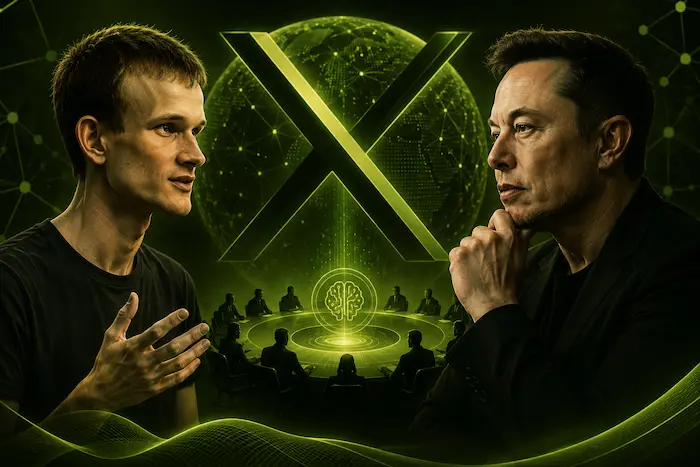
Vitalik Buterin has urged Elon Musk to redesign X into a platform where ordinary users can help shape global artificial intelligence governance. The proposal comes as AI development accelerates and debate grows over who should influence decisions that could affect governments, technology companies, and billions of people.
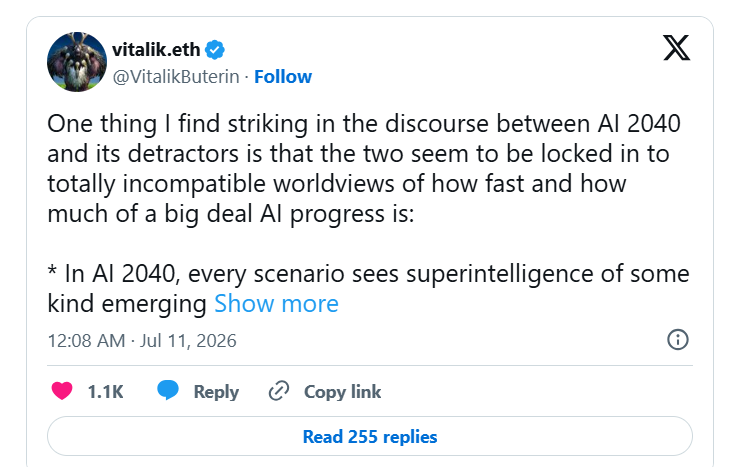
The Ethereum co-founder shared the proposal in a July 11 thread on X. He argued that social media platforms can do more than host debates. Instead, they can help people coordinate practical agreements on AI policy while reducing dependence on governments, major AI companies, and large nonprofit institutions.
X could become a public coordination network
Buterin directed his proposal at Musk, saying X could identify what he described as “grand win-win deals” between people with opposing views on AI development. Rather than amplifying ideological conflicts, he believes the platform should encourage agreements that distribute decision-making power more broadly.
His proposal builds on earlier comments about X. Buterin has repeatedly praised Community Notes and prediction markets as valuable tools that improve public knowledge. However, he has also warned that poor platform incentives could turn social media into a mechanism for coordinated harassment.
The discussion comes shortly after xAI introduced Grok 4.5 while OpenAI expanded its latest AI models. Musk described Grok 4.5 as an Opus-class system that delivers faster performance, greater token efficiency, and lower operating costs following positive beta testing.
Key developments
| Event | Details |
|---|---|
| Proposal date | July 11 |
| Platform | X |
| Main proposal | Turn X into an AI governance coordination platform |
| Target audience | Elon Musk and platform users |
| Long-term goal | Broader public participation in AI decision-making |
Competing AI visions remain at the center
A major part of Buterin’s argument focused on the widening divide within the AI community. One group believes artificial superintelligence could emerge around 2040 unless development slows significantly. Another sees AI as a continuation of previous technological progress and rejects warnings about existential risks or concentrated control.
Buterin acknowledged uncertainty about future AI timelines. Even so, he supported creating predefined conditions that could temporarily slow AI development if specific risks appear.
His suggested trigger events include:
- Unemployment exceeding 25 percent
- The emergence of super-pandemics
- Widespread deployment of autonomous lethal drones
Those ideas align with his defensive acceleration, or d/acc, framework. No matter how AI develops, the strategy focuses on AI investments in cryptography, secure hardware, formal verification, pandemic preparedness, and robust public information systems.
The strategy focuses on investments in cryptography, secure hardware, formal verification, pandemic preparedness and more robust public information systems across all future developments of AI.
Ethereum has taken this approach with their technical trajectory. However, Buterin has always been a proponent of the principles of decentralized and verifiable infrastructure, which he believes continue to hold value in various AI scenarios, despite the debate.
Buterin, however, has always championed privacy-focused infrastructure initiatives with his Lean Ethereum vision, where decentralized and verifiable systems continue to be applicable under a range of AI situations.
The broader implications for crypto and technology
Overall, if X uses governance tools that are based on transparency and public participation, the proposal has the potential to have a broader impact on digital assets.
With institutions using the market to confirm the occurrence of agreed artificial intelligence trigger events, prediction markets could become more relevant. Similarly, zero-knowledge technology and decentralized governance models could see further interest from institutions as they search for more transparent governance processes.
At the same time, Buterin avoided calling for stricter AI regulation. Instead, he argued that meaningful coordination between people holding opposing views offers a more practical path than concentrating authority within governments, leading AI laboratories, or major corporations.
His comments also arrive as industry debate intensifies around the recently released AI 2040 Plan A. The proposal recommends cooperation between the United States and China to intentionally delay artificial superintelligence while introducing transparent verification mechanisms. Several AI researchers have challenged the report, arguing that it overstates near-term AI risks while underestimating the political and economic disruption likely to emerge before superintelligence.
The proposal reflects a broader governance debate
Vitalik Buterin presented the proposal as an attempt to strengthen cooperation rather than expand regulation. He prioritizes open participation and ensures protection against high-risk AI outcomes in his vision.
It is unclear whether X will follow any of those concepts, but the conversation brings into light the emerging potential merging of the fields of AI, decentralized technology, and digital governance—industries that are constantly evolving.