

Key Insights
- Following the U.S. Commerce Department removing export restrictions, Claude Fable 5 is now available for global release.
- Anthropic added some new jailbreak detection systems and increased co-operation with US authorities.
- The ruling reflects a broader discussion about the pros and cons of AI innovation and national security.
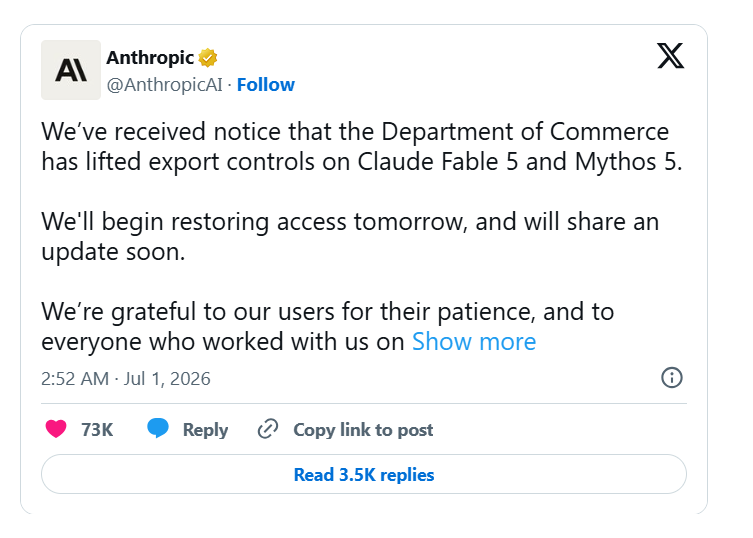
Claude returned to global users on July 1 after the United States lifted export restrictions that had blocked Anthropic’s advanced AI models for more than two weeks. The decision follows government reviews, new security measures, and an agreement between Anthropic and federal officials to strengthen oversight of future frontier AI releases.
Anthropic confirmed that users can once again access Fable 5 through Claude.ai, the Claude Platform, Claude Code, and Claude Cowork. Meanwhile, Mythos 5, which remains reserved for a smaller group of organizations, resumed limited access on June 26 after separate government approval.
Timeline Development
June 9: Anthropic launches Fable 5 and Mythos 5
June 12: US export controls force both models offline
June 26: Mythos 5 returns to about 100 trusted organizations
June 30: Commerce Department removes restrictions
July 1: Fable 5 becomes available worldwide
Government review reshaped the model rollout
Anthropic introduced Fable 5 in June as the public version of its more capable Mythos model family. The company designed both systems to perform advanced cybersecurity tasks while preventing misuse through built-in safeguards.
However, US officials raised concerns after Amazon researchers reportedly discovered a jailbreak technique that bypassed some of the model’s protections. This technique allowed the model to recognize software vulnerabilities and create code related to exploits in restricted settings.
The Commerce Department responded on June 12 with export controls. The directive prohibited foreign nationals from accessing the models, including non-US employees working at Anthropic. Because the company could not verify every user’s nationality in real time, it disabled both models globally.
Anthropic disputed the government’s assessment. The company argued that the reported jailbreak represented a narrow weakness rather than a universal failure. It also said several competing AI models could produce similar cybersecurity outputs under comparable conditions.
Over the following two weeks, Anthropic worked directly with Commerce Secretary Howard Lutnick and federal officials to resolve the dispute. Co-founder Tom Brown reportedly led the negotiations while engineers developed stronger protections against the reported jailbreak.
New safeguards support the return
Anthropic said it trained a new classifier that specifically detects the jailbreak method cited during the government review. According to the company, the updated system blocks more than 99% of attempts using that technique.
When the classifier identifies suspicious prompts, the request automatically transfers to the less capable Opus 4.8 model. Users also receive notification when that happens. Anthropic acknowledged that the stricter screening could increase false positives during legitimate coding sessions.
The agreement with the Commerce Department extends beyond restoring access.
Under the arrangement, Anthropic will
- Share information about malicious AI activity with US authorities
- Coordinate future releases of Mythos, Fable, and later models
- Expand collaboration on AI safety standards and testing
- Continue evaluating jailbreak techniques before public deployments
The company also plans to strengthen Project Glasswing, an industry initiative involving Amazon, Microsoft, Google, and other technology partners. The project seeks to establish common standards for measuring AI jailbreak risks.
Industry weighs security against competition
The temporary shutdown sparked wider debate across the artificial intelligence industry. Several technology executives warned that lengthy restrictions on advanced US models could strengthen international competitors, particularly Chinese AI developers releasing lower-cost alternatives.
OpenAI Chief Executive Sam Altman criticized proposals requiring direct government approval before deploying advanced models. He argued that phased launches under official supervision could slow innovation across the sector.
Anthropic maintained that recalling a commercial frontier model because of a narrow jailbreak would establish a difficult precedent for every leading AI developer. The company warned that such a standard could delay future releases across the industry.
The policy discussion also reached Europe. Austrian officials recently urged the European Union to explore deeper engagement with Anthropic, arguing that regional access to advanced AI should not depend entirely on US regulatory decisions.
The new deal comes as part of a new shift in Washington’s policy on AI, based on President Donald Trump’s executive order on advanced AI cybersecurity. The administration also remains pushing companies to make frontier models available to the government for evaluation, ahead of their public release.
Conclusion
Anthropic’s deal with U.S. authorities sees a return of public access to Claude Fable 5, and introduces a new protocol for working together on frontier AI safety. The resolution wraps up a two-week controversy raising concerns about advanced AI systems and their potential deployment in the future, marking growing government interest in regulating these developments.
The episode also highlights the tension between national security and AI advancements. These reviews may also be influential in the process for future frontier models as the regulators and developers further improve safety standards for the future models globally and across industries.