

- The government of Taiwan enacted a regulation requiring crypto exchanges and VASPs to get a license for their operations.
- Stable coin issuers require an authorization to issue such coins and hold full reserves.
- Companies operating with cryptocurrencies have some grace period for compliance with regulations.
Taiwan crypto regulation law has advanced after the country’s legislature approved a comprehensive legal framework governing virtual asset businesses, stablecoin issuers, and market conduct.
The Legislative Yuan passed the Virtual Asset Service Act in its third reading on Tuesday, moving Taiwan beyond its previous anti-money laundering-focused oversight toward a broader licensing system for the digital asset sector.
The legislation now heads to President Lai Ching-te for promulgation, after which the executive branch will determine when the law takes effect.
The licensing of VASP’s, the issuance guidelines for the stablecoin, the operational criteria of business, and the criminal sanctions for unlicensed businesses, fraudulent behaviour, and manipulation are among those stipulations included. There is also provision made for the transition period for crypto businesses who already have undergone registration under the anti-money laundering law.
Taiwan Crypto Regulation Law Introduces Licensing Framework
According to the new regulation, all virtual asset service providers (VASPs) must apply for permission from the FSC of Taiwan before starting to operate.
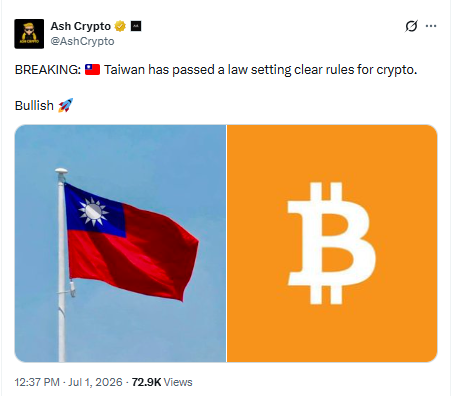
Source: Ash Crypto
The law replaces the existing regime under which crypto firms needed to register for anti-money laundering registration and fulfill their AML duties.
With the introduction of the new law, crypto companies that have registered under the existing AML framework will have 12 months to apply for a license to start their operations.They will then have up to 21 months to obtain FSC approval and any additional licenses required under the new framework.
According to the FSC, the legislation establishes a formal supervisory structure covering operational standards, internal governance, and business oversight across the virtual asset industry.
Stablecoin Issuers Subject to Extra Approval Requirements
Taiwan’s crypto regulation bill includes separate requirements that apply to firms that seek to launch or operate stablecoins in Taiwan.
According to the act, firms that issue stablecoins have to get approval both from Taiwan’s central bank and the FSC prior to launching operations. The legislation further stipulates that such firms have to keep sufficient reserve assets that can cover all the stablecoins issued by them.
Moreover, reserves have to be entrusted to trustees, and issuers will have to carry out audit procedures and disclose information.
Seven Types of Virtual Asset Businesses Identified by Law
The law categorizes seven types of virtual asset business which will be covered under it.
These are exchanges, trading platforms, transfer services, custodians, underwriters, lenders, and other virtual asset businesses.
Organizations falling under these categories will have to adhere to standards on the management of cybersecurity, internal control systems, internal audit, segregation of client assets, accounting, outsourcing, and listing and delisting processes for virtual assets.
Moreover, the law sets out the qualifying criteria for responsible persons and staff in licensed virtual asset business organizations.
Criminal Penalties Imposed for Violations
The law on crypto regulations in Taiwan imposes criminal penalties for unapproved operations and activities in the markets.
According to the bill, persons who operate virtual assets services providers or stablecoins without being authorized could be subjected to imprisonment of up to 7 years. Fines could also be imposed on them, with a maximum of NT$100 million ($3.14 million).
Separate provisions target fraud and the manipulation of cryptocurrencies. Those crimes attract jail sentences of three to 10 years, as well as fines ranging between NT$10 million and NT$200 million, which is about $314,000 to $6.28 million.
These enforcement measures become part of the broader legal framework governing digital asset businesses once the law takes effect.
Industry Transition Period and Regulatory Implementation
Implementation of the legislation will occur after President Lai Ching-te promulgates the law and Taiwan’s executive branch determines its effective date.
During the transition period, crypto businesses that previously registered under anti-money laundering requirements may continue operating while completing the licensing process within the timelines established by the legislation.
Kevin Cheng, a Taiwanese lawyer and founder of Harmony Governance Advisors, said businesses that previously operated within areas of regulatory uncertainty would no longer be able to rely on that uncertainty once the law becomes effective.
He also said traditional financial institutions will be permitted to operate virtual asset service providers under the new framework, adding that existing crypto firms could face increased competition from financial institutions with established compliance capabilities.
Titan Cheng, chairman of the Taiwan VASP Association and founder of BitoGroup, said the industry association will work alongside regulators as implementing rules are developed.
According to Cheng, the association plans to assist with drafting regulations covering licensing, personnel management, operational requirements, and internal control standards while helping companies navigate the transition period.
Lawmakers Request Additional Work on Crypto Derivatives
Alongside passage of the legislation, lawmakers also approved a separate resolution requesting additional regulatory work involving crypto derivatives.
The resolution asks the FSC to prepare a proposal within one year outlining how Taiwan’s crypto industry could provide derivative crypto commodity services.
The proposal is intended to examine a framework for expanding available investment products while supporting future regulatory development.
The FSC said the legislation strengthens protections for participants in Taiwan’s virtual asset market while creating a regulatory framework covering licensing, stablecoin issuance, business operations, and market conduct.