
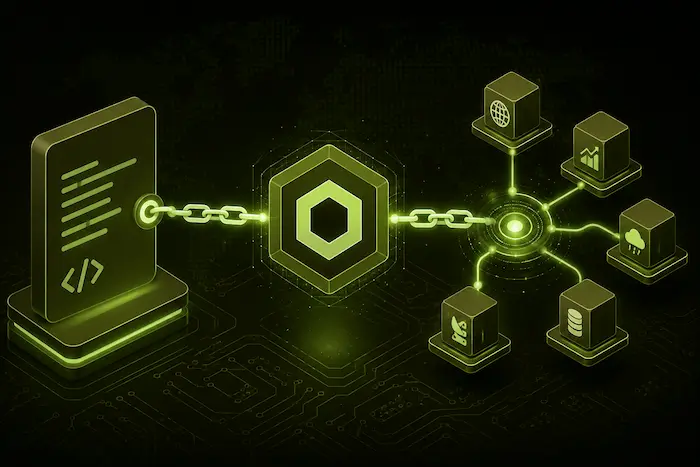
Through blockchains, it has been possible to have a revolution in the process of digitally storing transactions by allowing people to send values without having to rely on any centralized institutions. However, blockchains are not capable of accessing any type of external information available outside the blockchain network, such as the prices of cryptocurrency, stock markets, weather, and sports outcomes.
One such blockchain infrastructure service that has been widely adopted is Chainlink. Chainlink offers an oracle network that allows smart contracts to access off-chain verified data.
Connecting Chainlink Blockchains and External Data Sources
In its creation in 2017 by Sergey Nazarov and Steve Ellis, Chainlink emerged as a decentralized oracle network platform, which is aimed at connecting blockchains’ smart contracts with external data sources. The platform’s mainnet was launched on Ethereum in May 2019.
Source: Chainlink
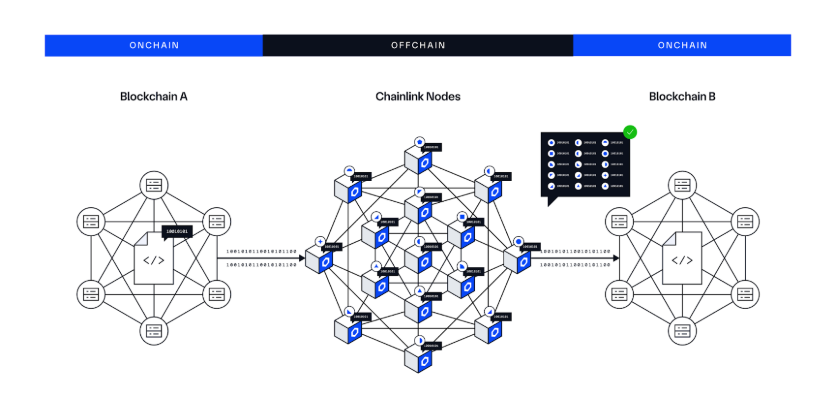
Chainlink, different from the centralized oracle, which depends on one data source, collects data through 900-plus independent nodes operating as oracles.
The network considers various responses and then gives the right information to the smart contract. The information provided is verified using cryptographic signatures and consensus to avoid any form of fraud or manipulation.
The Chainlink network monitors the performance metrics of the participating nodes. These include the number of successful jobs performed, speed, availability, and accuracy.
Chainlink Network Operation Process
Once a smart contract sends a request, Chainlink decentralizes the process by distributing it among different oracle nodes instead of delegating it to just one provider.
All the chosen nodes will source the required data from the trusted external resources. After that, the data will be compared, and a consensus will be reached to validate the final result, which will be sent to the requesting smart contract.
This method decreases reliance on one particular source for data and helps increase data accuracy within the decentralized world of applications. Currently, Chainlink is working with over 14 blockchains, including Ethereum, Avalanche, Polygon, and BNB Chain.
Why Developers Choose Chainlink Over Other Options
Due to decentralized technology, Chainlink is the most popular oracle platform in the blockchain industry. It not only provides data but also creates a platform that makes the system more secure and interoperable.
Data Validation Services
- Has more than 900 decentralized nodes for data validation instead of relying on a single provider.
- Validation of the data via decentralized consensus
- Tracks node performance using response speed, availability, and historical accuracy.
Multi-Chain Support
- Supports more than 14 blockchain ecosystems.
- Powers over 1,600 blockchain projects.
- Facilitates access to decentralized apps to trusted data on various blockchain networks.
More Services Apart From Price Feeds
- The CCIP is used for communication and transfer of value across blockchain networks.
- PoR proves the backing of off-chain reserves to the digital assets.
- VRF is used to generate cryptographically secured randomness on blockchain games and NFTs.
Chainlink’s Token Makes Things Possible
Link coin is the native currency that drives Chainlink’s operations.
The node operators earn some LINK for providing the service of fetching, validating, and transmitting external data. With the help of the Link coin, it is possible to stake, which means users have the chance to strengthen the network and make node operators work effectively.
The first release of the token took place on September 16, 2017, and it was limited to one billion coins. In the history of Chainlink, it reached its peak price of $52.70 on May 10, 2021. In mid-February 2025, LINK traded around $17.20.
As opposed to crypto-based systems that emphasize transactions, LINK is a utility token used in running Chainlink’s decentralized oracle system.
Offering Other Services Apart from Price Feeds
Though initially Chainlink offered price feeds of cryptocurrencies, there have been other services created by Chainlink to improve blockchain systems.
Chainlink came up with the Cross-Chain Interoperability Protocol (CCIP) in July 2023 that enables the transfer of messages and assets across various blockchains.
Proof of Reserve is yet another service offered by the network, which allows blockchains to confirm that their digital assets are still collateralized by reserves.
Finally, Verifiable Random Function (VRF) provides cryptographically generated random numbers which are used by blockchain games and NFTs. These services allow developers to build interoperable dApps requiring trustless random numbers and reserve verification.
Different Usages of Various Blockchains
The Chainlink is used in different industries where there is a need for accurate data from outside the blockchain system.
This means that in the decentralized finance industry, the oracle data acts as the market rates for the lending services and decentralized exchanges. External information is used in insurance applications to automate payment when predefined criteria are fulfilled. Gaming applications need random data to ensure a level playing field for all participants.
Chainlink is also employed in weather apps that require access to unaltered data on the environment to help in the process of executing smart contracts.
An early instance of how the network was used publicly is in 2021, when the Associated Press used Chainlink for the automation of election results, financial statements, and sports results while validating the published information using cryptography.
Chainlink Network Adoption Keeps Growing
Chainlink’s infrastructure is currently used by DeFi applications, insurance networks, gaming blockchain networks, supply chain solutions, and tokenized assets.
The release of CCIP, Proof of Reserve, and VRF made the Chainlink network expand beyond the use cases of oracles by providing more options for interoperability and validation.
With blockchain technology being widely adopted, Chainlink remains one of the most popular infrastructure solutions for applications that need access to verified off-chain data.
Development Milestones of Chainlink
Chainlink is one of those projects that has continued to develop its infrastructure via a number of technical achievements.
After its launch in 2017 and successful fundraising amounting to $32 million, Chainlink acquired Town Crier in 2018, introduced its mainnet on Ethereum in 2019, and added the DECO verification process in 2020. Later on, Chainlink Labs released the Chainlink 2.0 White Paper in 2021.
The latest achievements include the integration of Chainlink price feeds into Base in September 2023, integration of Ethereum Price Feeds in World Liberty Financial in November 2024, and Ripple collaborating with Chainlink in January 2025 to integrate RLUSD stablecoin in DeFi applications.
Based on statements made in January 2025, further developments in the Chainlink ecosystem are set to revolve around institutional blockchain integrations while upholding the existing network security standards.
Conclusion
The use of Chainlink as a platform that allows smart contracts to have access to external information has made Chainlink one of the most prominent blockchain projects today.
The platform offers a variety of data that can be used by various decentralized solutions, including finance, gaming, insurance, logistics, and business-related blockchains.
FAQs
What is Chainlink?
Chainlink is a decentralized oracle platform which enables smart contracts to access external data such as cryptocurrency prices, financial market data, weather data, and sports events.
Why do smart contracts require Chainlink?
Smart contracts cannot access any external data without help. Chainlink acts as an intermediate between external sources and smart contracts in order to provide the latter with verified external data.
What is Proof of Reserve?
Proof of Reserve allows blockchain platforms to verify that their digital currencies are collateralized by off-chain reserves.