

The exchange of digital assets is documented on public blockchains that provide the possibility for any person to track the transfer of money from one address to another.
Even though the addresses do not disclose the owner, thanks to blockchain analysis, it became possible to link the history of transactions to individuals or companies.
This technology has been adopted by people who want to increase their financial privacy, but at the same time, it has been questioned by regulatory authorities and law enforcement due to its involvement in money laundering of cyber crimes.
Recently, the US authorities made some moves in the legal framework, admitting that the mixing services have a legal application, but going on with the prosecution of its creators and operators.
How Coin Mixers Work
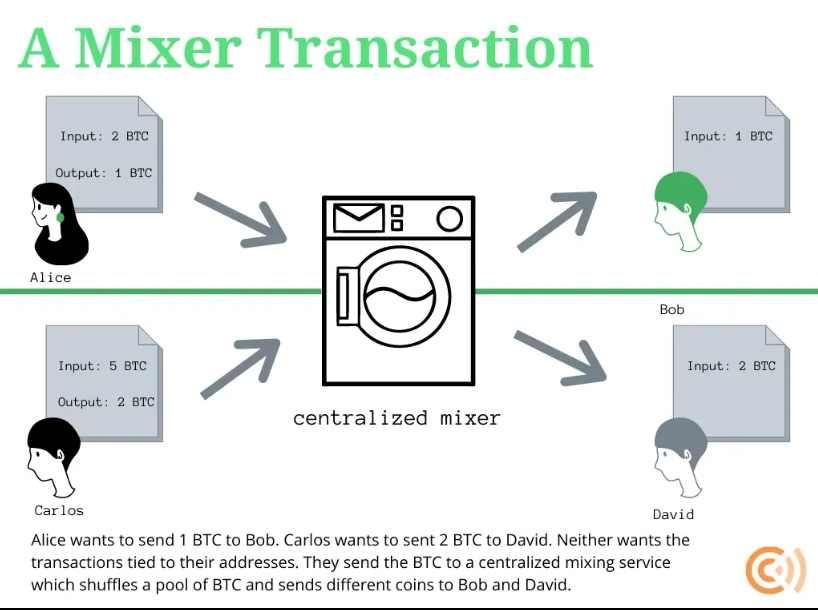
Coin mixing is the process of mixing different users’ digital coins together and then returned back to other wallet addresses. This process aims at lowering the traceability of the transferor to the transferee on the public blockchain.
Source: OKX
There are several stages involved in the normal coin mixing process:
- The user makes a deposit in the form of cryptocurrency in the mixing service.
- These funds are then mixed with other users’ deposits.
- Service takes its fee and sends out the equivalent value of cryptocurrency to the chosen wallets of the user.
In addition, many service providers offer a number of other privacy features that aim to make the analysis of the transactions harder.
They can consist of:
- Dividing funds between several wallets.
- Introducing delays in withdrawal after releasing the funds.
- Introducing randomness in payments or creating customizable mixing options.
As opposed to blockchain transactions, the outgoing funds come from one pool, rather than the initial deposits of the user.
| Characteristics | Description |
| purpose | Masking transaction history on the blockchain |
| Depositing | The user deposits the cryptocurrency in a mixer pool |
| Withdrawing | Equivalent amounts are withdrawn to fresh wallets after paying the fees |
| Privacy Features | Multiple wallets, delay in withdrawals, random transfers |
| Primary worry | Potential use in money laundering and other illicit activity |
Types of Coin Mixing Services
The coin mixers can be categorized in one of two ways depending on their working.
The centralized mixers work under the management of an individual or company which will take in cryptocurrency from the user, mix it internally, and send back other currencies. These mixers are fairly easy to use but need customer trust in the service provider for both funds and transactions.
In contrast, decentralized mixers operate without the need for a middleman through smart contracts and blockchain protocols. The use of automation allows customers to keep control of their funds while reducing dependence on a third-party entity.
Tornado Cash was a non-custodial mixing solution running on Ethereum through smart contracts before sanctions were placed in 2022. The users would put tokens in smart contracts and then withdraw tokens from different addresses.
Coin Mixers and Regulatory Developments
Coin mixers have been targeted by regulatory authorities due to their use by criminals for money laundering through coin mixers involving cryptocurrencies that are stolen, from ransomware payments, or any other kind of illegal activity.
On August 8, 2022, the U.S. Treasury Department sanctioned Tornado Cash as it involved processing over $7 billion worth of digital currency since 2019.
However, legal developments later altered that position. The decision made by the United States Fifth Circuit Court in November 2024 was decided that it is impossible to regard the immutable smart contracts belonging to Tornado Cash as property due to their automatic nature
In March 2025, the Treasury removed Tornado Cash from its list of sanctioned entities. A federal court then permanently barred the Office of Foreign Assets Control (OFAC) from reinstating those sanctions in April 2025.
Nevertheless, the Treasury, in a report submitted to Congress, stated that the use of coin mixers is necessary to ensure privacy in the transactions made by law-abiding cryptocurrency holders despite ongoing attempts by the Department of Justice to prosecute Tornado Cash creator Roman Storm of the same unresolved charges.
Benefits of Privacy and Risks Associated
The use of coin mixers has been common among people and institutions who wish to make their transactions more confidential.
These have included:
- Ensuring the anonymity of wallet balances.
- Maintaining the confidentiality of business payments.
- Maintaining privacy in donation transactions.
On the other hand, a number of risks have been linked to such services. There may be instances where users will deal with centralized services that take off with money left in the account, and security risks where hackers can gain access to customer data.
Moreover, there have also been developments in blockchain analysis technology to help connect transactions to its source. Users may also find themselves dealing with coins that have already been linked to criminal activities.
Coin Mixers vs. Privacy Coins
While both technologies aim at improving the privacy of transactions, there is some difference between them.
Privacy-oriented cryptocurrencies, like Monero and Zcash, implement privacy features by means of cryptography within the protocol itself.
Coin mixers, on the other hand, use transparent blockchains, such as Bitcoin and Ethereum, in order to conceal the transaction history.
Newer privacy solutions have come up with different strategies as well. Railgun, for example, does not mix assets from multiple users but instead uses privacy technology alongside compliance mechanisms intended to prevent wallets associated with illicit activity from accessing the platform.
Conclusion
Coin mixers remain in a rather complicated status in the ecosystem of cryptocurrencies. They add an extra layer of transaction privacy to the transparent blockchain while still being under legal regulation. However, the court rulings from 2024 to 2026 and the US Treasury statement about legal financial privacy using coin mixers have altered the legal perception of this issue.
FAQs
What is a coin mixer?
It is a platform where cryptocurrencies from different users get mixed and then equally distributed to new addresses, making the blockchain transactions more complicated.
Is the usage of a coin mixer legal?
It is conditional upon the rules of the jurisdiction in question. While in some jurisdictions, the usage of coin mixers is legal to ensure privacy, the authorities of such jurisdictions are pursuing individuals accused of money laundering or sanctions violations.
How can one distinguish a coin mixer from a privacy coin?
One can distinguish the two by noting that privacy coins offer anonymity in terms of blockchain technology, while a coin mixer helps obtain the same through making the transactions difficult to trace via blockchain.