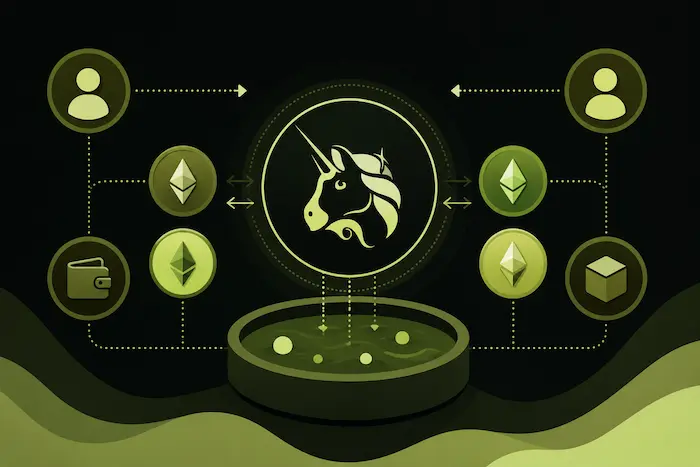
Uniswap is an automated market-making protocol where the buying and selling of crypto tokens take place through liquidity pools within the blockchain system and not order books. The protocol uses automated market makers (AMMs) in order to make prices during trades because of liquidity.
Since its inception on November 2, 2018, Uniswap has been active on the Ethereum blockchain network. According to DeFiLlama figures as of August 2026, Uniswap is currently in operation on 48 blockchain networks, with a total value locked of $3.1 billion and almost $50.8 billion in decentralized exchange volume in the last 30 days.
What Is Uniswap?
Uniswap is built around liquidity pools and smart contracts. Instead of using a centralized exchange to match buyers and sellers, users trade against assets deposited into pools. Liquidity providers supply assets to these pools and can receive a share of applicable trading fees.
This structure also means users generally maintain control of their wallets. A swap requires the user to connect a compatible wallet, select the assets to exchange and approve the blockchain transaction. The particular smart contract is responsible for executing the swap, and the purchased tokens are transferred to the user’s wallet.
The amount quoted may vary prior to the completion of the transaction since the prices are volatile. Moreover, the gas fees, which are not included in the Uniswap fees, should also be considered by the users. Slippage is described as the difference between the expected price and the execution price.
Terms you need to know
- Liquidity pools consist of assets that users trade via swaps.
- Liquidity providers contribute assets and may get trading fees.
- Slippage happens when the execution price differs from the expected one.
Development of Uniswap
Uniswap is an experimental platform on the Ethereum blockchain for automating liquidity supply. The first important update to Uniswap was Uniswap v2, which was launched in May 2020 and made trading possible between ERC-20 tokens with each other.
The update Uniswap v3 was launched in May 2021 and provided the concentrated liquidity model. This means that the LPs (liquidity providers) may choose the price intervals within which their capital will be working.
Uniswap v4 was released on January 31, 2025. It was accompanied by the hooks feature, enabling users to insert custom logic into operations with pools. This changed the structure from a standardized pool design toward a more programmable system.
Uniswap v4 and Permissioned Pools
One of the newer applications of Uniswap v4 is Permissioned Pools. The v4 hook introduced in July 2026 makes it possible for permissioned tokens to exchange using AMMs with compliance directly enforced on-chain.
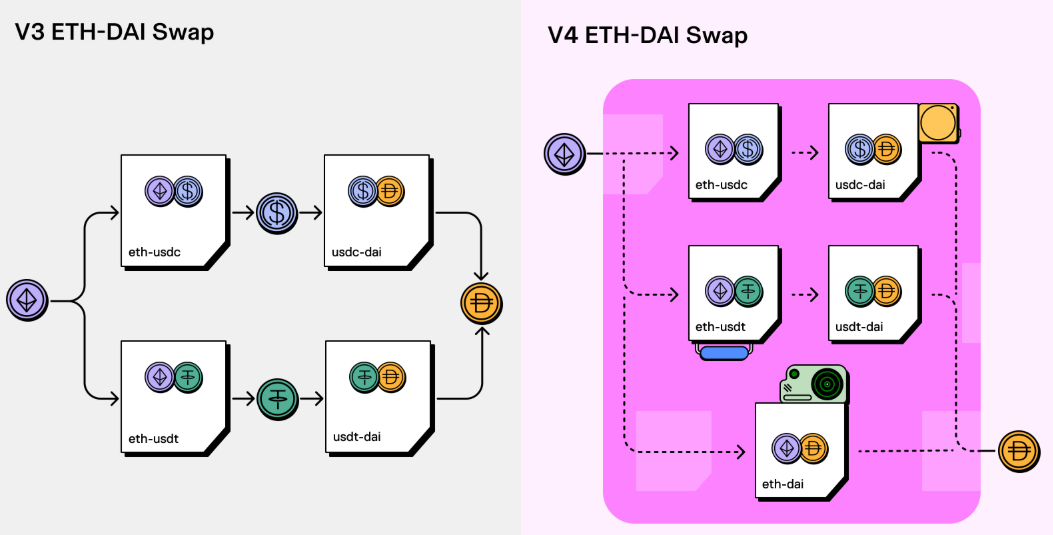
Source: Uniswap
The system allows an issuer to maintain an allowlist while the pool checks whether a wallet is authorized before allowing trading or liquidity actions. This creates a way for regulated tokenized assets to operate within an automated market-making structure.
Uniswap’s Multichain Expansion
Uniswap is no longer limited to Ethereum. DeFiLlama tracks the protocol across 48 networks, including Ethereum, Base, Polygon, Robinhood Chain, and Arbitrum. Ethereum remains the largest network for Uniswap, accounting for about 70% of its TVL.
Uniswap became available on Robinhood Chain in July 2026, with v2, v3, v4, and UniswapX supported through the ecosystem. The protocol also expanded to Linea in April and Tempo in March.
What Is UNI?
UNI is the governance token associated with the Uniswap ecosystem. UNI holders can participate in governance decisions involving protocol parameters, treasury management, and other ecosystem matters.
The December 2025 UNIfication initiative introduced protocol fee collection and a mechanism intended to use collected fees to buy and burn UNI. It also included a 100 million UNI treasury burn. In 2026, governance proposals extended protocol fee infrastructure to additional networks.
Risks Associated With the Use of Uniswap?
Using Uniswap involves risks associated with smart-contract vulnerabilities, malicious tokens, phishing, wallet compromise, and unfavorable transaction execution. Liquidity providers also face impermanent loss when the value of deposited assets changes relative to simply holding those assets.
Concentrated liquidity adds another consideration because providers must manage selected price ranges. Liquidity can become inactive when the market moves beyond those ranges.
Frequently Asked Questions
What is Uniswap used for?
Uniswap is a platform for swapping cryptocurrencies via liquidity pools on the blockchain.
What Is Uniswap v4?
Uniswap v4 is a newer iteration which utilizes hooks to provide additional custom functionality surrounding liquidity pools.
What are Uniswap Liquidity Pools?
They are liquidity pools built on smart contracts that hold assets to trade against for swaps.