
Key insights
- Schwartz argues the SEC’s complaint repeatedly identified XRP itself as the security.
- Fagel maintains the legal dispute ultimately focused on Ripple’s securities transactions.
- Judge Torres distinguished the digital asset from the manner in which Ripple sold it.
Ripple CTO Emeritus David Schwartz has challenged claims that the U.S. Securities and Exchange Commission limited its lawsuit against Ripple to the company’s XRP sales.
His remarks revive a central dispute from the long-running legal battle and come as the XRP community marks the third anniversary of the landmark July 2023 court ruling. The exchange highlights continuing disagreements over how the SEC framed its case and why the court ultimately rejected key parts of its legal theory.
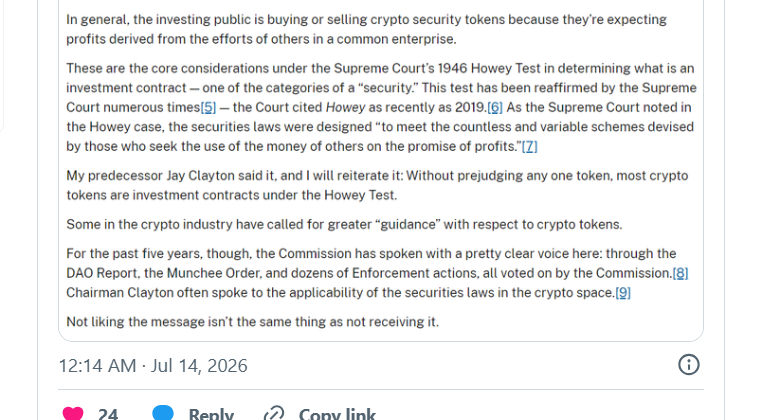
The discussion unfolded on July 14 on X after former SEC official Marc Fagel argued that the agency only needed to prove Ripple sold XRP as a security to establish a violation of Section 5 of the Securities Act. According to Fagel, the regulator never needed to determine whether every secondary market XRP transaction qualified as a securities transaction.
Legal filings remain at the center of the dispute
Ripple CTO Emeritus David Schwartz agreed that Ripple’s XRP sales formed part of the SEC’s case. However, he rejected the argument that those sales represented the regulator’s only legal theory.
Schwartz argued that the SEC repeatedly described XRP itself as a security throughout its complaint and public communications. He said attempts to portray the lawsuit as focusing only on Ripple’s sales rewrite the record established during the litigation.
The SEC’s December 2020 complaint alleged that Ripple and two executives sold more than 14.6 billion XRP units. According to the filing, those sales raised over $1.38 billion through an unregistered securities offering. The complaint also referred to XRP as a “digital asset security” in several sections.
Fagel later acknowledged that the SEC’s public messaging lacked precision and evolved during the case. Even so, he maintained that the legal issue before the court centered on Ripple’s XRP transactions rather than the token itself.
Schwartz disagreed again and pointed to the SEC’s summary judgment filings. He argued those documents showed the agency pursued a broader theory by claiming XRP buyers expected profits from Ripple’s efforts across multiple transaction types.
Key case figures
| Item | Details |
|---|---|
| SEC complaint filed | December 2020 |
| XRP allegedly sold | More than 14.6 billion |
| Funds allegedly raised | More than $1.38 billion |
| Institutional sales found unlawful | About $728.9 million |
| Final civil penalty | $125.04 million |
| Appeals dismissed | August 2025 |
Court ruling reshaped the legal interpretation
The debate reflects the distinction created by U.S. District Judge Analisa Torres in July 2023. Her determination distinguished tokens, like XRP, from contracts or schemes for delivering them.
The court ultimately found that the proprietary rights of XRP are not a contract, transaction or scheme under the Howey test. The ruling has, however, analysed the various methods of sales of Ripple separately.
Institutional sales worth about $728.9 million qualified as unregistered investment contracts because sophisticated buyers could reasonably expect profits tied to Ripple’s business efforts. By contrast, programmatic sales on public exchanges failed the same legal test because retail buyers could not identify the seller.
The mixed decision became one of Ripple’s biggest courtroom victories while still leaving the company liable for institutional sales.
The broader regulatory debate continues
Ripple CTO Emeritus David Schwartz says the court’s rejection of the SEC’s broader interpretation remains one of Ripple’s most significant legal wins. He believes that outcome changed how digital asset cases will be argued in future enforcement actions.
The litigation officially concluded in August 2025 after Ripple and the SEC withdrew their respective appeals. The final judgment preserved the $125.04 million civil penalty and a permanent injunction covering future institutional XRP sales that violate securities laws.
Meanwhile, Ripple executives have disclosed that the company spent roughly $150 million defending the lawsuit. They also revealed that Ripple considered shutting down after the SEC filed its complaint before deciding to continue the legal fight.
The anniversary of Judge Torres’ ruling has renewed discussion across the crypto industry because the decision continues to influence regulatory debates surrounding digital assets. Ripple CTO Emeritus David Schwartz maintains that the SEC originally advanced a broader argument than some observers now acknowledge. Meanwhile, Fagel continues to argue that the decisive legal question remained whether Ripple’s XRP sales constituted securities transactions.
Conclusion
Ripple CTO Emeritus David Schwartz has reopened debate over one of the most closely watched crypto enforcement cases in U.S. history. Not only did they disagree on the interpretation of the SEC’s original arguments, but their interpretation of the law is still being contested after the case has been concluded.
The Ripple decision continues to guide the regulators, courts and market participants in distinguishing digital assets and transactions with them. The point is important to future enforcement actions and securities law interpretations.