
Key Insights:
- ETF fees are falling rapidly, as Morgan Stanley’s 0.14% drive up competition in Ethereum and Solana funds
- The use of staking is becoming commonplace in ETF configurations and creates regulatory and technical risk layers.
- Traditional finance is catching on to crypto mechanics ETFs.
Morgan Stanley has taken its plans to launch Ether and Solana exchange traded funds (ETFs) a step closer after filing revised S1 registration statements on Thursday with the US Securities and Exchange Commission.
The changes indicate ongoing regulatory interaction as the bank continues to develop the product design and readiness for possible approval. The timing of the final launch will continue to be subject to the SEC review process and conditions of the market.
Regulatory filings and pricing pressure are to be expected.
A performance overview of the funds is also included in the latest filings, and for both funds, the sponsor fees are 0.14%. The pricing puts the products below other crypto ETFs in the U.S. market, which will further drive competition among issuers on pricing.
The company is working on improving its strategy to manage regulated digital asset exposure as well as executing on institutional investor demand for less expensive investment options, according to ETF filings. At the same time, Sol listings emphasize the same design concepts, emphasizing efficiency and yield generation via staking.
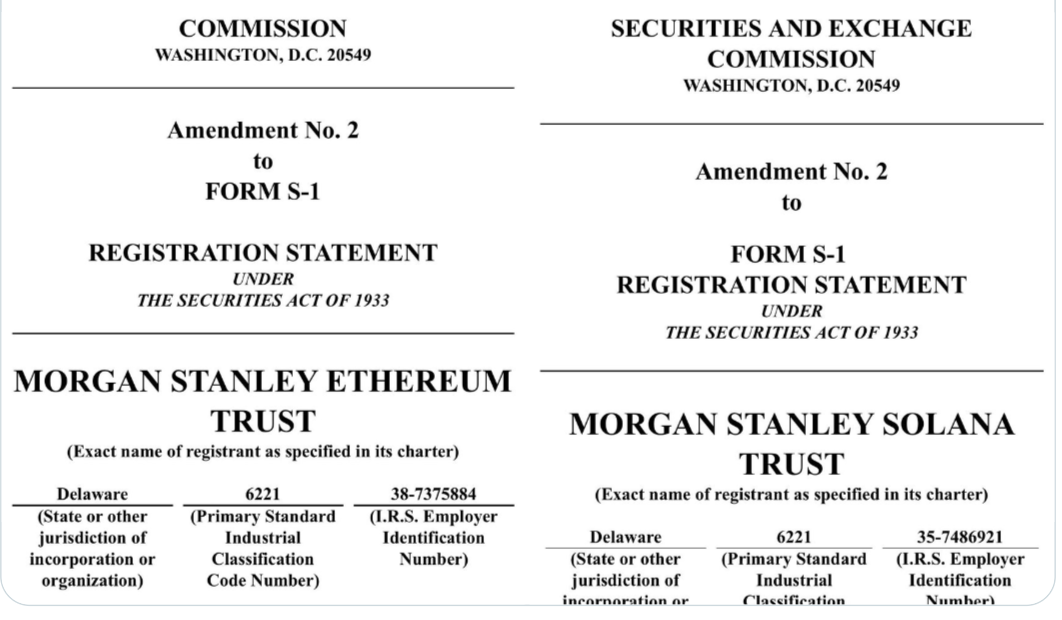
Bloomberg ETF analyst Eric Balchunas noted that the fee level places the products among the cheapest crypto ETFs globally. The update follows earlier submissions made in January and marks the second revision cycle for both funds.
Staking Framework and Operational Design
The revised structure includes a stake for both assets, enabling partial assets to be involved in blockchain validation. The idea behind this is to provide investors with additional yield without increasing the exposure to the regulated funds.
ETH staking will be done by third-party providers such as Figment, and Galaxy Blockchain Infrastructure will handle delegated transactions. The principal difference between the two is that the capacity of the network is not disclosed in sol staking.
Custodians have no direct control over private keys, which means there is lower exposure to them in the day-to-day operations. Rather, rewards are awarded, with 95% going to the fund’s investors and 5% going to service providers.
The metrics of the ETH market conditions also show network congestion during the validator onboarding process. The market conditions of ETH are also a reflection of validator onboarding network congestion. Ethereum has a substantial staking queue right now, which could see new validators queued up for over two months based on network constraints.
The structural features of key components are:
- The solution includes an operation of both assets as third party validators.
- Reward distribution with a bias towards the investors
- Mitch and the other boys have a shooting chance if they fail to behave themselves.
- Separation of custody / staking responsibilities
Sol integration adopts this structure but with a twist of delegated validation models for a network design.
A company’s position in the market and institutional strategy
Staking has gained traction in the regulated ETF sector as it has become more common for digital asset products to be built around the concept. The exposure to ETH via ETFs is coming with mechanisms which generate yields, hoping to become more competitive compared with the conventional financial instruments.
SOL products are part of diversified crypto allocations strategies alongside Ethereum-based ones. Relying solely on exposure is no longer the sole basis for competition for asset managers.
The competition in the ETF market is likely to grow with more issuers introducing staking and cutting fees to attract investors’ funds. Furthermore, with increasing institutional adoption in the alternative blockchain space, sol based funds are also under pressure.
Morgan Stanley’s solution is part of a wider shift in the industry to merge the traditional fund design with yield generation mechanisms on the blockchain. This puts both the Ethereum and Solana products in a fast-changing investment environment.
Systemic effects on crypto fund markets.
As a result of the filings, there has been a convergence between traditional asset management and blockchain infrastructure that has been observed. The inclusion of Eth in regulated funds reflects a trend of institutional recognition of the use of staking as a financial instrument.
Sol inclusion further strengthens the “all in” approach of multi asset crypto ETFs that seek to reflect the broader digital asset demand. With increased competition, market participants are hoping for more fee reductions from managers.
The custodial process and stakeholder partnerships are increasingly becoming a core component of product differentiation. Investor protection, validator risk and transparency remains the focus of regulatory review.
Conclusion
The updated filings by Morgan Stanley represent a major advance in the effort to regulate crypto ETFs in the United States. The new ETFs on ETH have introduced a new element of staking and cost efficiency that may challenge the competitive landscape of the ETF space. Sol based efforts are on a similar track, as further institutional growth in blockchain connected investment vehicles.
The market entry will be subject to approvals from regulators, which will dictate when and how it will happen. The result will also have a major influence on the speed of widespread adoption of staking in digital asset portfolios via ETFs. The review process for both products is expected to carry on, and Eth and Sol are poised to play a significant role in the evolution of regulated crypto investment markets.