NFT staking is a concept that involves rewarding the holders of NFTs without necessarily having to sell or trade them. NFT staking enables individuals to earn tokens through locking up the NFT in a smart contract on the blockchain.
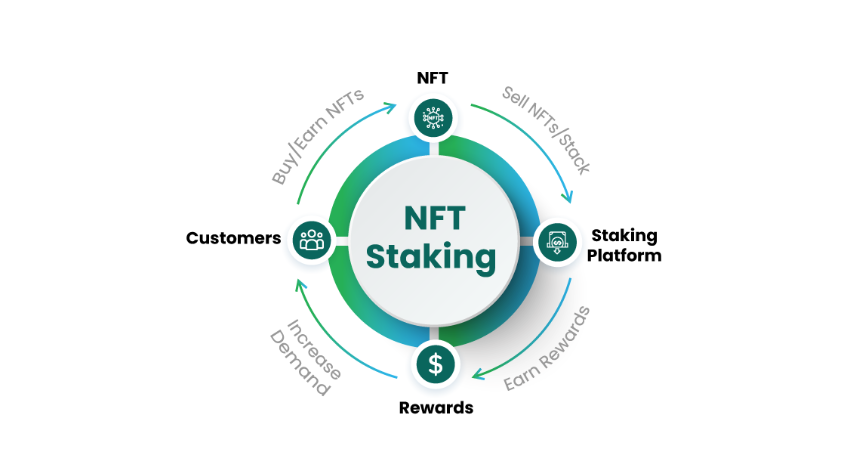
Source: Talentica
While this strategy is derived from cryptocurrency staking, it involves NFTs rather than cryptocurrency tokens. Over time, NFT ecosystems have been evolving to include more functionalities besides being used as a collectible.
What Is NFT Staking ?
The process of depositing eligible NFTs into a smart contract, which takes care of the reward distribution process, is known as NFT staking. The user gets a reward in return for the staking period, which varies according to the platform.
Moreover, the ownership of the NFT stays with the owner even after staking, but the NFT cannot be traded or transferred during the staking period.
The reward mechanism depends upon various factors, which are:
- Duration of staking period
- Number of NFTs staked
- Rarity of NFTs
- Reward rates of the platform
The procedure operates on the basis of principles that resemble those used in proof-of-stake protocols.
How NFT Staking Works ?
An NFT staking procedure generally includes several stages that allow for transferring NFTs into a staking contract and monitoring rewards accrual.
NFT Staking Procedure
| Step | Description |
| Connect Wallet | Connecting an appropriate cryptocurrency wallet to the staking platform |
| Choose NFT | Specifying supported NFTs for staking |
| Approve Contract | Applying permission to the staking contract to work with the chosen NFT |
| Stake Asset | Transferring the NFT into the smart contract |
| Earn Rewards | Accruing rewards in accordance with the platform’s rules |
| Unstake NFT | Withdrawing the NFT and getting rewards |
During the staking process, the NFT will be locked in the contract itself. In some platforms, users may get receipts for the NFT staking, which allows for some usage in other areas of the system.
NFT Staking Models
With the advent of NFT staking, there have been a number of models introduced by various platforms to perform specific tasks.
Yield-Based NFT Staking
It is the most basic form of NFT staking, where users lock NFTs and get tokens as rewards, depending on either staking time, amount of rewards available, or specific calculations done by the platform itself.
Some platforms generate the reward using token emissions while others generate it through protocol activities like fees.
Utility-Gated NFT Staking
In some cases, there are projects where staking becomes necessary for using the platform.
The advantages of which can be:
- Access to beta releases
- Exclusive community channels
- Early access
- Marketplace improvements
Accordingly, in this case, the NFT serves not only as a membership token but also as a staking asset.
Gaming and Metaverse NFT Staking
NFT staking is actively used in blockchain-based gaming and metaverse platforms.
Staking an NFT may allow for:
- Enhancing characters
- Boosting rewards
- Access to exclusive zones
- Extra game features
Furthermore, NFTs may be staked for participation in governance systems or to get part of the platform’s income.
Governance Staking
Some decentralized entities need users to stake their NFTs to make voting decisions.
The amount of voting rights will depend on:
- NFT attributes
- Duration of staking
- Tier of collection
- Amount of NFTs staked
In such a way, voting is connected to engagement with the ecosystem.
The Evolution of NFT Staking
Since the initial expansion stage of NFT staking, there have been many changes within the industry.
In the years 2021 and 2022, several staking platforms were focused on providing high annual percentage yields by means of token emissions. However, the problem of many such systems was the fall in token prices and participation rate.
The latest iteration of NFT staking projects includes novel approaches aimed at addressing these problems.
Key Features of NFT Staking
| Feature | Description |
| Dynamic Rewards | Adjustable APRs depending on market conditions and pool dynamics |
| Multi-chain adoption | NFT staking on multiple blockchains |
| Rental Composability | Ownership and usability separation |
| Real Yield Models | Yield is determined by platform revenue |
| Tiered Rewards | Different APRs depending on rarity and activity level |
New staking possibilities have arisen on networks like Ethereum, Solana, Polygon, BNB Chain, Immutable, and application-specific rollups.
The creation of standards such as ERC-4907 has also made way for new ways of using NFTs. These protocols distinguish between ownership and usage rights, which allows NFTs to be engaged in more actions even when staked.
Another one of the developments that has arisen is the tokenization of real-world assets. Here, real-world property, intellectual property, or funds could be used on staking protocols just like regular NFTs.
Risks Associated with NFT Staking
Although gaining popularity, NFT staking is subject to various risks that can be identified.
Smart Contract Risk
NFTs are governed by smart contracts. Any error or exploit in coding can put staked tokens at risk of loss.
Liquidity Issues
Once staked, NFTs become illiquid and cannot be sold. In case the value of the tokens falls during the period of staking, there will be no way out for the owner.
Sustainability of Rewards
Some reward systems depend heavily on token emissions. In case token emissions stop or token prices fall, rewards will lose their value.
Platform Risk
The operation of NFT staking is reliant on the continued functioning of the platform. Any matter relating to service disruption, insolvency, and closure may result in challenges when trying to access the staked assets.
Regulatory Considerations
There may be differences in how staking rewards are treated under the regulations. Treatment may vary based on jurisdiction and the structure of the platform.
NFT Staking Growth
The journey of NFT staking has moved from a basic system for earning rewards to a comprehensive one that includes governance, gaming, utilities, and ecosystem integration.
The model allows NFT holders to stake their digital assets via smart contracts and get rewards according to certain parameters. Even as staking infrastructure evolves through integration of dynamic rewards, multi-chain capability, rental practices, and revenue-based distributions, NFT staking is still a viable function within NFT ecosystems.
Conclusion
NFT staking has emerged as a system that enables users to earn rewards without relinquishing control over their digital assets. Participants are allowed to use their eligible NFTs through staking via smart contracts to obtain rewards based on time, rarity, governance, games, or platform-related purposes.
FAQs
What is NFT staking?
NFT staking involves storing NFTs in a smart contract for purposes of receiving rewards or utilizing the particular staking features provided by the platform.
Is NFT staking possible at all?
It is impossible. NFT staking is applicable only to some NFT collections or specific platforms that support staking.
Can a staked NFT be sold?
It is impossible most of the times because NFTs become locked during the staking period.