
- Quantum Computing Executive Orders establish deadlines for implementation of post-quantum cryptography.
- The United States introduced QC ADDS and advanced their strategy on quantum computing research and training.
- Systems should be readied to face quantum attacks of the future and strategy updated.
Quantum Computing Executive Orders signed by U.S. President Donald Trump have established new federal deadlines for the adoption of post-quantum cryptography while launching a separate national initiative to accelerate quantum computing research and commercialization.
The two executive orders signed on Monday set out the framework for the US government’s approach, which will include safeguarding critical systems against future quantum attacks and advancing the development of quantum technology.
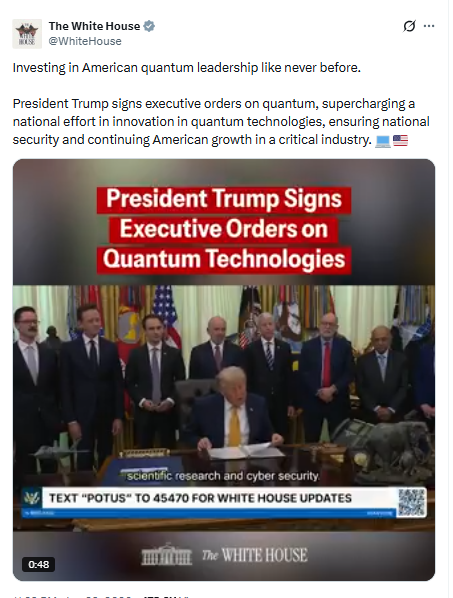
Source: The White House
Moreover, this comes at a time that the competition in the field of quantum science around the world is increasing, especially since China is making more investments in the realm of quantum science through the Five-Year Plan.
Timeline of Post-Quantum Transitions Laid Down Under Executive Orders
One of the executive orders, EO 14409, referred to as Securing the Nation Against Advanced Cryptographic Attacks, aims to combat quantum computers that could compromise current cryptographic methods.
According to the order, large-scale quantum computers can pose considerable difficulties for encryption technologies currently in use. It is also stressed that some adversaries might gather encrypted data at present in order to be decrypted at a later date when quantum computers are powerful enough.
As per the directive, the federal agencies should migrate their information systems and high-value assets to the Federal Information Processing Standards of Post-Quantum Cryptography approved by National Institute of Standards and Technology.
The order has defined certain deadlines for compliance as follows:
| Requirement | Deadline |
| Migrating high-value assets and high impact systems to PQC for key establishment | End of 2030 |
| Migrating to PQC for digital signatures | End of 2031 |
| Launch of NIST pilot project | Within 180 days |
| Completion of NIST pilot project | December 31, 2027 |
The pilot program will be conducted on a selected few information systems that are owned and run by NIST.
Executive Orders Address Cryptocurrency Security Concerns
The executive order focused on cryptographic security arrives as discussions continue regarding the long-term impact of quantum computing on digital asset networks.
According to information cited by Coinbase’s Independent Advisory Board on Quantum Computing and Blockchain, approximately seven million bitcoins are held in addresses that could potentially be exposed to future quantum attacks. The group noted that these holdings include both Satoshi-era addresses and active cold wallets associated with known exchanges.
Project Eleven, a cybersecurity company focused on post-quantum migration, has also indicated that the point at which quantum computers may be capable of breaking current encryption systems—commonly referred to as “Q-Day”—could emerge as early as 2030.
Due to these developments, entities involved in significant blockchain networks have started working on developing quantum-resistant methods
Blockchains Continue To Respond
- Post-Quantum Computing In Ethereum and Solana.
- Quantum-Readiness in XRP Projects.
- Bitcoin community discussions remain focused on potential approaches to securing older holdings.
EO 14411 Launches National Quantum Development Initiative
The second order, EO 14411, titled Ushering In the Next Frontier of Quantum Innovation, focuses on expanding the United States’ quantum research and development capabilities.
The order directs agencies to update the National Quantum Strategy and introduce policies intended to support the broader Quantum Information Science and Technology ecosystem. Federal agencies have been given 180 days to revise strategic plans and identify actions that support commercialization efforts and industry collaboration.
The critical element in this order is the creation of the Quantum Computer for Application Development and Discovery Science Initiative, known as QC-ADDS.
As per this order, the Quantum Computer for Application Development and Discovery Science Initiative is supposed to develop quantum computer systems that are scalable enough to facilitate scientific discoveries.
This initiative is one of the many attempts being made to analyse the impact that the increasing capabilities of commercial quantum computers would have, especially on post-quantum cryptography migration.
Research, Sensors, and Supply Chains Part of Expansion Efforts
In addition to computing advances, EO 14411 also calls for efforts regarding quantum sensors, workforce development, and supply chains in the United States.
The executive order asks agencies to develop at least three next-generation quantum sensors in the next 60 days, with the aim to put these devices into action by September 30, 2028.
Additional provisions focus on strengthening U.S.-based quantum supply chains and expanding workforce training programs intended to support future research and development needs.
The administration stated that the combined measures are designed to create a coordinated federal approach to quantum technology development while addressing emerging cybersecurity challenges associated with future advances in computing performance.
Trump stated that the United States would increase investment in quantum leadership efforts as part of the broader strategy. The executive orders also direct the Office of Management and Budget and the National Cyber Director to oversee an accelerated transition toward post-quantum cryptography across federal systems.