Loopring is the Layer 2 technology of the Ethereum platform built for making transactions in decentralized trading and digital payments fast and secure. Loopring was founded in 2017 by Daniel Wang, who had previously worked as a software engineer at Google.
The technology is aimed at performing settlement of transactions away from the Ethereum blockchain main network to reduce the cost of transactions while increasing their number.
How Does Loopring Use Layer-2 Scaling to Reduce Transaction Cost?
The Loopring protocol is a Layer 2 protocol built on top of the Ethereum blockchain. The protocol does not validate the transactions on the Ethereum mainnet; rather, it combines many transactions before validating one proof on the chain.
This protocol employs the use of zero-knowledge rollups, which are alternatively called zk-rollups, to validate the combined transactions. Zero-knowledge proofs help the network to ensure the validity of the transactions without exposing any extra information about them.
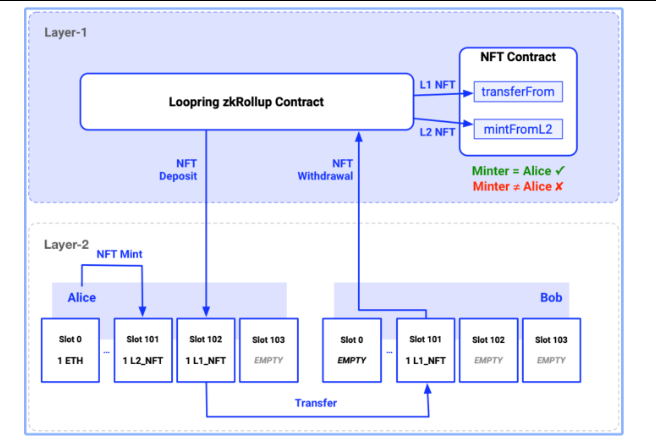
Source: zkrollups
However, once the transactions have been verified, they can now proceed to being executed through the Ethereum blockchain, ensuring the safety of the blockchain network but making transactions possible in the Layer 2 system.
This way, the processing of data on the Ethereum blockchain gets reduced, and so do the transaction fees, as compared to the processing of all transactions on Layer 1. Additionally, the number of transactions is increased because more than one transaction can be included in a single batch.
Main Features
- Carries out the transaction on the Layer 2 and finally settles it in Ethereum.
- Uses zk-rollup protocol for combining several transactions in one proof.
- Decreases the network load by restricting the amount of data to be posted on Layer 1.
Loopring for Decentralized Trading Based on Order Book
As opposed to numerous decentralized platforms that operate on automated market makers, Loopring operates on an order book mechanism. It allows buyers and sellers to make orders that are executed at market prices with possession of their tokens.
This is an infrastructure used in creating a non-custodial decentralized exchange rather than being a centralized trading platform. The users do not have to deposit their funds to a controlled exchange account in order to conduct any trade. Rather, the funds remain secure through Ethereum smart contracts while the transactions are carried out at layer 2.
Additionally, the development team of Loopring came up with Loopring Exchange, which was characterized as the first open-access decentralized exchange that used the zk-rollup protocol.
Core Trading Features
- Non-custodial trading in which users can have full control over their assets.
- Order book matching without any automated market makers.
- Smart contracts on Ethereum ensure the safety of funds.
- Components of the Loopring Ecosystem
The Loopring ecosystem is composed of various products.
The Loopring Protocol acts as the base platform for developers designing decentralized exchanges based on zk-rollup architecture. The Loopring Relayer is behind this protocol, and it helps in processing transaction information as well as order matching prior to the transactions being completed on Ethereum.
In addition, the Loopring ecosystem is equipped with the Loopring Exchange that allows customers access to Layer-2 trading services through the Loopring Protocol. Moreover, there is a Loopring self-custody mobile wallet that can hold digital assets on the Ethereum network.
The Loopring Smart Wallet is also equipped with social recovery, along with the feature for self-custody. This ensures that users can retain control over their private keys but are able to have a secondary method in case the access details are forgotten.
Loopring Offers Quick Payments and Increased Efficiency
While Loopring offers decentralized exchanges, it is also possible to make Ethereum-powered payments. These transactions happen on Layer 2 and then finally settle on Ethereum.
This technology has also claimed the capability to conduct around 200 transactions or deals per second. The rate of processing is nearly ten times faster compared to the basic throughput rate of Ethereum, as per the information given below, thus the efficiency gained through bundling transactions.
Features of Payment and Performance
- Enables Ethereum-based affordable payments.
- Can process about 200 transactions or deals per second.
- Employs Ethereum as the settlement layer for the security of transactions.
LRC Token Enables Governance and Ecosystem Services
LRC is the native ERC-20 token that operates within the Loopring ecosystem. The token owners are able to engage in governance actions and also gain entry into various ecosystem initiatives such as liquidity mining and the VIP program of the project.
The purpose of the token has changed as the protocol has advanced. Previously, the ecosystem had some functions related to staking and protocol incentives, and now, governance and ecosystem participation have become one of its main purposes. The LRC was trading at $0.09 at the moment of writing the paper, with the market capitalization amounting to $110 million.
Competition Intensifies in Ethereum Layer-2 Chains
Despite Loopring being one of the pioneers of zk-rollups in Ethereum, there have been a lot of new players in the Layer-2 space. Apart from Loopring, some other Layer-2 networks include Arbitrum, Optimism, Base, and zkSync, which provide more smart contract capabilities along with scaling solutions.
As far as Loopring is concerned, its primary use is for decentralized exchanges, crypto payments, and wallet applications. It does not function as a Layer-2 blockchain but rather serves as an application.
Conclusion
Loopring continues to be an Ethereum Layer-2 network that is created for enhancing decentralized trading and digital payment via zk-rollup technology.
The use of the protocol for processing transactions on Ethereum outside of the network increases transaction efficiency and throughput of the network. Its ecosystem combines decentralized exchange infrastructure, payment capabilities, a self-custody wallet, and the LRC token.
Frequently Asked Questions
What is Loopring?
Loopring is a Layer-2 Ethereum scaling solution built using zk-rollups technology for decentralized exchange and crypto payments, which provides users with lower costs and increased speed of transactions.
What makes Loopring reduce the costs of transactions on Ethereum?
In Loopring, numerous transactions are combined into one zk-rollup proof, which is then passed on to Ethereum; hence, a reduced amount of data is processed on the Ethereum blockchain.
Why is the LRC token required?
The LRC token is the native ERC-20 token of Loopring that is used for governance and other functions.