

Through the blockchain, DeFi has been able to increase the availability of financial products as they provide options of lending, borrowing, and managing digital assets without having to involve financial institutions. Smart contract usage in the lending process is a major factor that makes lending an integral part of DeFi.
Several lending platforms in these systems include Aave, which is one of the most popular lending platforms in DeFi. Aave started its operations on the Ethereum network but has moved into other blockchain networks.
What is Aave?
Aave is an open-source decentralized finance protocol that provides facilities for lending and borrowing of cryptos without any intermediary institutions. Instead of using financial institutions which manage deposits and provide loans, Aave makes use of smart contracts.
The project was launched in 2017 and initially named ETHLend but was later renamed Aave in 2020. The name “Aave” means “ghost” in Finnish. Since its inception, the protocol has not been limited to Ethereum and is now available on other blockchain networks as well.
While traditional lending platforms operate using credit scoring for the borrowers, the Aave protocol demands that its borrowers must collateralize their loans beyond the loan amount. Overcollateralization allows the protocol to guard itself from defaults as a result of fluctuations in the markets.
How Aave Lends and Borrows
The Aave protocol functions based on liquidity pools and not on individual pairings between the lender and borrower. The users simply lock their eligible cryptos in these pools to form liquidity.
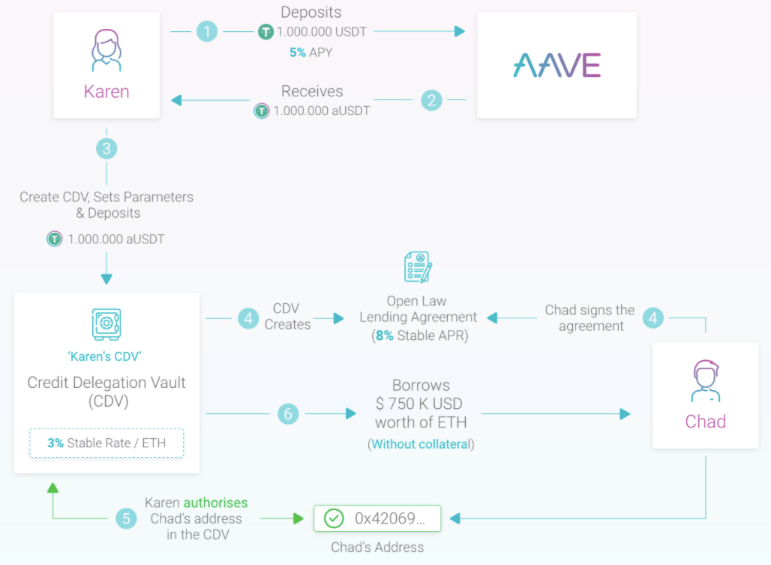
Source: holdex
Depositors receive interest from the activity of borrowing, while borrowers pay interest depending on the market demand for the assets they borrow. Interest rates are adjusted automatically in response to the supply and demand in the liquidity pool.
The process of borrowing involves the following stages:
- Customers deposit their cryptocurrencies like ETH, USDC, DAI, wrapped BTC, or other cryptocurrencies into the liquidity pools.
- Assets that are deposited earn interest from the activity of borrowers.
- Borrowers provide collateral from the cryptocurrencies in order to be able to borrow supported assets.
- The fall of collateral value below the set minimum by the protocol on account of fluctuations in the market price of assets would mean that the loan can now be liquidated.
Aave Protocol Features Flash Loans and Cross-Chain Support
Some of the features of the protocol that make Aave stand out from its predecessors include:
Flash loans are one of the most popular inventions from Aave. Unlike traditional crypto loans, flash loans are free from any collateral requirements since they have to be completed in one transaction on the blockchain network.
The flash loan facility is often utilized in scenarios of arbitrage, collateral swapping, refinancing of outstanding debt, and liquidation assistance. The platform further provides borrowing facilities at both variable and stable borrowing rates, enabling the borrowers to choose various interest rate structures according to their borrowing needs.
Starting its journey on the Ethereum blockchain network, the Aave platform has now extended its reach to Polygon, Arbitrum, Optimism, Avalanche, Base, Fantom, and Harmony networks. The latest version of Aave, i.e., Version 3, has introduced Portal, which enhances interoperability on supported blockchain networks.
Governance & Liquidity Pools in Aave
Aave works as a DAO platform where decision-making is carried out by token owners holding AAVE tokens. The token owners vote on upgrades to the protocol, assets, governance parameters, ecosystem projects, and risk management projects.
AAVE token has been used for governance and protocol purposes and not as a payment token. In liquidity pools, users will be able to deposit assets and receive aTokens like aDAI based on the deposited assets.
In addition to lending using cryptocurrency, Aave also enables users to lend certain assets in the real world via tokenized assets like real estate, freight invoices, and payment advances. From the information available, it is clear that Centrifuge helps enterprises tokenize these assets and use them via the protocol.
Conclusion
Aave remains a decentralized lending protocol, which uses smart contracts and liquidity pools to eliminate intermediaries used in traditional lending systems.
The network brings together several features like collateralized borrowing, dynamic interest rates, flash loans, decentralized governance, and multi-chain networks in one platform.
FAQs
What is Aave?
Aave is an open-source decentralized finance platform that offers the ability to lend and borrow crypto assets without intermediaries but using smart contracts instead.
How does Aave guarantee the safety of the lenders?
The borrowers need to post collateral whose value is higher than that of the loan. The position will be ready for liquidation once the collateral is below the needed level.
What are flash loans on Aave?
These are uncollateralized loans that should be borrowed and repaid within one blockchain transaction. In case of non-payment, the transaction is instantly reverted.