The increased use of blockchain technology in decentralized finance, cryptocurrency, and other smart contract implementations makes scaling the network a crucial aspect in developing it.
The release of the Fusaka Ethereum Upgrade on December 3, 2025, is the event that brought it into fame. The release was accompanied by numerous changes designed to improve the capacity of processing, availability, and scalability of the system.
Unlike many upgrades that had been concerned primarily about improving one function of the network, the Fusaka Upgrade comprised several improvements designed to boost processing power.
Moreover, this set of upgrades was tested on the Holesky, Sepolia, and Hoodi testnets before their implementation on the network.
The core changes include the increased gas limit of Ethereum’s blocks and Peer Data Availability Sampling (PeerDAS) and Verkle Trees. All of the above have an impact on data processing within the Ethereum platform.
What Was Introduced With The Ethereum Fusaka Upgrade?
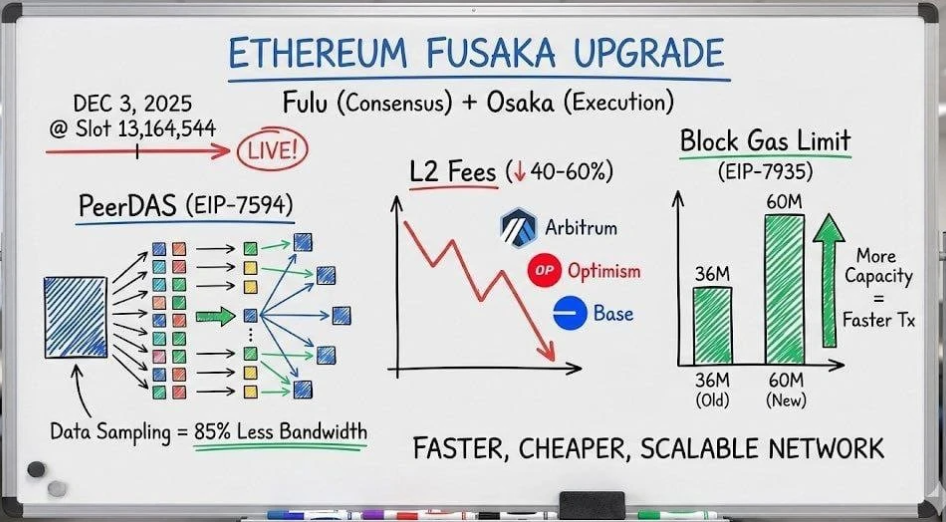
The most noticeable innovation introduced with the Ethereum Fusaka upgrade is that the gas limit on Ethereum blocks was raised from 45 million to 150 million.
When there is an increased gas limit on a network, it means more activities can be handled with more transactions per block. As such, the Ethereum network will be able to handle more activities during times of increased demand.
Source: Trading View
In addition to increasing the gas limit, the following two technical upgrades have been introduced in this update:
- Peer Data Availability Sampling (PeerDAS)
- Verkle Trees
These technological changes aimed at improving data efficiency.
Components of Fusaka
| Component | Uses | Effected Result |
| Increase in Gas Limit | Grows transaction throughput | Capacity for more transactions per block |
| PeerDAS | Performs sampling of data instead of downloading whole blobs | Less bandwidth consumption |
| Verkle Trees | Compresses proofs of blockchain state | Faster validation and less storage requirements |
| Bigger Blob Size | Leverages Layer-2 data submission | Faster validation and less storage |
Changes Made by PeerDAS in the Verification Process
Before Fusaka, the common practice involved validators downloading big chunks of data to validate blockchain data.
However, using PeerDAS, validators can use sampling of small data samples from several peers in the network without downloading big data sets.
The change will decrease the amount of information validators have to work with, but will still ensure that transaction information is available on the network. It will reduce bandwidth usage and cut down on the difficulties associated with managing the large amounts of blockchain information for validators and node operators.
Verkle Trees Optimize Blockchain Data Storage
One other crucial element of the Ethereum Fusaka Upgrade is the use of Verkle Trees. Verkle Trees create a more efficient way to organize and prove information from the blockchain data.
With an increased use of blockchain technology, the state data keeps increasing. However, the implementation of Verkle Trees ensures that there will be a reduction in the storage capacity while making the verification process efficient. This design is expected to be future-friendly without needing increased hardware capacity to cope with network growth.
Why the Fusaka Upgrade Was Needed by Ethereum
Ethereum still facilitates activities within decentralized finance applications, non-fungible tokens platforms, Layer-2 protocols, and smart contracts.
An increased number of transactions leads to resource utilization by the network. To make Ethereum cope with such activities, Fusaka was introduced.
The update revolves around three key aims:
- Boosting transaction throughput
- Enhancing data availability for Layer-2 networks
- Improving overall network efficiency
Apart from that, the developers created this update to assist in decentralization by reducing the extra load that the upgrade might have on the validators and node operators.
In spite of the elevated gas limit resulting in big blocks, PeerDAS and Verkle Trees are used to mitigate the extra load resulting from the increased capacity of the network.
Ethereum Fusaka Upgrade Deployment Timeline
The launch was carried out through a series of tests before implementation into the Ethereum mainnet.
| Network | Activation Date |
| Holesky Testnet | October 1, 2025 |
| Sepolia Testnet | October 14, 2025 |
| Hoodi Testnet | October 28, 2025 |
| Ethereum Mainnet | December 3, 2025 |
This way, developers were able to monitor its performance, find possible problems, and ensure the correct operation of its capabilities in the final version.
Effect on Users, Developers, and Validators
There are multiple categories of stakeholders impacted by the Ethereum Fusaka Upgrade.
Users
Among the user effects are:
- Fast confirmation times of transactions in case of high loads
- Increased consistency of transaction processing capability
- Developers
Developer benefits include:
- Higher blob storage capability for Layer-2 networks
- Enhanced data availability features
- Effective infrastructure to scale apps
- Validators and Node Operators
Beneficiaries among Validators and Node Operators include:
- Decreased need for bandwidth thanks to PeerDAS
- Easier process of validation
- Optimized networks to accommodate increased block sizes
- Pre-launch Security Measures
In preparation for launch, the Ethereum Foundation ran a four-week bug bounty program geared towards uncovering any possible vulnerabilities in the new upgrade.
This effort rewarded participants with bounties worth up to $2 million. The program was intended to encourage security researchers and community participants to review the code before the mainnet launch.
The review process formed part of the broader preparation effort that preceded the activation of the Ethereum Fusaka Upgrade.
Conclusion
As part of the Ethereum Fusaka Upgrade, there was an increase in the block gas limit, an introduction of PeerDAS, and Verkle Trees to facilitate scalability and improve data management capabilities. After testnet implementations and a security evaluation, the Ethereum Fusaka Upgrade was rolled out to the Ethereum mainnet on December 3, 2025.
FAQs
What is the Ethereum Fusaka Upgrade?
A network update in which a raise in block gas limit and incorporation of PeerDAS and Verkle Trees occurred.
When Was the Ethereum Fusaka Upgrade Introduced?
The Ethereum Fusaka Upgrade was rolled out to the Ethereum mainnet on December 3, 2025
What is PeerDAS?
Peer Data Availability Sampling enables the validators to check for data availability through random sampling rather than downloading whole data blobs.