

The CLARITY Act is still progressing through Congress as members attempt to create a proper regulatory structure within the country that will govern digital assets. Officially known as the Digital Asset Market Clarity Act of 2025, this piece of legislation aims to address the years of uncertainty regarding the regulations of cryptocurrency and the division of roles within various agencies.
This proposed legislation attempts to clarify whether or not cryptocurrencies are considered securities and when they must be considered commodities. However, it also provides the requirements on how to regulate exchanges, brokers, dealers, stablecoin transactions, and some decentralized finance.
The CLARITY Act is considered one of the best efforts at creating an organized system of regulation for the digital asset industry, along with outlining the duties of the Securities and Exchange Commission and the Commodity Futures Trading Commission.
Source: Coingecko
The bill has been passed in the House of Representatives, but there remain some issues that need to be addressed for its Senate vote to be taken up successfully.
Legislative Process and Status
The CLARITY Act was sponsored by Representative French Hill and Representative G.T. Thompson from the House Financial Services Committee and the House Agriculture Committee, respectively, on 04 May 2025. It was voted through in the House on 17 July 2025 with 294 votes in favor and 134 against.
Senate Committees reviewed the proposal in 2026. The Senate Banking Committee approved the bill in May, while the Senate Agriculture Committee advanced related legislation addressing digital commodity intermediaries.
CLARITY Act Legislative Timeline
| Event | Date | Result |
| Bill Introduction | May 2025 | Introduced in the House |
| House Vote | July 17, 2025 | Passed 294-134 |
| Senate Agriculture Action | Jan. 29, 2026 | Companion bill advanced |
| Senate Banking Vote | May 14, 2026 | Approved 15-9 |
| Current Stage | 2026 | Senate versions being combined |
Lawmakers are currently working to merge separate Senate proposals into a single version that can move to the Senate floor for consideration.
CLARITY Act Defines SEC and CFTC Responsibilities
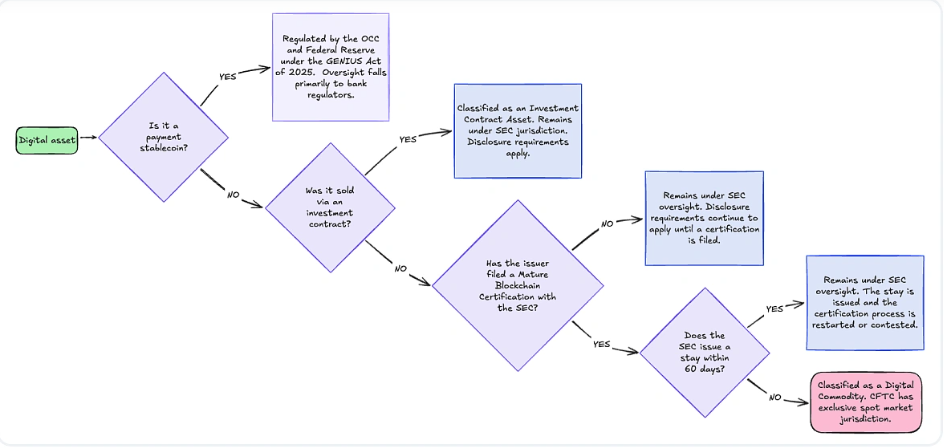
One of the most significant elements of the CLARITY Act is the division of oversight between the SEC and the CFTC.
Under the proposal, digital assets classified as investment contract assets would remain under SEC jurisdiction. Generally, such assets are associated with scenarios in which the expected profit is generated by the activities of a central company or management.
Digital commodities will be regulated by the CFTC. In addition, the bill gives the CFTC the power of direct jurisdiction over digital commodity spot markets.
Key Regulatory Provisions
There are several key regulatory provisions within the proposed legislation:
- The SEC will regulate investment contract assets.
- The CFTC will regulate digital commodities and spot markets.
- Asset categorization will be performed using decentralization criteria outlined in the legislation.
The legislation aims to create a regulatory regime that helps determine which regulator should have jurisdiction over certain digital assets.
Mature Blockchain Test Sets Decentralization Criteria
In accordance with the CLARITY Act, a mature blockchain test is presented by legislators. This model sets out criteria that the blockchain network needs to satisfy for any digital asset to be regulated by the CFTC, rather than the SEC.
Specifically, the criteria center on decentralization criteria, such as the distribution of tokens, voting power, access to the open-source code of the blockchain, and practical use of the asset.
Criteria Evaluated During Testing
The criteria include the following:
- Control of a substantial portion of tokens by one entity.
- Whether governance authority is distributed across participants.
- Whether the network operates with open-source infrastructure.
For established networks, additional ownership distribution requirements would apply before a transition in regulatory classification could occur.
New Operational Rules for Exchanges, Stablecoins, and DeFi
Aside from the asset classifications, the CLARITY Act introduces operational rules for firms operating in the U.S. in the crypto space.
Digital commodity exchanges, brokers, and dealers would be required to register with the CFTC. The registered businesses will comply with federal regulations on customer protection, reporting, and trading practices.
The act also raises compliance obligations concerning Know Your Customer policies, Anti-Money Laundering rules, suspicious transaction reporting, and auditing.
Compliance Obligations for Participants
This proposal includes the following compliance obligations:
- Exchange registration.
- KYC/AML compliance programs.
- Auditing and reporting obligations.
- Tax reporting obligations.
Furthermore, the new bill would expand the meaning of “broker” to include more platforms that will be required to file 1099-DA statements with customers and the IRS.
Discussions of the Stablecoin section are still ongoing in the Senate. Existing draft text refers to limits on rewards associated with holding stablecoins without trading, while offering some exemptions for rewards associated with transactions.
In addition, the bill provides a so-called carve-out from the Blockchain Regulatory Certainty Act. This section is aimed at protecting specific non-custodial software providers who do not control customer funds from becoming money transmitters.
What comes next
While the bill has been passed by the House and related proposals have progressed in committee in the Senate, some of the areas that are under discussion include restrictions on the rewards for stablecoins, the definition of DeFi, ethics, and SEC authority under the regulatory framework.
Following an agreement by the lawmakers on a Senate version of the bill, the bill will then go before a full Senate vote.
Conclusion
The CLARITY Act still represents one of the most influential acts concerning regulation of digital assets that is being considered in the USA. This act tries to determine the jurisdiction borderlines of both SEC and CFTC, set standards for decentralized networks, provide exchange registration requirements, increase the range of regulations, and determine the reporting requirements. Although some legislative measures have already been taken, the bill is still going through the process in the Senate.
FAQs
What is the CLARITY Act?
The CLARITY Act is a proposed U.S. law that aims at creating regulations for cryptocurrencies and digital assets as well as laying down the duties of SEC and CFTC.
Has the CLARITY Act become a law?
No. The bill has already been approved by the House and has made its way through the Senate committee, but it has not been officially ratified by the Senate yet.
What does the CLARITY Act change?
The bill will set out rules for classifying digital assets, increase CFTC’s jurisdiction, require exchanges to register and set out the compliance requirements for market participants.
What is the Mature Blockchain Test?
It is a measure that defines decentralization conditions for the asset to move from SEC jurisdiction to CFTC jurisdiction.