
The blockchain network employs various features such as fixed transaction fees, determinate settlements, privacy tools aimed at ensuring compliance, and interoperability solutions in order to enable users to conduct transactions in the form of digital dollars.
While most other blockchain networks are general-purpose, the Arc blockchain network aims to facilitate stablecoin payments and services using USDC transactions.
The development of the Arc blockchain network as a private blockchain network has been prompted by the understanding that Circle has regarding the shortcomings in developing stablecoin technology in blockchain networks.
From the information released by the firm, the Arc network will primarily serve payment providers, financial institutions, developers, and businesses involved in stablecoin transactions.
Circle made it known that the testnet version of the public chain of Arc is scheduled for release in October 2025, but the beta version of the mainnet would be released in 2026. Moreover, the white paper for the Arc blockchain was also released in May 2026.
Arc Blockchain At a Glance
| Feature | Description |
| Network Type | Layer-1 blockchain |
| Purpose | Financial applications using stablecoins |
| Main Cryptocurrency | USDC |
| Testnet | October 2025 |
| Mainnet Beta | To be launched in 2026 |
| White Paper | Issued in May 2026 |
| Consensus Engine | Malachite BFT based on Tendermint |
| ARC Token Supply | Issue of 10 billion tokens |
Why Circle Developed Arc Blockchain
Several issues were identified by the firm that affected the architecture of the network, such as the volatility in transaction fees, a probabilistic settlement process that causes chain reorganization, liquidity that is distributed across different blockchain networks, and a lack of privacy solutions.
Source: Yellow
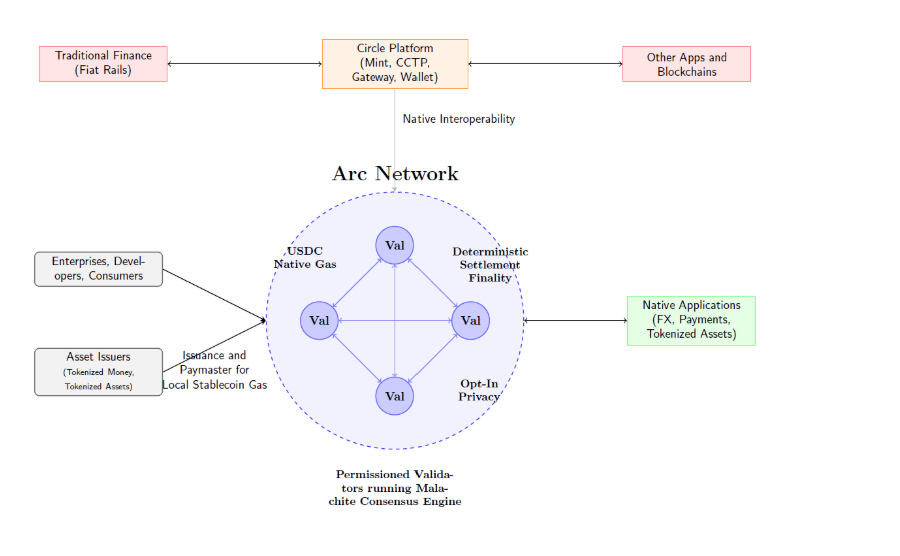
The Arc blockchain network tackles these aspects through the use of deterministic transaction settlement, fees in terms of USDC, privacy features, and interoperability with other blockchain systems.
Key challenges identified
- Transaction fee volatility across blockchain networks.
- Fragmented liquidity and settlement uncertainty.
- Limited privacy options for commercial transactions.
One of the distinguishing technical characteristics of Arc is its approach to transaction fees. Instead of charging the users in volatile native cryptocurrencies to cover the network costs, the blockchain charges the transactions using the USDC token.
According to Circle’s claim, such a system was put in place to ensure that the costs of transactions are predictable without being subjected to any price volatility.
The fee model is derived from Ethereum’s EIP-1559 proposal, but the block-by-block adjustment of the fee is replaced by the weighted moving average on the network demand. Circle said this model smooths fee changes over time while directing collected fees to an on-chain Arc Treasury.
Arc also supports additional stablecoins as transaction fees through a paymaster system, allowing developers and applications to use multiple supported stablecoins while maintaining USDC as the primary settlement asset.
Consensus Model and Validator Structure
Arc operates using the Malachite Byzantine Fault Tolerant consensus engine, which is based on the Tendermint architecture. Circle stated that validator participation is currently permissioned and selected according to operational resilience, geographic distribution, and regulatory compliance requirements.
The company said the network is expected to transition toward a permissioned proof-of-stake model. Under this framework, validators would continue producing blocks while receiving rewards generated from newly issued ARC tokens and network fee revenue converted into the native token.
To reduce opportunities for unfair transaction ordering, Circle said it is developing additional infrastructure that includes encrypted mempools, multi-proposer consensus, and batch transaction processing.
Consensus highlights
- Malachite BFT consensus based on Tendermint.
- Permissioned validator participation.
- Planned transition to permissioned proof-of-stake.
ARC Token Distribution and Network Incentives
The Arc white paper outlines an initial supply of 10 billion ARC tokens. According to the published allocation, 60% of the supply is reserved for ecosystem activities, including developer grants, participation programs, and token sales.
Circle is allocated 25% of the supply, while the remaining 15% is designated as a long-term reserve intended to address unforeseen network conditions.
The company said annual issuance is expected to begin at approximately 2% to 3%, with a stated long-term objective of reaching inflation neutrality, depending on network growth.
ARC also functions as the coordination mechanism for the blockchain as it transitions toward proof-of-stake. Circle said the token’s responsibilities may expand alongside additional protocol services, applications, and developer tools introduced over time. Stakers may also qualify for discounted transaction rates and access to selected ecosystem services.
Privacy and Cross-Chain Functionality
The Arc Blockchain has a privacy protocol that is meant to be a compromise between privacy and regulation. The first implementation, confidential transfers, conceals transaction amounts while keeping wallet addresses publicly visible.
Smart contracts communicate with Trusted Execution Environments that perform private computation, while institutions may selectively disclose transaction information through view keys when required by auditors or regulators.
Circle said future development plans include support for private state management, confidential computation, zero-knowledge proofs, multi-party computation, and fully homomorphic encryption.
The network also integrates several existing Circle services. Mint converts fiat currencies to USDC on the Arc platform, whereas the Cross-Chain Transfer Protocol moves USDC across compatible blockchain networks using burn and remint mechanism. Gateway provides chain-agnostic USDC balances with automated liquidity rebalancing for supported wallets and applications.
Planned privacy technologies
- Zero-knowledge proofs (ZKPs).
- Multi-party computation (MPC).
- Fully homomorphic encryption (FHE).
Development Timeline and Market Position
According to Circle, Arc enters a blockchain market that already includes public Layer-1 networks such as Bitcoin, Ethereum, and Solana, stablecoin-focused blockchains including Plasma and Frontier, Layer-2 networks such as Arbitrum and Base, and private payment networks.
The company identifies its role as the issuer of USDC as one of the characteristics supporting Arc’s infrastructure strategy.
Circle also disclosed that ARC completed a $222 million token presale in May 2026 at a fully diluted valuation of $3 billion. The funding round was led by Andreessen Horowitz and included participation from BlackRock and Apollo Funds.
According to the company, the network is intended to support programmable financial operations, real-time settlement, tokenization, and stablecoin-based payments as development continues toward the planned mainnet beta release in 2026.
Conclusion
Arc is Circle’s Layer-1 blockchain developed specifically for stablecoin-based financial applications. According to the company’s published information, the network combines deterministic settlement, USDC-denominated transaction fees, permissioned validator participation, modular privacy capabilities, and interoperability services into a platform designed for programmable financial operations.
FAQs
What is the Arc Blockchain?
The Arc Blockchain is the Layer-1 blockchain from Circle that has been created to process payments using stablecoins. Its base currency is the USDC.
When will Arc launch?
Circle launched the Arc public testnet in October 2025 and expects the mainnet beta rollout to take place during 2026.
How are transaction fees paid on Arc?
Denominating transaction fees in USDC, unlike having another volatile native token, is what Arc does. Also, Arc allows for use of other stable coins as gas via a paymaster protocol.
How many ARC tokens are there in total supply?
The white paper for Arc indicates that the supply starts at 10 billion ARC tokens, where 60% is used by the ecosystem, 25% goes to Circle, and 15% remains in the reserve.