The digital privacy factor has continued to influence the evolution of messaging services due to issues of metadata harvesting, centralized architecture, and identity of users among other aspects of online communication.
Whereas end-to-end encryption has become the common characteristic of most messaging platforms, it is not possible to eliminate all cases of data harvesting. BChat was created using a different approach by excluding phone number registration and making use of a decentralized architecture.
Created as part of the larger Beldex ecosystem, the platform makes use of encrypted communication, distributed infrastructure, and cryptographic identities without having any centralized account system.
What Is BChat?
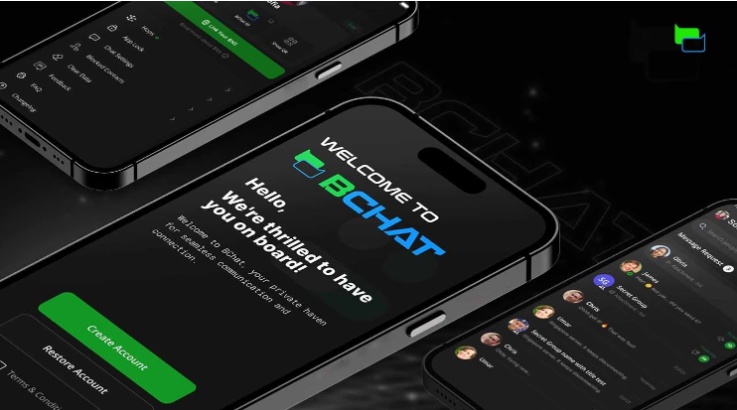
BChat is an open-source messaging service that was launched to the public in 2022 on Android, iOS, Windows, macOS, and Linux platforms. BChat is an anonymous communication service in which users do not have to sign up by providing a phone number, an email address, or a username.
Each user gets their own account based on the cryptographic identity with the help of the recovery seed phrase, the unique BChat ID, and the Beldex wallet address. Communication takes place using these identities.
The app is a part of the Beldex suite, which includes services such as BelNet, Beldex Browser, Beldex Privacy Protocol, and BDX utility token.
Highlights
- An open source messaging app available from 2022.
- Supported on Android, iOS, Windows, macOS, and Linux.
- No need for telephone numbers or emails to register.
How BChat Deals with Identity and Messaging
BChat differs from other messaging apps in that, unlike the latter which use centralized databases for accounts, it creates its own cryptographic identity on a user’s device. The recovery phrase typically consists of 24 to 26 words and is used to restore access if needed. If the recovery phrase is lost, the associated account cannot be recovered.
To simplify user identification, the Beldex Name Service allows users to register human-readable “.bdx” names that map to their unique BChat IDs. This system replaces the need to exchange long cryptographic identifiers while maintaining the underlying identity structure.
Messages are encrypted before leaving the sender’s device and are transmitted across the Beldex network through multiple independent service nodes. According to the project, each message is routed through at least three nodes before reaching its destination.
Identity and Messaging Features
- Uses cryptographic identities instead of personal contact details.
- Supports human-readable .bdx names through the Beldex Name Service.
- Routes encrypted messages through multiple decentralized service nodes.
BChat Privacy Features Focus on Metadata Reduction
A defining feature of BChat is its effort to reduce metadata collection alongside message encryption.
Many mainstream messaging platforms already use end-to-end encryption to protect message content. Metadata, which includes information on when the message is sent, who communicates with whom, and timestamping on message delivery, may remain accessible through certain legal procedures.
Source: Defiant
An FBI document first reported by Rolling Stone in 2021 stated that investigators could obtain certain WhatsApp metadata despite encrypted message content.
A separate court case involving former U.S. Treasury Department official Natalie Edwards also referenced WhatsApp message records as part of legal proceedings after investigators documented approximately 70 messages exchanged with a BuzzFeed reporter following publication of leaked government reports.
BChat removes phone number registration entirely, reducing one source of personally identifiable information commonly associated with messaging accounts. Users interact through cryptographic identifiers instead of mobile numbers or email addresses.
Privacy Features
- No phone number or email registration.
- End-to-end encrypted communications.
- Lower metadata exposure with decentralized architecture.
BChat Overview
| Attribute | Details |
| Launch | Released publicly in 2022 |
| Account Registration | Without any need for phone number or email |
| Identification | System uses recovery seed, BChat ID and Beldex wallet address |
| Encryption | Open-source TextSecure encryption |
| Network | Larger than 2,000 Beldex masternodes |
| Message Routing | Message routed via at least three nodes |
| Available Platforms | Android, iOS, Windows, macOS, Linux |
| Additional Features | Group chat support, disappearing messages, media, audio message sharing, emoji reactions, text formatting |
Decentralized Architecture Enables BChat Communication
Unlike conventional communication apps that use corporate servers, BChat uses its own decentralized network to route messages.
The network currently consists of more than 2,000 masternodes that relay encrypted communications without accessing message contents. Because routing responsibilities are distributed, the application avoids maintaining a centralized repository of user accounts or message histories.
The application also uses the open-source TextSecure encryption protocol, the same protocol that originally formed the foundation of Signal’s encryption model.
Alongside private messaging, BChat supports group conversations, disappearing messages, image sharing, video transfers, voice notes, emoji reactions, and text formatting features including bold, italics, and strikethrough text.
Network Characteristics
- Distributed routing through independent masternodes.
- No centralized storage of user identities or message histories.
- Supports a range of messaging and media-sharing features.
How BChat Connects With the Beldex Ecosystem
BChat operates alongside several other services built on the Beldex network.
Each BChat account includes a corresponding Beldex wallet address, allowing the same recovery phrase to function with both the messaging application and the Beldex wallet. The native BDX asset serves as the utility token across the wider network.
Other components include BelNet, an onion-routing virtual private network, Beldex Browser for Web3 access, and the Beldex Privacy Protocol, which is designed to improve cross-chain privacy.
According to the project roadmap, the Beldex blockchain is scheduled to incorporate the Dandelion++ network protocol during the second quarter of 2026. The protocol is intended to make network activity more difficult to trace or correlate at the network level.
Ecosystem Components
- BelNet privacy-focused VPN.
- Beldex Browser for Web3 access.
- Beldex Privacy Protocol and BDX utility asset.
BChat Uses a Different Account Model Than Conventional Messaging Apps
Many widely used messaging platforms require users to verify a phone number before creating an account. The telephone number and email address may also have ties to other online services such as social media sites and identity verification systems.
BChat instead uses cryptographic identities that can be produced locally and do not necessitate the use of personal contact details.
In addition, because there is no need for centralized account registration, there is less need for the involvement of a single company that manages the users’ identities or manages the message distribution infrastructure.
Conclusion
With the advancements in privacy technologies, BChat is one instance of a decentralized messaging system which utilizes encryption, decentralized routing, and identity management.The application remains part of the broader Beldex ecosystem, where messaging, privacy services, and blockchain infrastructure are designed to operate together through shared decentralized technology.
Frequently Asked Questions
Does BChat require a phone number to register?
No. BChat makes use of cryptographic identities to create accounts rather than mobile numbers or email addresses.
How are messages sent in BChat?
The messages are first encrypted and then transferred via several decentralized nodes on the Beldex network.
Which encryption protocol is used by BChat?
BChat employs TextSecure encryption protocol, which is an open-source protocol that has been used in the development of Signal encryption protocol.