Blockchain is the decentralized ledger of transactions that occur through the distributed network, but not the centralized database.
Some performance metrics are used to estimate the efficiency of the blockchain network, such as TPS rate, block generation time, and finality time.
Data provided by Chainspect of September 9, 2026, reveals significant disparity between practical usage and theoretical performance capabilities of blockchains.
According to its one-hour screenshot, Solana had 1,554 transactions per second (TPS), Internet Computer had 1,493 TPS, and BNB Chain had 211 TPS.
The comparison of these indicators is based on the indicator of TPS in real time. However, it also takes into account such indicators as maximum observed TPS, theoretical TPS, block time, and finality.
These metrics give the different perspective of performance because the maximum or theoretical capacity of the blockchain network does not correspond to the actual transaction activity.
Fastest Blockchains Based on Live Throughput
Chainspect’s snapshot covered 10 networks. Solana and Internet Computer were separated by 61 TPS.
RankBlockchainReal-Time TPSMax TPSFinality1Solana1,55411,01512.8s2Internet Computer1,49325,6210s3BNB
Chain2113,252650ms4Stellar1342030s5TRON130.3439.457s6Base113.92,51513m 13s7Aptos103.312,9330s8Sui74.291,1250s9Polygon67.22537.55s10BSV Blockchain40.981,9751h
Chainspect recorded about 940 million transactions for Solana and roughly 903 million for Internet Computer. Solana’s snapshot showed a 316-millisecond average block time and 65,000 TPS theoretical capacity. Galaxy reported that Solana’s non-vote throughput remained in the low thousands during the second quarter of 2026.
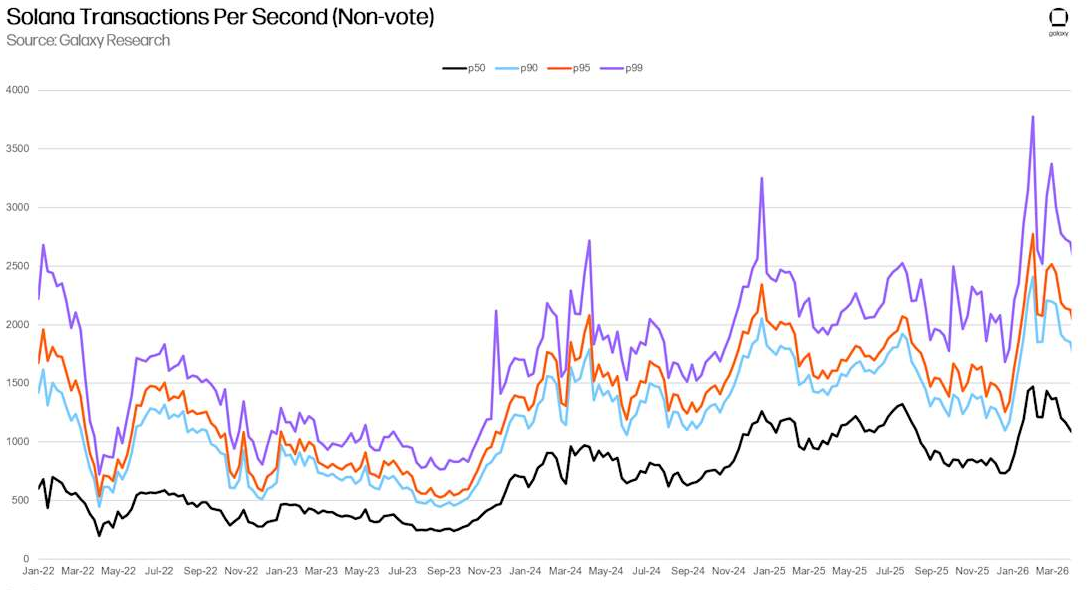
Source: Galaxy
Internet Computer posted 1,493 TPS against a maximum observed rate of 25,621 TPS. Its developer documentation says blocks are finalized in roughly one second and distinguishes throughput from computational capacity, making direct TPS comparisons between different blockchain architectures imperfect.
BNB Chain, Stellar, TRON, and Base Performances
The performance of BNB Chain stood at 211 TPS with 450 milliseconds of block time and 650 milliseconds of finality time. According to its 2026 roadmap, benchmark throughput was estimated at around 5.20. A March 2026 SEC filing for a VanEck BNB product reported approximately 187 TPS as of March 4.
Stellar and TRON had almost equal real-time transaction speed, but their finality numbers were quite different. The speed of transactions for Stellar was 134 TPS, and finality was 0 seconds, while the real-time speed for TRON was 130.3 TPS and finality at 57 seconds.
In addition, the real-time speed of For Base was 113.9 TPS, while its maximum throughput was 2,515 TPS. The finality of Chainspect was recorded at 13 minutes and 13 seconds. Base is an Ethereum Layer 2; hence, it relies on Ethereum for settlement.
Aptos, Sui, Polygon, and BSV Highlight Capacity Gaps
Aptos, the biggest Layer-1 proof-of-stake blockchain with high performance, managed to deliver a transaction speed of 103.3 TPS, when its theoretical maximum is 160,000 TPS and the actual maximum is 12,933 TPS. Sui, on the contrary, delivered 74.29 TPS, while its theoretical maximum throughput is 120,000 TPS, the actual maximum.
The supplied data states that these transactions moved through off-chain channels, so the figure does not represent ordinary Sui Layer 1 throughput.
According to The Polygon, the blockchain attained a speed of 67.22 TPS with a block time of 1.5 seconds and a finality of five seconds. The BSV Blockchain has attained a speed of 40.98 TPS despite having a theoretical speed of 31.81.
Key notes in the guide
- Solana and Internet Computer logged more than 1,400 real-time TPS in the snapshot on September 9th.
- BNB Chain logged 211 TPS, while Stellar, TRON, and Base were stuck in the range of 113.9 to 134 TPS.
- Theoretical and maximum throughput figures can differ sharply from live activity across networks.
Conclusion
The live throughput on the various chains does not always correlate with theoretical maximum capacity, according to Chainspect data.
For instance, Solana recorded a throughput speed of 1,554 TPS, and Internet Computer came in second place with 1,493. BNB Chain has 211 TPS, while Stellar has 134 TPS, and TRON had a rate of 130.3 TPS.
Base, Aptos, Sui, Polygon, and BSV Blockchain showed a progressively decreasing TPS rate in the snapshot. The data also shows why blockchain speed cannot be assessed through TPS alone. Finality varied considerably across the networks, while theoretical and maximum observed throughput figures were often much higher than live activity.
FAQs
What are the fastest blockchains by real-time TPS?
Based on the September 9 Chainspect snapshot, Solana recorded 1,554 TPS and Internet Computer recorded 1,493 TPS.
Which network had the highest theoretical TPS?
The Aptos data indicated a theoretical throughput of 160,000 TPS, whereas Sui’s was 120,000 TPS.
Why is the finality important for the speed comparison?
Similar TPS figures can still come with very different finality, as seen with Stellar and TRON.