

The switch from proof of work to proof of stake on the Ethereum blockchain has kept impacting how the blockchain is securing its transactions and rewarding participants. Since then, the amount of ETH staked on the Ethereum blockchain has been increasing, and withdrawals have become possible thanks to the Shapella update in April 2023.
With the introduction of the Pectra update in May 2025, the economics of validation have been transformed as eligible validators were allowed to compound their rewards for balances of up to 2,048 ETH. Ethereum has 42.44 million ETH staked, which accounts for 35.17% of its circulating supply.
The expansion of staking has also increased attention on validator concentration, operational risks and Ethereum’s future issuance policy. A proposal published in August would reduce staking issuance as the proportion of staked ETH rises, but the proposal has not been adopted.
How Ethereum staking works
Validators take part in consensus in place of miners in Ethereum. The role of validators is to propose blocks and to attest to blocks proposed by other validators. They get rewards for performing these tasks well and penalties for not participating and not complying with the consensus.
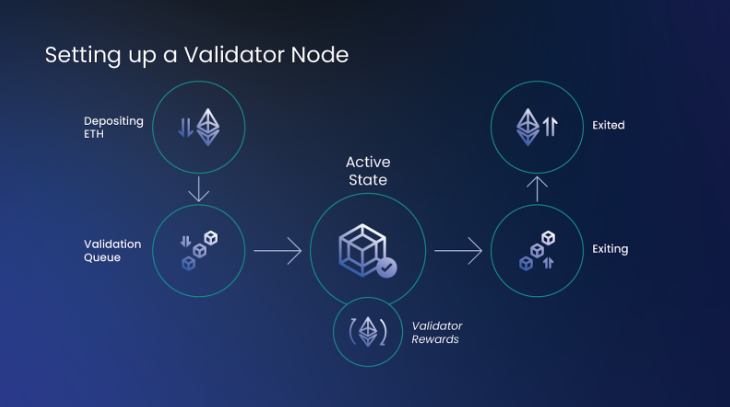
Source:Hextrust
Direct validator operation traditionally requires 32 ETH. Holders with smaller balances can participate through pooled or liquid staking services, which transfer much of the infrastructure responsibility to third-party operators.
The approximately 2.62% reward rate reported by Staking Rewards is an estimate rather than a guaranteed return. Actual results can differ because of validator performance, commissions, execution-layer rewards, and the structure of the staking service.
| Staking metric on Ethereum | Current/relevant statistic |
| ETH staked | 42.44 million ETH |
| Share of ETH staked to supply | 35.17% |
| Estimated reward rate | 2.62% |
| Proof of stake on Ethereum | September 2022 |
| Shapella upgrade | April 2023 |
| Pectra upgrade | May 2025 |
| Maximum eligible validator | 2,048 ETH |
Solo staking offers control but adds operational duties
Solo staking gives users direct control over their validators and staking infrastructure. Operators are responsible for running Ethereum’s consensus and execution software, maintaining uptime, securing keys, applying software updates, and monitoring their validators.
Pectra increased the maximum effective balance from 32 ETH to 2,048 ETH through EIP-7251. Eligible compounding validators can earn consensus rewards on their full balance up to that limit, with additional ETH above the former 32 ETH threshold able to contribute to effective balance.
Legacy validators operate differently. Rewards above 32 ETH are automatically swept to the withdrawal address instead of being added to the validator’s effective balance.
The greater control of solo staking comes with greater responsibility. Infrastructure failures, incorrect configurations, software issues, poor key management and duplicate validator instances can create operational problems.
Pooled and liquid staking lower barriers
Pooled staking allows multiple users to combine ETH so an operator can run validators for them. This removes the need for an individual participant to supply 32 ETH and reduces the technical infrastructure required from the user.
Centralized exchanges are one example of pooled staking, whereas decentralized protocols are another example. With centralized services comes the risk of custody and counterparty risks, and on the other hand, decentralized systems may expose one to smart contract risks, governance risks, and token liquidity risks.
The concept of liquid staking adds another dimension since the user receives tokens that represent staked ETH and the rewards on it. These tokens may have the potential to be moved or used for decentralized finance applications while the staked ETH remains locked with the validators.
Nonetheless, liquid staking comes with extra risks. Lido has highlighted smart-contract, technical, slashing, and staked-token price risks as per the June 2026 release.A liquid staking token can also trade below the value of its underlying ETH during market stress.
Slashing remains a major validator risk
Ethereum can slash validators for specific forms of provably conflicting behavior, including signing two different blocks for the same slot or making contradictory attestations.
Slashing involves an initial penalty followed by a forced exit process and a correlation penalty. The latter becomes larger when more ETH is slashed during the same period. In an extreme mass-slashing event, losses can reach a validator’s entire effective balance.
Operational risks can be controlled by professional staking service providers through monitoring, distribution of infrastructure, and diversification of clients; however, protocol risk and slashing risks remain.
Takeaways
- There is about 42.44 million ETH staked on Ethereum, representing 35.17% of total supply.
- Staking methods differ in control, liquidity, capital requirements and technical risk.
- EIP-8361 proposes reducing staking issuance as the staking ratio increases, but it remains a proposal.
Ethereum staking rewards face a policy debate
The growing amount of staked ETH has intensified discussion over Ethereum’s future issuance model. On Aug. 4, researchers including Ethereum Foundation researcher Justin Drake published EIP-8361, which proposes a “tapered issuance burn” that would destroy a progressively larger share of validator rewards as more ETH becomes staked.
The proposal is not an adopted protocol rule. The Block reported Aug. 12 that its modeling could reduce annual consensus yield from roughly 2.6% to about 1.2% at current staking levels if implemented, with the transition phased over 18 months.
Institutional participation is also increasing. The Ethereum Foundation stated in February 2026 that it had started staking 70,000 ETH from its treasury. The Block reported in August that Bitmine had more than 5 million ETH staked.
Ethereum’s Glamsterdam upgrade is planned for Q4 2026, with the Platåberget testnet launched Aug. 17 for early testing. The upgrade is focused on scaling and network architecture rather than directly changing basic staking mechanics.
Conclusion
Ethereum staking has grown to about 42.44 million ETH as validator participation continues to expand. The current estimated reward rate remains around 2.62%, but returns and risks differ substantially between solo, pooled and liquid staking.
Meanwhile, EIP-8361 has opened a debate over how future staking issuance should respond to the growing share of ETH securing the network.
FAQs
What is the current number of staked ETH?
The current number is 42.44 million ETH, representing 35.17% of the total circulating supply, according to Staking Rewards, August 27, 2026.
Is staking on Ethereum without any risk?
No. Depending on the mode chosen for staking, there is the risk of operational, liquidity, smart-contract, counterparty, and slashing.
Are staking rewards on Ethereum reduced?
No. There are no proven reward reductions. However, there is EIP-8361 proposing changes to issuance.