

A guide to DeFi yield farming is becoming more important as the different methods of DeFi offer ways to earn through holding digital assets.Ethereum staking currently offers a comparatively straightforward yield mechanism, while liquidity pools, lending markets and automated strategies can produce higher but more variable returns.
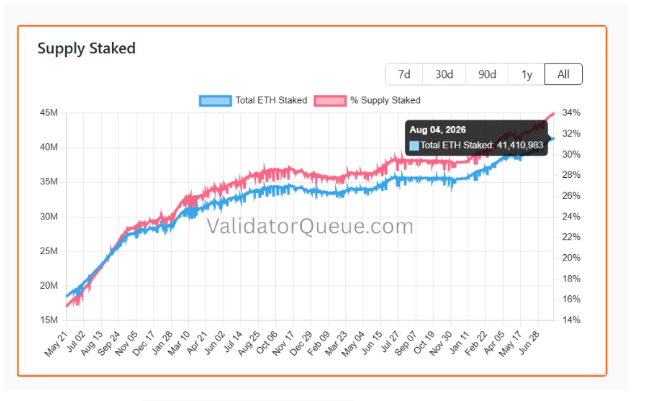
All-time high as of August 2026 Source: Coinpedia
According to the official staking metrics of Ethereum, roughly 39.45 million ETH are staked by over 885,000 validators, with the current APR for validators standing at about 2.63%.
DeFi Yield Farming Guide Explains How Profits Are Made
Yield farming is a process of placing crypto assets into DeFi protocols in order to make money. The profits will be derived from lending interest rates, transaction fees, or any combination of the above, depending on the specific yield farming strategy used.
For instance, with Aave, users can stake their crypto in liquidity markets and earn interest.Its supply rates change according to borrowing utilization and governance parameters, meaning the displayed return can change after funds are deposited.
Liquidity provision uses another mechanism. In Automated Market Makers (AMMs), such as Uniswap, individuals add token pairs to pools for trading purposes. Here, liquidity providers get rewarded a share of trading fees, and the composition of their portfolio is subject to changes due to traders exchanging one token with another.
Some strategies incorporate several DeFi services.A user can stake ETH, receive a liquid staking token and then use that token in another protocol or liquidity pool. Each additional layer creates another potential source of yield while adding further smart-contract and market exposure.
Sources of income in DeFi include
- Interest earned from lending demand.
- Fees collected from trading, which are paid out to liquidity providers.
- Tokens minted by DeFi systems.
Staking vs. Yield Farming – Different Models
Staking on Ethereum has an immediate connection with the proof-of-stake consensus algorithm operations. An individual validator locks up 32 ETH and runs validator software to engage in transaction verification and block production. There are incentives provided for correct engagement and penalties for bad performance.
Pooled staking lets individuals with under 32 ETH stake with the help of outside services. Ethereum.org notes that these methods introduce different trust, execution and technical risks compared with operating a validator directly.
Yield farming has a different return structure. APYs can change with trading activity, borrowing demand, liquidity conditions, token prices and protocol incentives. A high displayed APY can therefore change substantially as market conditions shift.
Bitwise reported that Ethereum’s annualized staking yield was 2.84% in the second quarter of 2026, compared with 6.25% for Solana. The report also found that newly issued tokens represented 93% of Ethereum staking rewards and more than 90% of Solana staking rewards during the period.
Impermanent Loss Affects Liquidity Providers
Impermanent loss occurs when a liquidity provider’s position becomes worth less than holding the deposited assets outside the pool under the same market conditions.
Automated market makers adjust token balances as trades occur. When one asset changes significantly in price relative to the other, arbitrage activity changes the pool’s composition. A provider can therefore hold fewer units of an appreciating asset than would have been held without providing liquidity.
Uniswap describes the effect as resulting from changes in token prices after liquidity is added. The impact depends on the relative price movement between the assets.
Concentrated liquidity adds another consideration. However, the Uniswap protocol allows the liquidity providers to pick their own price ranges, increasing efficiency but requiring more management. When the price moves beyond the selected range, the exposure to impermanent loss increases.
APY Volatility Requires Careful Comparison
A DeFi yield farming guide also highlights why headline APYs cannot be treated as fixed returns. DeFiLlama tracks thousands of yield pools across hundreds of protocols and chains, while noting that it does not audit or endorse the protocols listed on its platform.
High APYs can reflect temporary token incentives, thin liquidity or unusually strong borrowing demand. Those conditions can change, causing displayed yields to decline.
The source of a return also matters. Protocol fees, lending demand and trading activity represent different sources of income from newly issued tokens. As a result, two pools with similar APYs can have different underlying return structures.
Smart-Contract Risks Remain Important
Yield farming can expose users to coding vulnerabilities, economic exploits and interactions between multiple protocols. Complex strategies may depend on smart contracts, price oracles, bridges, lending markets and liquid-staking systems.
Uniswap’s security documentation identifies external dependencies as factors that can increase risk exposure for systems using custom hooks. Uniswap v4 introduces the hooks feature that allows for altering the behavior of the pool according to the liquidity and swaps.
Moreover, Aave has acknowledged that its Umbrella staking mechanism has the risk of slashing the staked assets if there is any shortfall in the protocol.
The Aave Lab launched Stable Vaults in July 2026 for deploying stablecoin deposits into Aave markets and other ERC-4626 strategies. In June 2026, Uniswap reported that Spark had migrated $150 million of stablecoin liquidity to Uniswap v4 and planned to use a hook that keeps idle inventory in yield-bearing ERC-4626 vaults.
FAQs
What is yield farming?
The concept of yield farming involves using cryptocurrencies to earn income from borrowing and trading fees.
What is impermanent loss?
The difference in value while storing your crypto in the liquidity pool versus having it stored outside of the liquidity pool while the value of the crypto changes compared to other crypto assets is called impermanent loss.
Are DeFi APYs fixed?
No. APYs could be variable depending on token prices, volumes, borrowings, and liquidity.