
key insights
- Morgan Stanley expects that slower growth in USDC will cap future earnings.
- Competition from tokenized cash products could pressure reserve income.
- New payment initiatives remain too small to offset slowing stablecoin growth.
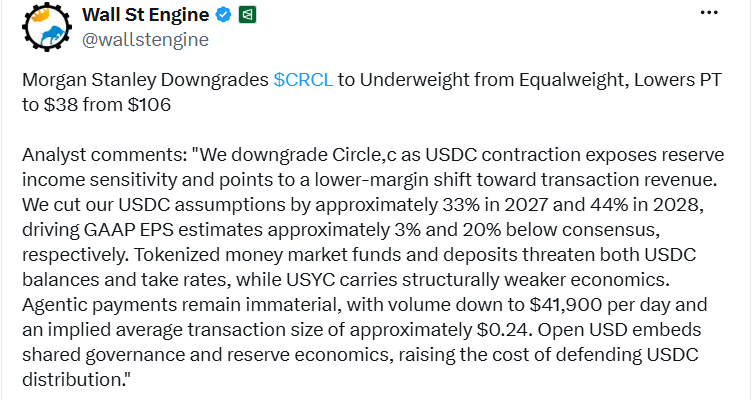
Circle came under fresh pressure after Morgan Stanley downgraded the stablecoin issuer from Equal Weight to Underweight and cut its price target from $106 to $38. The investment bank cited weaker long-term expectations for USDC circulation and warned that slowing reserve income could weigh on earnings despite improving regulatory progress.
The downgrade arrived just days after the company secured a New York trust charter and ahead of its second-quarter earnings report. Investors responded quickly, sending the stock about 6% lower in premarket trading while highlighting the growing divide among Wall Street analysts over the company’s long-term prospects.
Lower USDC Forecasts Drove the Rating Cut
Morgan Stanley based its downgrade on revised assumptions for USDC expansion over the next several years. Analyst James Faucette reduced projected USDC circulation by about 33% for 2027 and 44% for 2028 after concluding that growth has fallen short of earlier expectations.
The brokerage also lowered its earnings outlook. It now expects GAAP earnings per share to come in roughly 3% below market consensus in 2027 and about 20% below consensus in 2028.
According to the report, the contraction in USDC balances exposes the sensitivity of the company’s reserve income. Morgan Stanley believes that future revenue could shift toward lower-margin transaction services instead of benefiting primarily from reserve earnings.
The bank also questioned whether management could achieve its stated objective of averaging 40% annual USDC growth across market cycles. It argued that circulation has remained largely unchanged since the third quarter of last year despite continued industry expansion.
Competition Could Pressure Reserve Income
Morgan Stanley also pointed to increasing competition across digital cash products.
The report argued that tokenized money market funds and tokenized bank deposits could compete directly with USDC for customer balances. That shift may reduce both reserve income and the revenue-sharing economics supporting the stablecoin ecosystem.
The brokerage also expressed reservations about USYC, the company’s tokenized money market fund. According to the report, the product carries structurally lower economics than the reserve-income model built around USDC.
Another concern centered on OpenUSD. Morgan Stanley said the shared governance and reserve income framework could increase the cost of maintaining distribution incentives across the stablecoin network.
Meanwhile, the bank found little evidence that newer payment initiatives have reached meaningful commercial scale. It estimated agentic payment activity had declined to roughly $41,900 in daily transaction volume, representing an average transaction size of approximately $0.24.
Wall Street Remains Divided on the Stablecoin Issuer
While Morgan Stanley adopted a more cautious outlook, another investment bank reached the opposite conclusion.
TD Cowen initiated coverage with a Buy rating and an $82 price target, arguing that investors may be underestimating the company’s ability to expand beyond stablecoin issuance. Analyst Bryan Bergin said the business is developing financial infrastructure across payments, treasury services, tokenized real-world assets, interoperability and developer tools.
The firm believes those businesses could diversify revenue over time instead of relying primarily on USDC circulation. It also described the company as an attractive way to gain exposure to institutional stablecoin adoption and the modernization of financial infrastructure.
The mixed opinions reflect a broader divide among analysts. Of the 30 analysts covering the stock, 16 recommend Hold or Sell, with the other 14 Buy or Strong Buy, according to LSEG data.
The differing views underline uncertainty surrounding the company’s long-term earnings model. Although regulatory clarity has improved, analysts remain divided over whether new products can generate enough revenue to offset slower reserve income growth.
Regulatory Progress Has Yet to Lift Investor Sentiment
The downgrade came only days after the company secured a limited-purpose trust charter from the New York Department of Financial Services for Circle Internet Trust Company LLC, operating as Circle New York Trust.
The approval complements the federal trust bank authorization previously granted by the Office of the Comptroller of the Currency. The company has said USDC issuance will continue through its New York trust entity before gradually transitioning under its approved regulatory structure.
Chief Executive Jeremy Allaire previously described the New York charter as an important milestone because it strengthens regulatory oversight and builds on a relationship with the NYDFS that began in 2015.
However, those regulatory achievements have not translated into stronger market performance.
Shares ended July 31 lower before Morgan Stanley released its report. At the same time, Cathie Wood’s ARK Invest purchased 109,129 shares across three exchange-traded funds ahead of the company’s scheduled second-quarter earnings announcement on Aug. 5.
Also closely watched by investors are the proposed U.S. crypto laws and the Clarity Act, which would provide a more complete regulatory framework for cryptocurrencies. Despite this, Morgan Stanley thinks that the future financial prospects depend on more than regulatory progress, as they believe USDC adoption, transaction activity and revenue diversification will be more important.
Conclusion
Now, Circle is getting its biggest test since it went public when analysts look closely at the long-term prospects for USDC and the sustainability of its business model. The downgrade by Morgan Stanley signals a concern about the slower growth of the stablecoins and the rising competition as they could hinder future profits despite having achieved regulatory milestones recently.
Meanwhile, Wall Street is still not united. Some analysts are anticipating that lower reserve income will compromise results in the future, while others are thinking that increased infrastructure services will help future results. At the heart of the debate as to which of the two outlooks will come true will be the company’s next earnings release, as well as future trends in the adoption of the USDC in the United States.