
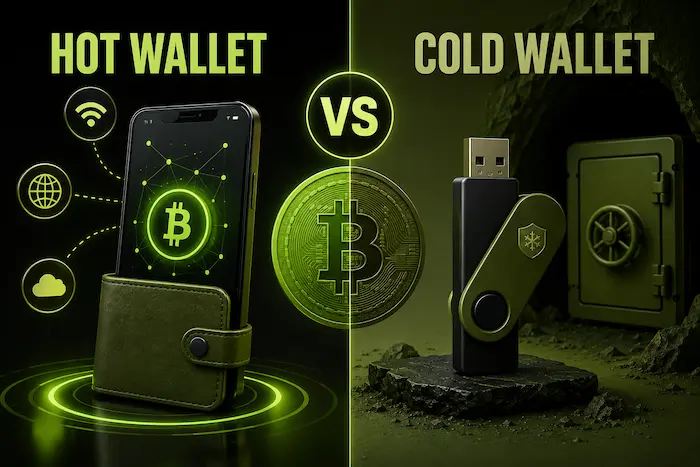
Comparisons of Hot & Cold Wallets have become very crucial in recent times owing to the growing popularity of cryptocurrencies and people looking at various options for ensuring their assets.
Crypto wallets do not actually contain the crypto coins in them; rather, they contain the private keys that give you access to the assets held on the blockchain.
There are two types of crypto wallets – hot wallets and cold wallets, the former being internet-connected, while the latter are offline storage places for the private keys.
What is a Crypto Wallet?
Crypto wallets can be described as software or hardware that is meant to safeguard private keys required for accessing and managing blockchain assets.
The wallet itself does not store any cryptocurrencies but instead authorizes the management of the blockchain-based digital assets.
Wallets usually come in two major forms: hot wallets and cold wallets. There are also two other categories of wallets that are called custodial wallets and non-custodial wallets according to access to private keys. The literature offered primarily focuses on distinguishing between online wallets and offline wallets.
Hot vs Cold Wallet: The Difference Between the Two Types of Wallets
The hot wallet remains connected to the Internet and can function either as a browser extension, a desktop program, a mobile application, or an exchange wallet.
Examples of hot wallets include MetaMask, Trust Wallet, Coinbase Wallet, and Phantom. As a result of its continuous internet connection, the user can transfer cryptocurrency, use DeFi services, trade on DEXs, and handle NFTs quickly.
Unlike hot wallets, cold wallets keep all private keys completely offline. The most popular form of cold storage is represented by hardware wallets with secure chips that prevent hackers from obtaining access to the private keys stored on them. In the process of authorizing transactions, an unsigned transaction is sent to the hardware wallet and verified on the device screen.
Comparison of Hot and Cold Wallets
| Feature | Hot Wallet | Cold Wallet |
| Internet connectivity | Always connected | Offline |
| Level of security | High | Very high |
| Level of convenience | Very high | Moderate |
| Purpose | Frequent transactions and Decentralized finance | Large sums storage |
| Pricing | Cost-free | Must be purchased |
| Exposure to online threats | Greater | Very small |
Security and Convenience: Two Opposite Sides of Cryptocurrency Wallets
The first major benefit that comes with hot wallets is availability. With its help, people will be able to perform all actions faster, use the functionality of DApps, and work with the blockchain without requiring any additional devices.
However, considering that all private keys remain on devices connected to the Internet, hot wallets face such dangers as malware attacks, phishing websites, corrupt browser extensions, and malicious wallets. The specialist recommends keeping minimal funds in hot wallets, the ones that are required right now.
This technique greatly reduces the exposure to these online vulnerabilities because the private keys will never connect to the Internet. However, keeping the funds offline is not devoid of all risks. Theft of a device, recovery phrase scam, or the lack of a backup copy may occur. Additionally, hardware wallets need to be purchased.
New Wallet Technologies Provide More Storage Possibilities
Apart from the classical Hot and Cold Wallets division, new kinds of security technologies have emerged in the wallet market.
- MPC wallets break down private keys into different shares and make them incapable of signing the transaction alone.
- Smart contract wallets (ERC-4337) use smart contracts for various purposes, including social recovery, expiring permissions, and batch operations.
- Passkey wallets do not use a mnemonic phrase but require user authentication via a fingerprint or face recognition through device hardware.
Choosing the Right Wallet According to Your Needs
There are several situations when one particular type of wallet can be applied.
Hot wallets are used in cases when there is constant trading of cryptocurrency, using DeFi services, and exchanging NFTs. Cold wallets are used in situations when there is long-term storage, a bigger portfolio of cryptocurrencies, and less internet exposure.
A hybrid strategy means keeping most of the coins in cold storage, but having a smaller amount of assets in a hot wallet. There are also multisignature wallets that some people use for their big portfolio.
Conclusion
The comparison between Hot vs. cold wallets is based on connectivity, security, and convenience. While hot wallets offer immediate accessibility for blockchain activities, cold wallets ensure that assets are secure offline for a longer period of time.
Additionally, new technologies used in wallets and security methods include protection of recovery phrases, use of two-factor authentication, checking of transaction data, buying of hardware wallets from producers directly, revocation of smart contract approval, and not storing seed phrases digitally.
Frequently Asked Questions
What is the basic difference between a hot wallet and cold wallet?
A hot wallet is always online, while a cold wallet has private keys stored offline.
Which wallet is more appropriate for storing cryptocurrency for a long period of time?
Cold wallets are more appropriate for storing cryptocurrency for a long time, as the private keys stay offline.
Do the two wallet techniques overlap?
Yes. This can be seen where the author says that both techniques may be combined.