
The development of the blockchain industry saw numerous projects being able to go beyond the founders of the projects themselves, and the involvement of the community in the development of the blockchain becoming more and more prominent.
One such project is Toncoin, which is the native coin of The Open Network (TON) Layer-1 blockchain that evolved from Telegram’s blockchain project.
The blockchain was initially introduced in 2018 under the name Telegram Open Network, and it was developed to provide digital payments, decentralized apps, and blockchain-related services.
With the regulation putting an end to Telegram’s association with the project in 2020, the open-source code of the project ensured the continued development of the project in a new framework. By July 2026, Toncoin was valued at roughly $1.47, having a market cap of around $4 billion, while continuing to be the primary cryptocurrency within the TON network for all purposes.
Telegram’s Blockchain Project Ended After SEC Action
The blockchain plans were unveiled by Telegram with the help of a white paper published in 2018. Plans included the release of a Layer-1 blockchain referred to as Telegram Open Network (TON), which was accompanied by its native cryptocurrency called Grams.
The project raised approximately $1.7 billion through its initial coin offering, making it the second-largest ICO at the time behind EOS. Telegram designed the blockchain as a proof-of-stake network using sharding to improve transaction capacity while supporting decentralized storage, domain names, privacy tools, instant payments, and high-speed transaction processing.
Development stopped after the U.S. Securities and Exchange Commission determined that Gram constituted an unregistered securities offering. Telegram later discontinued its participation in the project during 2020 and began refunding investors.
Toncoin Continued Through Community Development
Following Telegram’s withdrawal, independent developers continued work using the blockchain’s open-source code hosted on GitHub. The development of the network was guided by Anatoliy Makosov and Kirill Emelianenko, while the TON Foundation renamed it The Open Network using the acronym TON.
At present, Toncoin is the native cryptocurrency for the network and facilitates payments, staking, governance, and dApps within the ecosystem.
Major Development Milestones
- The involvement of Telegram was concluded in 2020 due to the SEC case.
- Further development of the blockchain by independent developers has been ongoing through the use of the public source code.
- TON Foundation oversees the further ecosystem development while keeping the network open-source.
Toncoin for The Open Network
Toncoin is used as the utility coin for almost all operations conducted on the blockchain. People use the tokens as transaction fees, and validators lock Toncoins in the proof-of-stake network to validate transactions.
Source: Pixeplex
The blockchain employs dynamic sharding that enables multiple chains to handle transactions at once. As per the project’s information, TON was able to achieve 55,000 transactions per second in 2021 and claims that its architecture can accommodate millions of transactions.
Furthermore, the blockchain is capable of hosting smart contracts, DeFi applications, blockchain games, digital collectibles, and more decentralized services.
| Feature | Description |
| Native token | Toncoin (TON) |
| Consensus | Proof of Stake |
| Maximum supply | 5 billion TON |
| Circulating supply | Approximately 3.4 billion TON |
| Inflation | 0.6% annually |
| Main use cases | Payment, staking, governance, and dApps |
One of the key characteristics of Toncoin is that it is integrated with Telegram. TON Wallet allows users to make free transfers of crypto to other Telegram users and is the main entry point for Telegram Mini Apps.
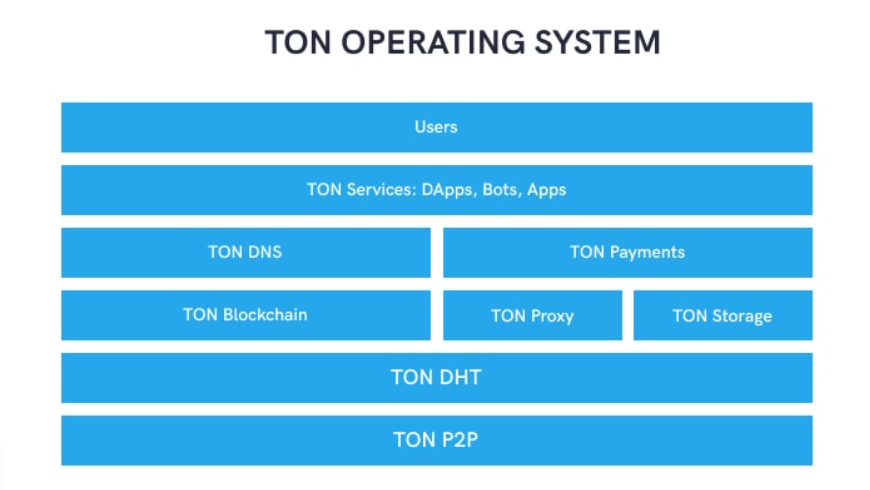
The blockchain also supports TON Storage, TON Proxy, and the TON naming system. These services use Toncoin for payments and network operations. At the time of writing, the ecosystem included more than 500 applications operating on the network.
Main Network Functions
- Pays transaction fees across the blockchain.
- Supports staking rewards for validators.
- Voting in governance and payments for decentralized applications.
Tokenomics and Developer
Toncoin has a total number of tokens that amount to 5 billion, where 3.4 billion tokens are currently circulating. The validators generate revenues from securing the network, and there is an inherent rate of inflation of 0.6% per year.
Open Network behaves as a decentralized autonomous organization, allowing Toncoin users to vote for network development proposals.
In accordance with the TON Developer Report for the second quarter of 2023, there was an increase in developer activities by 102% compared to the previous year. The report states that at the end of June, the number of developers was 9,134, while in April it stood at 8,572.
In August 2023, blockchain-based gaming platform Tap Fantasy shifted from Binance Chain to TON due to its integration with Telegram, which boasts of 700 million monthly active users. As of July 24, 2026, Toncoin was priced at $1.47 with a market cap of $4 billion.
Conclusion
Toncoin is still the native currency of The Open Network after the move from Telegram’s blockchain project to the community-driven one. The blockchain keeps using the proof-of-stake consensus, dynamic sharding, and decentralized governance, along with support for payments, staking, Dapps, and Telegram services.
Frequently Asked Questions
What is Toncoin?
Toncoin is the cryptocurrency of The Open Network that can be utilized for transactions, staking, governance, and fees.
What caused Telegram to end its development of TON?
Telegram ended its involvement after the U.S. Securities and Exchange Commission challenged the Gram token sale as an unregistered securities offering.
How is Toncoin used?
Toncoin is utilized for making payments, staking coins, governance, and usage of dApps and blockchain.